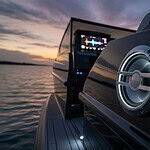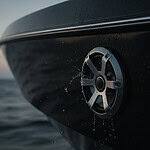
Most boat owners believe that getting more volume simply means cranking the dial until the speakers start to crackle. If you’ve ever wondered how to get loud clean sound on a boat while cruising at 30 knots, the answer isn’t just about raw size. It’s a matter of digital precision and custom acoustic placement. We understand the frustration of your favorite playlist getting swallowed by the roar of the engine or the whistle of the wind. It’s exhausting to fight the elements just to hear your music, and nobody wants to deal with that harsh, distorted “crunch” when you try to push the system further.
Our team is ready to show you the professional secrets to cutting through that noise with high-output audio that stays crystal-clear. You don’t have to worry about battery drain or speakers that fail after one season. This 2026 guide previews the latest in compact, high-power amplifiers and smart system integration. We’ll explore how to achieve concert-level volume and deep bass that actually survives the harsh marine environment. From tower speakers to custom enclosures, we are focusing on the finished result so you can enjoy every minute behind the wheel.
Key Takeaways
- Understand how the “Marine Noise Floor” and “Open Air Loss” work against your speakers to solve the mystery of why your audio disappears at speed.
- Learn how to get loud clean sound on a boat by prioritizing high-output amplifiers with enough headroom to maintain clarity without straining your equipment.
- Discover why Digital Signal Processing (DSP) is the secret weapon for correcting acoustic issues and creating a professional-grade sound stage on the water.
- Find out why moving beyond factory speaker locations and utilizing custom fabrication can transform the way you experience music while cruising.
- Explore our “result-first” philosophy that focuses on engineering a complete experience tailored to your boat’s specific power and layout.
Why Boat Audio Fails at Speed: The Physics of Open Water
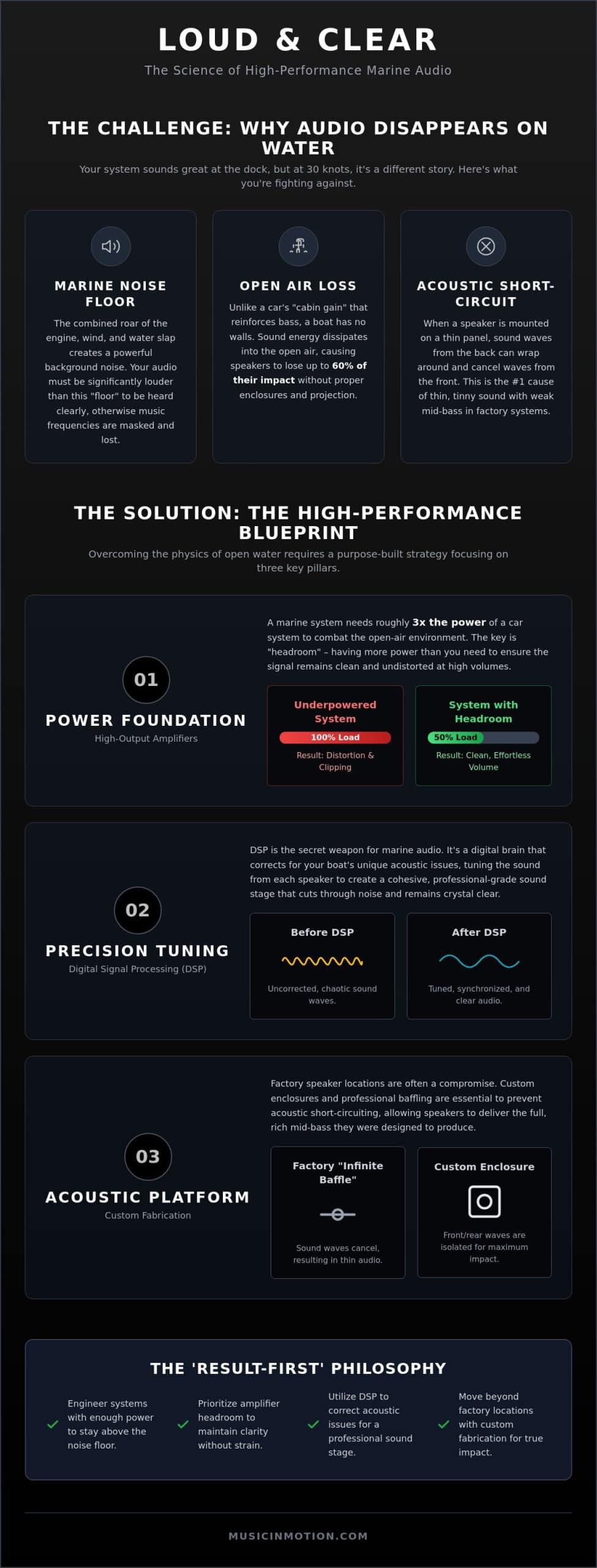
Boats present a unique acoustic challenge that most land-based systems never face. Unlike a car or a living room, a boat has no walls to contain sound energy. This lack of boundaries is the first hurdle in learning how to get loud clean sound on a boat. When you are at the dock, your system might sound decent, but the moment you hit the throttle, everything changes. We call this the Marine Noise Floor. It is the combined volume of your engine exhaust, the slap of the hull against the water, and the rushing wind. To hear your music clearly, your audio system must be significantly louder than this constant background roar.
Understanding The Physics of Sound Perception helps explain why your ears struggle on the water. When engine noise and wind occupy the same frequency ranges as your music, your brain “masks” the songs you want to hear. You might try to compensate by turning up the volume, but in standard factory systems, this only leads to clipping. Clipping is that harsh, distorted sound that happens when an underpowered system reaches its limit. It doesn’t just sound bad; it can actually destroy your equipment. We solve this by engineering systems with enough power to stay above the noise floor without straining the hardware.
Open Air Loss is another physical reality boaters face. In a car, you benefit from “cabin gain,” where the enclosed space naturally reinforces bass frequencies. On a boat, that energy simply disappears into the horizon. Research shows that speakers without proper enclosures can lose up to 60% of their impact in an open environment. While car speakers often rely on reflection to bounce sound off glass and plastic, marine speakers must focus on projection. They need to act like a megaphone, throwing the sound directly at the passengers to overcome the lack of a cabin.
The Engine and Wind Noise Floor
Engine RPMs create a constant low-frequency hum that acts like a blanket over your bass notes. As you speed up, wind noise at 30 mph or higher creates high-frequency masking that kills vocal clarity and makes cymbals disappear. If your music feels “lost” while you are cruising, your system is failing to overcome these specific frequency barriers. We counter this by using high-output drivers that are specifically tuned to cut through the elements. You need more than just volume; you need a system that targets the right frequencies to remain audible over the wind.
Acoustic Short-Circuiting in Boats
Many boat owners suffer from thin, tinny sound because of acoustic short-circuiting. This happens when the sound waves from the back of a speaker cone wrap around and cancel out the waves from the front. If you have factory “infinite baffle” installs, where the speaker is just screwed into a thin fiberglass panel, this is likely your #1 cause of poor performance. We use professional baffling and isolation techniques to prevent this cancellation. By separating the front and rear sound waves, we ensure your speakers deliver the full, rich mid-bass they were designed to produce. If your boat needs better impact, we provide the custom enclosures and baffling required to fix it.
The Power Foundation: High-Output Marine Amplifiers
Power is the engine of your audio system. To understand how to get loud clean sound on a boat, you have to look past the head unit and focus on the amplifier. A premium marine audio system typically requires three times the power of a standard car setup. This is because we aren’t just filling a small, enclosed cabin; we’re fighting the vastness of the open water. While 50 watts per channel might feel loud in a sedan, that same power will sound thin and weak once you are cruising. We need that extra energy to push through the wind.
We prioritize “headroom” in every build we design. Think of it this way: a 1000W amplifier running at 50% capacity will always sound cleaner and more effortless than a 200W amplifier pushed to its absolute limit at 100%. When an amp works at its maximum ceiling, it generates excessive heat and signal distortion. This is the primary enemy of clarity. By choosing an amplifier that provides significant headroom, we ensure the signal stays pure even at high volumes. Understanding The Physics of Sound on Water reminds us that sound energy dissipates rapidly in open spaces, so having that power in reserve is essential to maintain impact at a distance.
True marine-grade amplifiers are built to survive. We use hardware featuring conformal-coated circuit boards that protect internal electronics from moisture and salt air. Non-corrosive power terminals are also vital because they prevent the oxidation that eventually chokes off electrical current. When we match components, we look at the speaker’s peak handling and ensure the amplifier’s RMS output provides a consistent, safe flow of energy. This brings the drivers to life without the clipping that ruins the listening experience. If you want to see what professional power looks like, our team at Music In Motion can help you select the right hardware for your hull.
Class D Efficiency for 2026 Boats
Modern Class D amplifiers are the gold standard for 2026 marine builds. They are incredibly efficient, converting nearly 90% of their energy into sound. Older designs often wasted half their power as heat, leading to thermal shutdown on hot summer days. This efficiency is critical because most boats have limited battery capacity. These amps run cooler and boast a superior signal-to-noise ratio. This technology eliminates that annoying background hiss when the music is quiet, ensuring you only hear the song.
Power Management and Battery Setup
A high-performance system is only as good as the electricity feeding it. We often recommend a dedicated audio battery to separate your stereo from your engine cranking power. Using high-quality marine-grade Oxygen-Free Copper (OFC) wiring instead of cheap Copper-Clad Aluminum (CCA) prevents voltage drops that starve your equipment. A secondary battery or a high-capacity stiffening capacitor acts as the backbone of loud sound by providing the instant energy required during heavy bass hits. Proper wiring ensures your system remains reliable for years to come.
Beyond Volume: Achieving Clarity with DSP and Premium Drivers
If power is the muscle of your system, then the signal processor and drivers are the brain and voice. Learning how to get loud clean sound on a boat requires more than just high wattage. You need to ensure that every note is directed exactly where it needs to go without interference. High-sensitivity drivers are the first step in this process. These speakers are engineered to convert every watt of power into audible sound more efficiently than standard factory units. When you choose premium drivers, you aren’t just getting better materials; you’re getting a component that works harder with the power it’s given.
We often recommend component speaker systems over traditional coaxial designs for high-performance builds. Coaxial speakers have the tweeter mounted in the center of the woofer, which is convenient for space but limits your “sound stage.” By separating the tweeters and mounting them higher up on the deck, we pull the vocals out of the footwells and place them at ear level. This separation, combined with precise frequency crossovers, ensures that your mid-range drivers aren’t struggling with deep bass they weren’t built to handle. We prioritize this balance to ensure your music feels full and natural rather than strained.
Digital Signal Processing (DSP) Explained
Digital Signal Processing is the “clean” secret that separates professional installations from DIY projects. Most boats have terrible speaker placement options, often firing directly into knees or across the cockpit at odd angles. A DSP compensates for these physical limitations through time alignment and EQ correction. We can delay the signal from the speakers closest to you by milliseconds so that the sound from every driver reaches your ears at the exact same moment. With a DSP, we can tune the system for the “Captain’s Chair” during a long cruise or switch to a “Swim Platform” preset for a cove party with the touch of a button. This technology removes the “muddiness” by cutting out frequencies that cause vibration or distortion in specific hulls.
Marine Subwoofers: The Key to ‘Full’ Sound
You cannot achieve truly clean sound at high volumes without a dedicated subwoofer. When your smaller 6.5-inch speakers try to reproduce deep bass, they lose their ability to play clear vocals. A dedicated marine subwoofer takes over the heavy lifting of low frequencies, which allows your smaller speakers to focus exclusively on the mid-range and high notes where they excel. By offloading the low-frequency demands to a subwoofer, you significantly reduce the physical stress and distortion on your main speakers.
We offer both free-air and enclosed subwoofer options depending on your boat’s layout. Free-air subs use the cavity of the hull as their box, providing a space-saving solution that still adds plenty of depth. However, if you want that “thump” you can feel in your chest even while moving, a custom-fabricated enclosure is the gold standard. These sealed or ported boxes provide the air pressure needed for maximum impact in open environments. We focus on the finished result, ensuring your bass is felt as much as it is heard.
Custom Fabrication: Optimizing Sound Stages in Open Environments
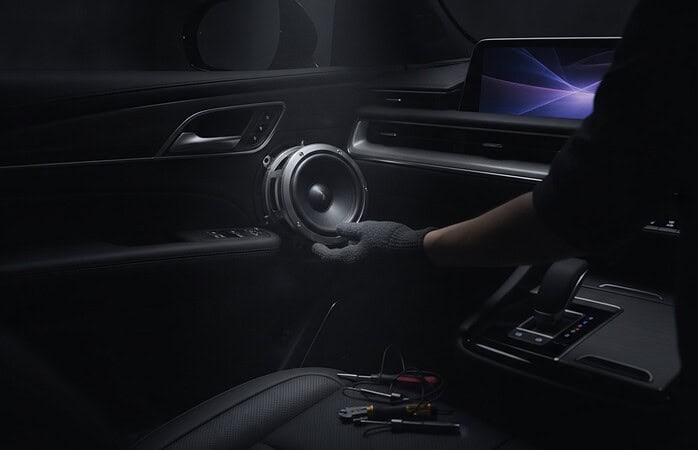
Factory speaker locations are rarely ideal for high-fidelity listening. Manufacturers often place speakers where they fit easily during assembly, which usually means they end up tucked into footwells or firing into the side of a seat. If you want to know how to get loud clean sound on a boat, you have to stop relying on factory holes. We take the same precision used in custom car audio fabrication and adapt it for the marine environment. This allows us to relocate drivers and angle them toward the passengers. We also design custom subwoofer enclosures that can be hidden inside storage lockers, maximizing bass reflex without sacrificing deck space.
Our team focuses on the finished result rather than just the hardware. By building acoustically engineered speaker pods, we can direct the sound stage toward your ears instead of your ankles. This creates a much more immersive experience that doesn’t require you to max out the volume just to hear the lyrics. We bridge the gap between technical precision and lifestyle benefits by ensuring your system looks as good as it sounds. Whether we are working with a center console or a luxury cruiser, our goal is to improve your daily life on the water. If you are ready to upgrade your vessel, our custom installation experts are here to help.
Tower Speakers and Wake Pods
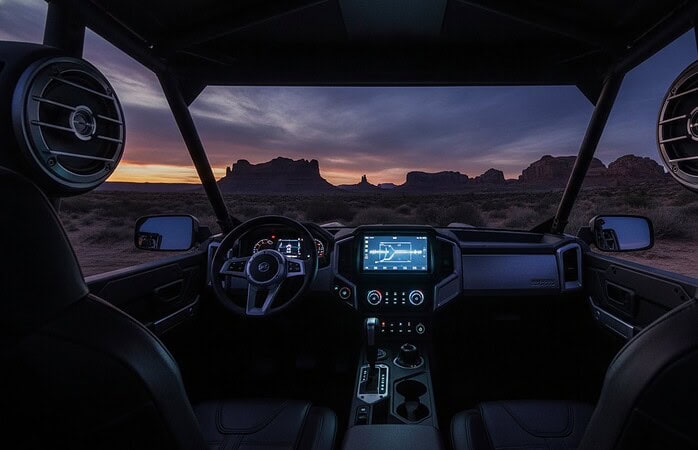
High-performance wake pods are all about “throw.” We utilize Horn Loaded Compression Driver (HLCD) technology to ensure your music reaches a skier 50 feet behind the boat with total clarity. This technology projects sound with incredible efficiency, cutting through the roar of the engine and the wake. For sandbar parties, we install swivel mounts that allow you to aim the music exactly where the crowd is gathered. If your boat features a non-standard tower, we fabricate custom mounts to ensure a secure, professional fit that looks like it came from the factory.
Acoustic Treatment for Fiberglass Hulls
Fiberglass is a highly resonant material that can ring like a bell when hit with deep bass. To prevent this, we apply marine-grade sound deadening to the interior of the hull to stop unwanted vibrations. This quiets the background noise and allows the music to shine. We also reinforce mounting surfaces to prevent the “flex” that kills mid-bass response in most boats. By creating custom infinite baffle walls, we physically separate the front and rear speaker waves. This eliminates the cancellation effect that often makes marine audio sound thin and weak.
Designing Your High-Performance Marine System with Music In Motion
Our team operates on a “Result-First” philosophy. We don’t believe in just selling you a pile of hardware and wishing you luck. Instead, we engineer experiences that transform your time on the water. When you ask us how to get loud clean sound on a boat, we look at the entire vessel as a single cohesive system. This starts with a detailed consultation where we assess your boat’s current power capacity and unique acoustic layout. We identify the specific challenges of your hull design to ensure the final result meets your expectations for both volume and clarity.
Professional integration is a key part of our process. Modern boats rely on sophisticated electronics, and your audio system should be no different. We ensure your new setup talks seamlessly to your GPS and Multi-Function Display (MFD). This allows you to control your zones and playlists directly from your helm. Our promise is simple: we provide high-output sound that lasts for seasons, not just a single weekend. We prioritize reliability so you can focus on the horizon. We are masters of the technical details, but our ultimate goal is to improve your daily life behind the wheel.
Expert Installation vs. DIY Hacks
Getting a “flat” and accurate audio response in an open-air environment is nearly impossible without professional tools. We use a Real Time Analyzer (RTA) to tune your system, correcting for the acoustic peaks and valleys created by fiberglass and open decks. DIY projects often result in a “rat’s nest” of tangled wires that are difficult to service and prone to failure. Our technicians follow strict ABYC safety standards, ensuring every connection is secure and every wire is properly fused. This organized approach prevents electrical issues and protects your investment. We prioritize safety and functionality in every standard utility system we install.
Start Your Marine Transformation Today
Preparing for your consultation is easy. Think about how you typically use your boat, whether you’re towing skiers, hosting sandbar parties, or enjoying quiet sunset cruises. We offer a wide spectrum of solutions, ranging from simple speaker swaps to full-scale custom builds with integrated lighting. No matter the size of your project, we apply the same level of care and technical precision. We are ready to help you build a system that conquers the elements and stands the test of time. Contact Music In Motion to design your custom marine sound system and experience the difference that professional engineering makes.
Elevate Your Experience on the Water
We’ve explored the science behind why factory stereos fail and the technical precision required to fix them. Achieving a high-performance result means balancing raw power with digital accuracy. By using high-output Class D amplifiers and Digital Signal Processing, we can finally solve the puzzle of how to get loud clean sound on a boat. We don’t just want you to hear the music; we want you to feel the impact of every note without the frustration of distortion or thin audio. It’s about creating a system that works with the environment rather than fighting against it.
Our team brings over 30 years of custom fabrication expertise to every vessel we touch. We specialize in high-output systems that integrate perfectly with your modern MFDs and GPS units. This ensures your boat remains a sanctuary of relaxation and excitement for many seasons. Whether you’re cruising the coastline or anchored at your favorite sandbar, you deserve a sound stage that matches the beauty of the open water. Ready for a concert on the water? Schedule your marine audio consultation with Music In Motion. We look forward to helping you design the ultimate marine soundtrack that stays crystal clear at any speed.
Frequently Asked Questions
Can I use car audio speakers on my boat to save money?
No, using car speakers on a boat is a mistake because they aren’t built to survive the marine environment. Marine speakers feature treated cones, UV-resistant plastics, and non-corrosive hardware to handle salt, humidity, and constant sun exposure. A car speaker will usually rot or rust within a single season as the paper components absorb moisture. Investing in marine-certified hardware is the only way to ensure your system remains reliable year after year.
Will a high-power marine amplifier drain my boat battery while the engine is off?
High-power amplifiers will eventually drain your battery if the engine isn’t running, but modern Class D efficiency helps mitigate the draw. We always recommend installing a dedicated deep-cycle audio battery to separate your stereo from your starting battery. This setup allows you to enjoy your music at the sandbar for hours without worrying about whether the engine will crank when it’s time to head home.
What is the difference between ‘loud’ and ‘clean’ in marine audio?
“Loud” refers to raw decibel levels, while “clean” describes the total absence of distortion and background noise. You can achieve high volume with cheap gear, but it often sounds harsh or “crunchy” at the limit. Learning how to get loud clean sound on a boat involves using high-quality amplifiers with plenty of headroom. This allows the music to remain clear and detailed even when you are fighting wind and engine noise at high speeds.
How many speakers do I actually need for a loud boat system?
The number of speakers depends on your boat’s layout, but most high-performance systems start with four 6.5-inch or 8-inch cabin speakers. For those who want to be heard while cruising, adding two to four tower speakers is essential. We focus on the quality of the projection rather than just the quantity of the drivers. A well-placed, high-output set often outperforms a dozen poorly powered factory units.
Do I need a subwoofer if I have large 8-inch tower speakers?
Yes, you still need a subwoofer even if you have large tower speakers. Tower speakers are designed for long-distance projection and mid-range clarity, but they cannot reproduce the deep, low-frequency notes that a dedicated subwoofer handles. Adding a sub offloads the heavy lifting from your main speakers. This prevents distortion and creates a much fuller, more immersive sound stage throughout the entire cockpit.
What is a ‘Marine DSP’ and is it worth the extra cost?
A Marine DSP is an electronic brain that tunes your system to your boat’s specific acoustics. It is absolutely worth the investment because it allows for precise time alignment and frequency correction. By compensating for the odd speaker angles found in fiberglass hulls, a DSP ensures that every passenger hears a balanced, clear signal. It is the final step in achieving professional-grade audio on the water.
How do I prevent my boat speakers from distorting at high volume?
Preventing distortion requires matching your amplifier’s RMS output to your speaker’s power handling and using proper crossovers. Most distortion happens when an underpowered amp is pushed too hard, causing the signal to “clip.” We use high-pass filters to stop smaller speakers from trying to play deep bass. This keeps the vocals clear and protects your equipment from the heat damage associated with pushed signals.
Is it possible to get good bass on a boat without a custom enclosure?
You can achieve decent bass using “infinite baffle” subwoofers that use the hull’s cavity as a box, but custom enclosures are always superior. A custom-fabricated box provides the air pressure needed for the tight, punchy bass you can actually feel. If you are looking for how to get loud clean sound on a boat with real physical impact, an enclosure is the best way to maximize your subwoofer’s performance.