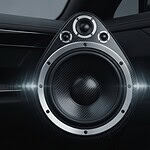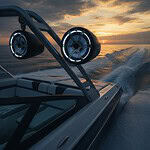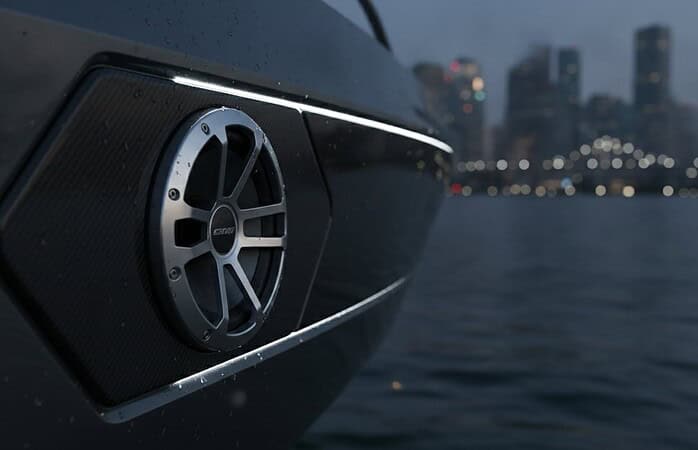
Why does a premium vessel often struggle to deliver clear sound the moment you push the throttle forward? It’s a frustrating reality for many boaters who find their favorite tracks drowned out by wind and engine noise. We understand that a great day on the water requires more than just volume; it requires precision. Effective marine audio system design for boats is the science of creating a controlled acoustic environment in an uncontrolled open-air space.
We know you worry about salt and sun destroying your electronics or accidentally draining the starter battery while anchored at your favorite spot. You deserve a system that’s as rugged as it is refined. This guide will teach you how to architect a high-performance marine sound system that delivers crystal-clear audio in open-water environments without compromising your boat’s reliability. We’ll walk you through the 2026 engineering standards, including NMEA 2000 network integration, the latest Bluetooth 5.3 receivers, and how Digital Signal Processing (DSP) can finally overcome the unique challenges of the sea.
Key Takeaways
- Master the art of acoustic zoning to ensure every passenger enjoys a tailored soundstage, whether they are lounging in the bow or skiing behind the wake.
- Protect your vessel’s reliability by implementing a dual-bank battery strategy that powers your high-output system without risking your engine’s ability to start.
- Discover how professional marine audio system design for boats overcomes the challenges of open-air environments to deliver clarity that cuts through wind and engine noise.
- Learn to select components like high-voltage source units and efficient amplifiers that balance massive power density with essential heat dissipation.
- Understand why custom fabrication and integration are the keys to achieving a seamless, factory-look finish that outperforms a standard box-of-parts installation.
The Fundamentals of Marine Audio System Design
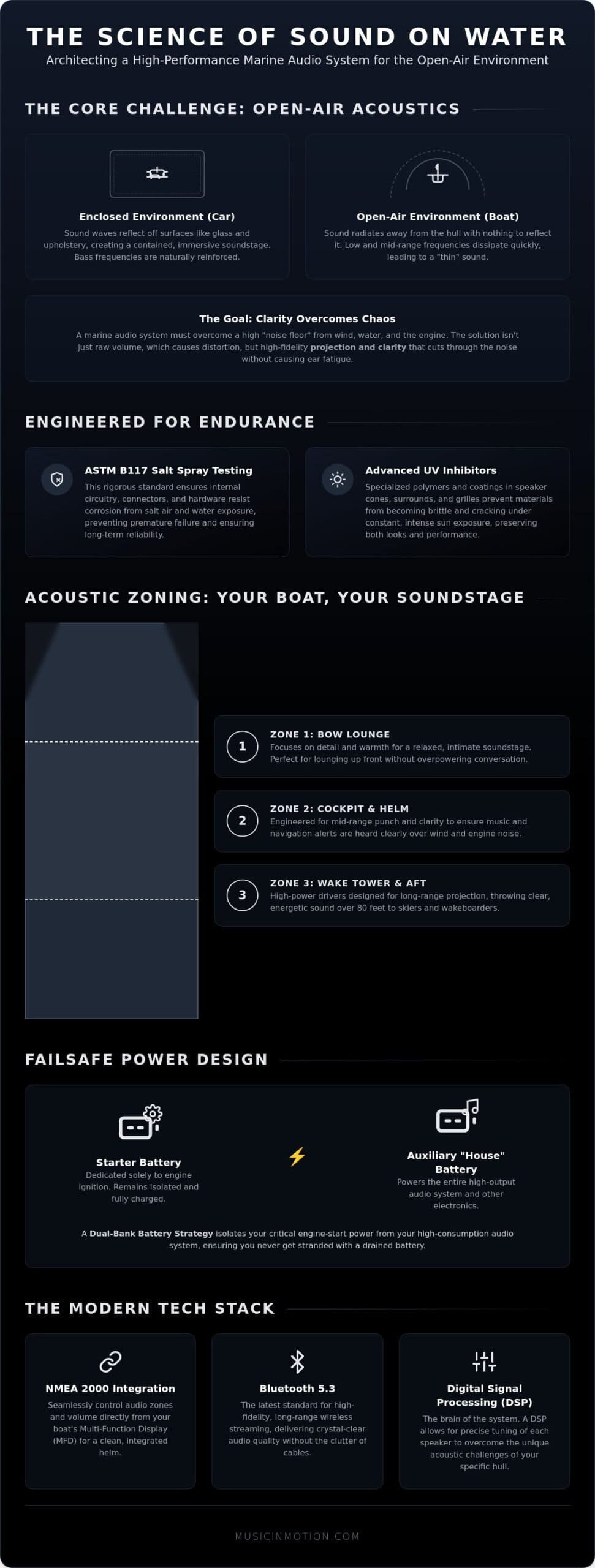
Most boaters assume they just need “waterproof” speakers to get the job done. We see it differently. Designing a high-fidelity system for a vessel is radically different from a car or a home. In an enclosed cabin, sound waves bounce off glass and upholstery, creating a rich, immersive environment. On the water, sound has no boundaries; it simply radiates away from the hull. This “open air” reality is the primary obstacle in marine audio system design for boats.
Our team focuses on the critical difference between loudness and clarity. It’s easy to make a system loud, but it’s much harder to make it clear when you’re cruising at 30 knots. High ambient noise from the wind, water, and engine creates a “noise floor” that your audio must overcome. If you just add raw volume, you often end up with harsh distortion. We aim for high-fidelity projection that cuts through the chaos without fatiguing your ears. We want you to feel the music, not just hear it.
We start every project by defining the specific goal. Are we designing for wake-zone projection to reach a skier 80 feet behind the boat, or are we focusing on cockpit-level imaging for a relaxed sunset cruise? Each scenario requires a unique approach. Professional marine audio system design for boats starts with a hull-specific acoustic map. We look at your boat’s layout, seating positions, and mounting depths to determine exactly how sound will travel across the deck.
Acoustic Dispersion in Open Water
Without walls to reflect sound, low and mid-range frequencies tend to dissipate almost instantly. This is why many factory systems sound “thin” once you leave the dock. We compensate for this by using high-frequency projection drivers and strategically placed subwoofers. These components ensure the “meat” of the music stays within the vessel. We use specific mounting angles to ensure sound waves reach the listeners’ ears before they are lost to the horizon.
Marine-Grade vs. Marine-Rated: What Really Matters
The marine environment is brutal. Between constant vibration, salt air, and relentless UV exposure, standard electronics don’t stand a chance. We only use components that meet the ASTM B117 salt spray testing standard. This rigorous testing ensures the internal circuitry won’t corrode after a single season of use.
UV inhibitors are equally vital. Without them, speaker cones and surrounds become brittle and crack under the sun’s intensity. While a car speaker might last a few months, it lacks the specialized seals and treated materials found in a comprehensive Marine Electronics Overview. We prioritize reliability because we know your time on the water is precious. We don’t just sell parts; we deliver a finished result that survives the elements year after year.
Acoustic Zoning: Tailoring Sound for Every Section of the Boat
One size rarely fits all on the water. A common mistake in standard marine audio system design for boats is treating the entire vessel as a single listening area. We believe true luxury is the ability to have a quiet conversation at the helm while the kids are listening to high-energy tracks on the wakeboard tower. This is the essence of acoustic zoning. By dividing your boat into independent audio regions, we give you total control over the atmosphere in every corner of the hull.
Each zone serves a distinct purpose. We design the bow as an intimate soundstage, using smaller speakers that focus on detail and warmth for those lounging up front. The cockpit and helm require a different approach. Here, we prioritize clarity and mid-range punch so the captain can hear navigation alerts or music over the rush of the wind. Finally, tower speakers are engineered for long-range projection. These aren’t just loud; they’re designed to throw sound 80 feet behind the boat to keep a wakeboarder in the groove.
The Role of Zone Controllers and MFD Integration
Modern marine audio system design for boats relies heavily on seamless integration. We use NMEA 2000 protocols to link your audio system directly to your Multi-Function Display (MFD). This allows you to adjust the volume of the tower speakers or the cabin subwoofers directly from your Garmin, Simrad, or Lowrance screen. When we integrate these complex networks, we strictly adhere to ABYC Electrical Standards to ensure your vessel’s data backbone remains stable and safe. We also provide wireless remotes or smartphone apps, giving your passengers the freedom to adjust their own local volume without bothering the captain.
Speaker Placement Strategies for Maximum Imaging
Fiberglass is a challenging material for audio. Its hard, non-parallel surfaces can cause messy reflections that muddy the sound. We solve this through strategic placement and custom angling. We aim for optimal vertical and horizontal dispersion, ensuring that whether you’re standing at the bait well or sitting in the lounger, the sound hits your ears at the right time.
Bass management is equally technical. We don’t just throw a subwoofer in a storage locker. We identify structural sweet spots that provide tactile bass response without making the hull panels rattle. If you’re ready to see how these zones could transform your time on the water, our team at Music In Motion can help you visualize a custom layout. We focus on the finished result, ensuring every speaker looks like it was installed at the factory.
Power Architecture: Ensuring Your System Doesn’t Leave You Stranded
High-performance audio requires more than just high-end speakers; it demands a robust electrical foundation. A common pitfall in marine audio system design for boats is neglecting the power supply. When you’re pushing multiple amplifiers to overcome wind noise at cruising speeds, your system’s current draw can skyrocket. Without a calculated power architecture, you risk more than just distorted sound. You risk a dead battery miles from the nearest dock.
We solve this by implementing a dual-bank battery strategy. We keep your starting battery sacred, dedicated solely to turning over your engines. A separate house bank, isolated by an automatic charging relay, powers the audio system and other accessories. This ensures that no matter how long you stay at the sandbar, your boat will start when it’s time to head home. We also prioritize Class D amplification. These modern amplifiers are incredibly efficient, converting up to 90% of their power into sound rather than heat. This efficiency is vital in the cramped, poorly ventilated compartments common on many vessels.
Grounding is another critical factor we address during the engineering phase. Poor grounding is the primary cause of “alternator whine” and can even accelerate galvanic corrosion. We use central grounding points to keep the electrical potential consistent across all components. This meticulous approach to marine audio system design for boats results in a dead-quiet noise floor and long-term protection for your hull’s metal components.
Battery Technology for Marine Audio
We often guide our clients through the choice between AGM and Lithium (LiFePO4) batteries. While AGM is a reliable, cost-effective standard, Lithium is the 2026 benchmark for serious systems. LiFePO4 batteries offer deeper discharge cycles and significantly faster charging times. They also provide a steady voltage output until they are nearly depleted. This means your music stays clear and punchy even at the end of a long day. If you store your boat during the winter, we always recommend a dedicated maintainer to protect your investment during the off-season.
Wiring and Circuit Protection Standards
The marine environment is a graveyard for cheap wiring. We only use tinned copper (OFC) wire because it resists the “green rot” caused by salt air. Standard copper wire can corrode from the inside out within a single season. We also size our power cables to minimize voltage drop over long runs from the battery to the amplifiers. Following ABYC standards, we place circuit breakers or fuses within seven inches of the power source. This protects your vessel from electrical fires and ensures every component operates within its safe limits.
Component Selection for Durability and Performance
Choosing the right hardware is about more than just matching brands. In professional marine audio system design for boats, we look for synergy between every component. A high-end speaker is only as good as the signal it receives. That’s why we prioritize source units with high-voltage pre-outs. These units provide a cleaner signal to your amplifiers, significantly reducing the chance of picking up electrical interference from your boat’s engine or navigation systems. While Bluetooth 5.3 is the modern standard for convenience, a wired digital connection via NMEA 2000 often provides the stability needed for true high-fidelity performance.
Marine amplifiers act as the heart of your system. They must balance massive power density with effective heat dissipation. Because boats often have limited airflow in storage lockers, we select amplifiers with heavy-duty heat sinks and thermal management circuitry. For tower speakers, we help you choose between traditional coaxials for close-range warmth and Horn Loaded Compression Drivers (HLCD) for maximum projection. HLCDs are essential if you want your music to reach a wakeboarder clearly at 80 feet without sounding thin or distorted.
The Science of Subwoofer Enclosures on Boats
Bass is notoriously difficult to capture in an open hull. Many installers rely on “infinite baffle” designs that use the cavity of the boat as the box. While this saves space, it often lacks the punch and accuracy of a dedicated enclosure. We often apply custom car audio fabrication techniques to create specialized marine housings. We never use MDF, as it swells and rots in humid air. Instead, we build enclosures from expanded PVC or Starboard. These materials are completely waterproof and provide the rigid structure needed for tight, tactile bass response.
Signal Processing: The Secret to Studio Sound on the Water
Digital Signal Processing (DSP) is the ultimate tool for overcoming acoustic flaws. Every boat has “dead spots” and areas where frequencies cancel each other out. We use Marine DSP to implement time alignment, ensuring the sound from every speaker reaches the captain’s ears at the exact same millisecond. This creates a focused soundstage that feels like a private concert at the helm.
We also program specific equalization curves to match your environment. You might want a “lounging” preset for clear background music at the dock and a “cruising” preset that boosts mid-bass and high frequencies to cut through the roar of the wind. If you’re ready to hear the difference professional engineering makes, contact our team for a marine audio system consultation. We focus on the internal experience of the user, ensuring every note is crisp and every beat is felt.
The Professional Advantage: Custom Fabrication and Integration
We believe that a truly exceptional system is measured by the finished result, not just the sum of its parts. Anyone can buy a box of high-end components, but without professional marine audio system design for boats, those parts rarely reach their full potential. Our goal is to transform your vessel into a cohesive acoustic environment where the technology disappears, leaving only the experience of perfect sound. We approach every project as a unique engineering challenge, ensuring that the hardware works in harmony with your boat’s specific layout.
Custom fabrication is where our expertise truly shines. We don’t just “bolt on” speakers and hope for the best. We create custom pods and mounting solutions that match the curves and textures of your hull. This ensures your new system looks like it was installed at the factory, preserving the aesthetic integrity and resale value of your vessel. When we design premium marine audio systems, we consider every detail, from the structural rigidity of the mounts to the way the finish catches the light on the water.
Professional tuning is the final, most critical step in our process. In an open-air environment, the acoustic properties change the moment you leave the dock. We use specialized calibration tools to adjust the DSP settings we discussed earlier, ensuring the audio remains balanced and powerful whether you are idling in a quiet cove or running at wide-open throttle. This level of precision is what separates a standard install from a world-class audio experience.
Stealth Installation and Aesthetics
We prioritize a clean, uncluttered look that respects the limited space on a boat. This means hiding amplifiers and complex wiring in ventilated, dry compartments that don’t compromise your storage for life jackets or fishing gear. We also integrate LED lighting upgrades directly into the audio system. This creates a cohesive nighttime experience where the glow of your speakers matches the mood of your music, adding a dynamic feel to your evening cruises while maintaining the safety of your standard utility systems.
Music In Motion: Your Partners in Marine Excellence
Mike and Kim founded this business on a simple philosophy: prioritize long-term reliability over quick sales. We view ourselves as your partners in marine excellence. Our collaborative marine audio system design for boats starts with a thorough consultation to understand exactly how you spend your time on the water. We then move from a broad mission statement into the specific engineering of your system. Our national expertise ensures that when you pull into the marina, your boat doesn’t just look the part; it sounds better than anything else at the dock. We are dedicated specialists who take pride in delivering a finished result that improves your daily life on the water.
Elevate Your Experience on the Water
Your time on the water is an investment in relaxation and adventure. We believe your sound system should reflect that. By mastering the science of acoustic zoning and implementing a robust power architecture, you ensure that every cruise is accompanied by studio-quality clarity. Effective marine audio system design for boats isn’t just about selecting the loudest speakers; it’s about the precision of the final result and the long-term reliability of the installation. We focus on the details so you can focus on the horizon.
Since 1994, our team has specialized in custom fabrication and professional integration. We bring national expertise in high-performance marine electronics to every vessel we touch, ensuring your technology stands up to the rigors of salt, sun, and wind. We’re here to help you move beyond a standard box of components to a fully realized audio masterpiece that enhances your life behind the wheel. Our collaborative process ensures that the safety and functionality of your boat remain our top priorities.
Ready to transform your vessel into the ultimate acoustic stage? Design your dream marine audio system with the experts at Music In Motion. We look forward to helping you create the perfect soundtrack for your next journey offshore.
Frequently Asked Questions
What is the difference between marine-rated and car audio equipment?
Marine-rated equipment is specifically engineered to survive constant exposure to salt spray, humidity, and intense UV rays. Unlike car audio, these components use specialized seals and non-corrosive materials like tinned copper wiring. We only select gear that meets ASTM testing standards to ensure it won’t fail after a single season. Car speakers lack these protective treatments and will likely corrode or crack within months of being on the water.
Do I need a second battery for my boat’s sound system?
We almost always suggest a dual-bank battery system for high-performance installations. This setup keeps your starting battery isolated, ensuring it stays fully charged to turn over your engines. A separate deep-cycle house bank powers your audio system and accessories. By using an automatic charging relay, we can charge both banks while the engine is running without risking a dead battery while you’re anchored.
Can I control my boat’s audio through my GPS/Fishfinder?
You can certainly control your audio through your Multi-Function Display (MFD) if your hardware supports it. Most modern Garmin, Simrad, and Lowrance units use the NMEA 2000 network to act as a remote control for your stereo. This integration keeps your dash clean and allows the captain to manage volume zones or change playlists without ever letting go of the wheel.
Why do my boat speakers sound distorted when I’m driving fast?
Distortion at high speeds is usually a sign that your system is underpowered for the environment. When you turn up the volume to overcome wind and engine noise, a weak amplifier will clip the signal, resulting in harsh, distorted sound. Professional marine audio system design for boats solves this by using high-efficiency Class D amplifiers and Digital Signal Processing to maintain clarity even at wide-open throttle.
What are tower speakers, and do I really need them?
Tower speakers are specialized drivers mounted high on a wakeboard tower to project sound 80 feet or more behind the vessel. They are essential for watersports because standard cockpit speakers can’t throw sound far enough to reach a skier. We often use Horn Loaded Compression Drivers (HLCD) for these applications because they provide the long-range projection and clarity needed to cut through the wake.
Is it worth adding a subwoofer to an open-bow boat?
A subwoofer is one of the most impactful upgrades you can make to an open-bow boat. Bass frequencies are the first to disappear in open-air environments, leaving your music sounding thin and tinny. Adding a subwoofer restores the low-end foundation of your favorite tracks. We use custom-fabricated enclosures made from waterproof materials like Starboard to ensure the bass is tight, punchy, and durable.
How do I protect my marine audio system during winter storage?
Protecting your system starts with maintaining your batteries during the off-season. We recommend using a high-quality battery maintainer to prevent your house bank from discharging and freezing. You should also treat all exposed electrical connections with a marine-grade corrosion inhibitor. If your boat is stored outdoors, ensure your covers are tight to prevent moisture buildup around your speaker cones and head unit.
What is NMEA 2000 and how does it relate to my stereo?
NMEA 2000 is a specialized communication network that allows your marine electronics to share data. It’s the brain of a modern vessel, connecting your stereo, GPS, and engine sensors. In the context of marine audio system design for boats, this network allows your head unit to display track info on your fishfinder or receive commands from remote controllers located throughout the boat.