For years, audiophiles have argued that you must sacrifice compact efficiency for pure tone, but in 2026, that old rule of thumb is officially dead. We’ve seen many enthusiasts hesitate to upgrade because they fear a smaller amp will sound thin or digital compared to the heavy, traditional gear of the past. It’s a valid concern when weighing a class D vs class AB amplifier for sound quality in a custom build. You don’t want to invest in a high-end system only to deal with a unit that overheats in a tight trunk or drains your battery during a long day on the water. Whether you’re cruising in a custom truck or a sleek center console, you need power that’s both reliable and refined.
We understand that the ultimate goal isn’t just buying hardware; it’s about the feeling of total immersion when you’re behind the wheel or at the helm. This guide settles the debate by showing you how modern engineering has finally leveled the playing field between these two architectures. You’ll learn exactly how they handle heat management and power consumption without compromising on clarity. We’ll walk you through the real-world performance differences so you can choose a power source that fits your vehicle’s constraints and delivers the superior sound you deserve.
Key Takeaways
- Learn why the gap in class D vs class AB amplifier for sound quality has vanished in 2026, making modern switching technology a top-tier choice for high-fidelity systems.
- Understand how Class D’s high efficiency prevents overheating and battery drain in demanding environments like marine and powersports applications.
- Identify which amplifier class fits your specific goals, from “money-no-object” audiophile builds to high-output subwoofer systems.
- Discover why professional integration and DSP tuning often have a larger impact on your final sound clarity than the amplifier’s internal circuitry.
Decoding the Debate: Class D vs. Class AB for Sound Quality
Sound quality is a blend of measurable data and personal emotion. We define it through clarity, punchy dynamics, and a total lack of background hiss. For decades, the industry lived by a rigid rule: Class AB was for the front stage, and Class D was for the trunk. That rule is gone. In 2026, both architectures deliver world-class performance. Choosing between a class D vs class AB amplifier for sound quality is no longer about settling for less. It’s about selecting the right engineering for your specific environment.
The 2026 baseline is clear. High-fidelity results are possible with either choice. We’ve moved past the era of grainy switching amps. Today, the debate over a class D vs class AB amplifier for sound quality focuses more on the physical reality of your vehicle. If you have a compact sports car or a boat with limited battery capacity, Class D is a lifesaver. If you have the room and want that traditional linear signature, Class AB remains a powerhouse. Both can make your daily drive feel like a front-row concert.
What is a Class AB Amplifier?
Class AB represents the traditional linear standard. It uses transistors that stay partially active to ensure a smooth, continuous flow of energy. This eliminates the harsh crossover distortion found in older designs. Old-school enthusiasts favor this class for its perceived warmth. It delivers a signal that feels organic and rich. We often recommend these for systems where space isn’t an issue and the listener wants that classic analog soul. It’s a reliable, time-tested approach to high-fidelity sound.
What is a Class D Amplifier?
Class D is frequently misunderstood as digital audio. It isn’t. It is a switching technology that uses Pulse Width Modulation (PWM). The transistors flip between fully on and fully off thousands of times per second. This doesn’t sample your music like a digital file; it simply changes how the power is delivered. Modern output filters are the secret sauce here. They take that high-speed switching and smooth it back into a clean analog wave before it reaches your speakers. The result is incredible power in a tiny package.
We see these two technologies as different paths to the same goal. While bench tests might show a lower noise floor for Class AB, the gap has closed significantly. Modern Class D units now offer signal-to-noise ratios that were once thought impossible. The choice now depends on your specific needs:
- Class AB: Best for enthusiasts who prioritize traditional circuitry and have plenty of mounting space.
- Class D: Ideal for modern vehicles where efficiency, size, and heat management are the top priorities.
The Evolution of Class D: From ‘Grainy’ to High-Fidelity
Early Class D amplifiers earned a reputation for sounding “grainy” or “brittle.” This was a fair assessment twenty years ago. Those early units used lower switching frequencies that often bled noise into the audible range. Today, the landscape is completely different. Modern switching frequencies have skyrocketed. They push unwanted noise far beyond what the human ear can detect. This shift has changed the entire conversation regarding a class D vs class AB amplifier for sound quality. We now see these modules in six-figure home audio towers and elite competition vehicles alike.
High-end internal components have also played a massive role in this evolution. By using premium capacitors and tighter tolerances, manufacturers have boosted the Signal-to-Noise Ratio (SNR) to levels that rival traditional linear designs. This means you get a black, silent background during the quiet passages of your music. It allows the subtle details of a recording to shine through without the “hiss” associated with older technology. The result is a listening experience that feels open and effortless.
Closing the Distortion Gap
Total Harmonic Distortion (THD) used to be the Achilles’ heel of switching amps. In 2026, top-tier Class D units offer distortion figures so low they are effectively transparent. Another critical factor is the damping factor. Damping factor is the amplifier’s ability to control a speaker’s woofer after a signal stops. A high damping factor ensures your bass sounds tight and controlled rather than muddy or boomy. When comparing a class D vs class AB amplifier for sound quality, you’ll find that modern Class D often excels here, providing a “grip” on the speaker that Class AB struggles to match in a compact chassis.
The ‘Digital’ Misconception
Many people still think “Class D” stands for “Digital.” This is a myth. Class D is an analog process that uses high-speed pulses to deliver power. It doesn’t convert your music into binary code. This pulse-based efficiency is why these amps stay cool. In power-restricted environments like a boat or a modern EV, this efficiency leads to a cleaner signal because the amplifier isn’t fighting thermal stress. If you’re looking for expertly integrated car audio upgrades, understanding this distinction helps you choose gear that performs reliably under pressure. Transparency is the new gold standard. We want the amplifier to get out of the way and let the music speak for itself.
Efficiency Meets Impact: Why Size and Heat Matter
Efficiency isn’t just a technical spec; it’s a fundamental part of how your music sounds. Class AB amplifiers are famously inefficient, converting roughly 50% of their energy into heat. That means half of the power you’re drawing from your battery never reaches your speakers. In contrast, Class D units operate at 90% efficiency or higher. This massive gap plays a central role when deciding between a class D vs class AB amplifier for sound quality. Heat is the natural enemy of electronics. It increases electrical resistance, which can lead to signal degradation and a shorter lifespan for your equipment.
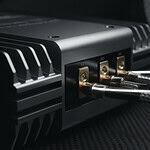
Because Class D units don’t waste energy as heat, they don’t need massive metal fins to stay cool. We can tuck these compact powerhouses into places a Class AB would never survive. Think under a passenger seat, inside a motorcycle fairing, or deep within a boat’s storage locker. This “form factor” advantage allows us to build high-power systems without sacrificing your legroom or utility. It also means your alternator doesn’t have to work nearly as hard to keep the music playing. Preserving your vehicle’s electrical health is just as important as the audio itself.
Thermal Management in Tight Spaces
Class AB amplifiers rely on heavy heat sinks to move warmth away from their internal circuits. If you’ve ever felt an amp that’s too hot to touch, you’re experiencing the limits of that design. During long drives in the summer heat, many Class AB models trigger “thermal rollback.” This is a safety feature that automatically lowers the output to prevent the unit from melting. Class D amplifiers stay remarkably cool even during hours of high-volume playback. This stability ensures your music stays clear and consistent from the moment you start your engine until you reach your destination.
Electrical System Integration
Your vehicle’s electrical system has a finite amount of energy. When an inefficient amplifier draws too much current, it causes a voltage drop. This drop is a primary cause of clipping and distortion. By choosing an efficient design, you preserve the health of your battery and alternator. This is especially critical for those looking at Premium Marine Audio Systems. On a boat, where you might be listening while the engine is off, every milliamp counts. Using a class D vs class AB amplifier for sound quality in a marine setting ensures you get hours of high-fidelity audio without worrying about a dead battery at the end of the day.
Choosing Your Power: Which Class Wins for Your Audio Goals?
Selecting the right power source depends entirely on what you want to achieve with your system. We see every project as a unique puzzle where the amp must match the speaker’s needs and the vehicle’s limits. When weighing a class D vs class AB amplifier for sound quality, consider the specific role of each component. While Class D has made massive leaps in full-range fidelity, it remains the undisputed king of subwoofer amplification. Its ability to deliver massive bursts of energy without draining your battery makes it the only logical choice for driving heavy bass.
For the ultimate listening experience, we often recommend hybrid systems. This approach uses the best of both worlds. You can use a refined Class AB amplifier to power your tweeters and mid-range speakers for that legendary smoothness. Simultaneously, a high-efficiency Class D unit can handle the mid-bass and subwoofers. This balanced setup provides incredible impact where you need it while maintaining delicate detail in the higher frequencies. It creates a soundstage that feels both powerful and precise.
When to Choose Class AB
Class AB is the go-to for purists who have the luxury of space. If you’re building a dedicated competition vehicle where every micro-detail is judged, the traditional linear signal is still a gold standard. These builds often include upgraded alternators and custom-fabricated amplifier racks—designed with the same attention to detail found in a HiFi Rack—that turn the hardware into a visual centerpiece. If your goal is a “money-no-object” sound quality build and you don’t mind the extra weight or heat, Class AB offers a soul and character that many enthusiasts still crave.
When to Choose Class D
Class D is the perfect solution for modern daily drivers. Most of our clients want a massive sound improvement without losing their trunk space or changing the look of their interior. This technology is essential for a car audio upgrade for stock stereo because we can hide the amplifiers under seats or behind dash panels. It is also the only viable option for motorcycles, ATVs, and boats where battery capacity is strictly limited. You get high-output performance that won’t leave you stranded with a dead battery.
We believe your gear should work with your lifestyle, not against it. Whether you want a hidden stealth install or a show-stopping custom rack, we can help you navigate the class D vs class AB amplifier for sound quality debate to find your perfect match. Contact our team at Music In Motion to start designing a system that brings your music to life exactly the way you want to hear it.
Beyond the Specs: Professional Integration for Maximum Fidelity
In our 30 years of experience, we’ve learned that the most expensive hardware in the world can’t overcome a poor installation. The heated debate over a class D vs class AB amplifier for sound quality often ignores the most critical factor: how the equipment is integrated into the vehicle. An amplifier is only as good as the signal it receives and the environment where it lives. At Music In Motion, we focus on the total outcome rather than just the technical specs on a box. We believe that a well-designed system should feel like a natural part of your car or boat, delivering a finished result that exceeds your expectations.
Our team sees every vehicle as a unique acoustic challenge. We don’t just sell a product; we provide a solution that balances power, space, and reliability. Whether you’re cruising on land or water, the goal is always the same. We want to improve your daily life by putting you in the center of your favorite music. This requires looking past the “Class” of the amp and focusing on the total system architecture.
For those looking to bring this same level of high-fidelity performance and seamless control into their homes, Pro Integration offers expert design and installation for custom home theaters and smart home automation systems.
The Importance of Custom Fabrication
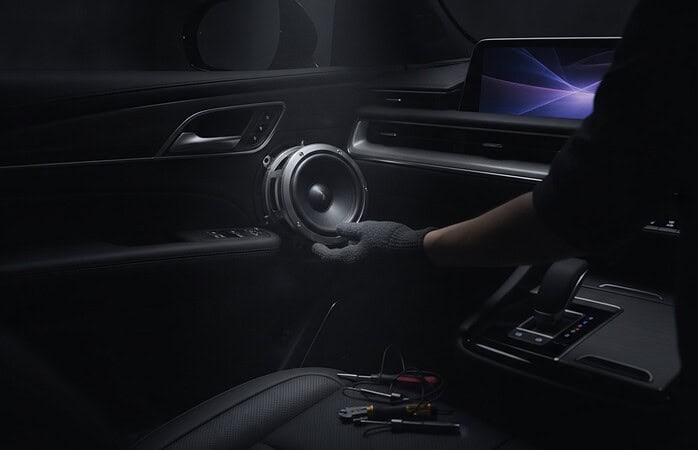
Custom mounting is about more than just looking good. It ensures your amplifier has the airflow it needs to stay cool and the structural support to resist road vibration. We incorporate these units into our car audio fabrication projects to achieve a “factory-plus” look that preserves your vehicle’s interior. Every detail matters. Professional wiring reduces the noise floor regardless of amp class. By using high-quality cabling and secure grounding points, we eliminate the interference that can ruin a high-fidelity experience.
Expert Tuning and System Calibration
Your vehicle’s cabin is a difficult acoustic environment. Hard glass surfaces and soft upholstery create reflections and dips in sound that no amplifier can fix on its own. This is where Digital Signal Processing (DSP) becomes the hero of the story. We use expert tuning to calibrate the system specifically for your seating position. In the real world, a professionally tuned Class D system will outperform an untuned Class AB system every single time. The precision of a DSP allows us to correct timing and frequency issues, bringing the stage to life right on your dashboard.
The choice between a class D vs class AB amplifier for sound quality is an important step, but it’s just the beginning of the journey. Whether you’re looking for a simple upgrade or a complex custom build, the right integration makes the difference. We invite you to sit down with our team to discuss your goals. We’ll help you navigate the technical options and design a solution that fits your vehicle perfectly. Let’s build something that makes every mile more enjoyable.
Take the Next Step Toward Superior Sound
The choice between a class D vs class AB amplifier for sound quality no longer requires you to settle for second best. Modern engineering has transformed switching technology into a high-fidelity powerhouse while preserving the classic soul of linear designs for those who want it. We’ve seen that the real magic happens when you look beyond the spec sheet. Success depends on how your gear fits your lifestyle and your vehicle’s unique constraints. Every car, boat, and motorcycle presents a different acoustic challenge that requires a tailored approach.
We specialize in high-performance audio for cars, boats, and powersports. Our team focuses on expert integration and specialized custom fabrication to ensure every component performs at its peak. We don’t just install hardware; we deliver a finished result through professional tuning that brings 2026-level audio fidelity to your daily drive. Whether you’re on the open road or the open water, your system should be a source of constant excitement and reliability. We’re here to help you build a system that sounds as good as it looks.
Ready for a sound system that moves you? Consult with the experts at Music In Motion today.
Frequently Asked Questions
Is Class D really digital?
No, Class D is not a digital technology. It uses a method called Pulse Width Modulation to switch transistors on and off at incredibly high speeds. While the resulting waveform looks like a square wave, the signal remains analog throughout the process. The “D” was simply the next letter in the alphabet after the industry established Class A, B, and C designs. It has nothing to do with binary code or digital sampling.
Why are Class AB amplifiers so much larger than Class D?
Size differences come down to thermal management. Class AB amplifiers are roughly 50% efficient, meaning half of their energy turns into heat. They need large, heavy aluminum heat sinks to prevent the internal components from melting. Class D operates at over 90% efficiency. Because they generate very little waste heat, we can install them in much smaller chassis that fit easily under seats or behind dashboards.
Can I mix Class D and Class AB amplifiers in the same car audio system?
Mixing different classes is a great way to optimize your system’s performance. We frequently design systems that use Class AB for the tweeters and mid-range speakers to capture that classic linear warmth. We then pair them with a high-output Class D amplifier for the subwoofers. This hybrid approach gives you the best of both worlds: delicate detail for your vocals and massive, efficient power for your bass.
Does Class D cause more radio interference (EMI) than Class AB?
Early switching designs did struggle with radio noise, but those days are long gone. Modern high-end amplifiers use sophisticated output filters and shielded casings to keep Electromagnetic Interference (EMI) contained. If you experience interference, it’s usually a sign of a poor ground or low-quality RCA cables. A professional installation ensures that your Class D equipment won’t mess with your FM reception or sensitive vehicle sensors.
Which amplifier class is better for high-end component speakers?
Both classes can deliver breathtaking results for component speakers in 2026. Purists often prefer Class AB for its smooth, continuous signal, while others love the clinical transparency of modern Class D. The most important factor is the quality of the specific module and the professional tuning. When evaluating a class D vs class AB amplifier for sound quality, the installation and DSP calibration will have a bigger impact than the class itself.
Do Class D amplifiers still have a ‘hiss’ or high noise floor?
High-quality Class D amplifiers now have noise floors that are effectively silent. Manufacturers have increased switching frequencies to push any potential noise far beyond the range of human hearing. If you hear a hiss, it’s typically caused by an incorrect gain structure or a noisy source unit rather than the amplifier class. We use precision tools to set your levels, ensuring a pitch-black background during quiet musical passages.
Why is Class AB often more expensive if it’s less efficient?
Class AB units are expensive because they require more physical materials to build. Large copper transformers and massive aluminum heat sinks add significant cost to the manufacturing process. These units are also more labor-intensive to assemble. While Class D is more efficient, the premium materials and heavy-duty construction of a high-end Class AB unit still command a higher price tag for enthusiasts who want that specific linear sound signature.
Which amplifier class should I use for a marine audio system?
We almost exclusively recommend Class D for marine applications. Boats have limited battery capacity and very little space for bulky equipment. The high efficiency of Class D allows you to play your music at high volumes for hours without worrying about a dead battery. When deciding on a class D vs class AB amplifier for sound quality on a boat, the cool-running nature of switching technology is essential for long-term reliability.