Most riders think a loud soundbar is enough to conquer the trail, but volume alone won’t save your music when you’re buried axle-deep in a mud hole. We understand the frustration of a system that sounds crisp in the driveway only to cut out the moment the vibration hits or the mud starts flying. It’s a common headache to deal with blown speakers or a dead battery because a setup simply wasn’t built for the reality of off-road life.
We believe your soundtrack should be as rugged as your machine. This guide will help you engineer a powersports audio system for UTVs that survives the elements while delivering studio-quality audio directly to your seat. We’re moving past basic kits to look at high-performance solutions that prioritize clarity and reliability. We’ll preview the latest 2026 technology, including IPX6-rated components like the Rockford Fosgate Stage 5 and power management strategies that ensure your music stays as loud and clear as the day you installed it.
Key Takeaways
- Learn why open-air acoustics and the “Triple Threat” of water, UV rays, and high-G vibration require specialized engineering beyond standard car audio.
- Compare the convenience of plug-and-play kits against the superior sound stages achieved through custom-fabricated speaker pods and subwoofer enclosures.
- Master the “power budget” by calculating your stator output to ensure your high-output system doesn’t leave you stranded with a dead battery.
- Discover how to select a powersports audio system for UTVs that integrates seamlessly with safety tech like dash cameras and LED lighting.
- Understand why professional tuning is the secret to maintaining studio-quality clarity even when you’re pinned at full throttle in a high-noise environment.
Why Standard Audio Fails in a Powersports Environment
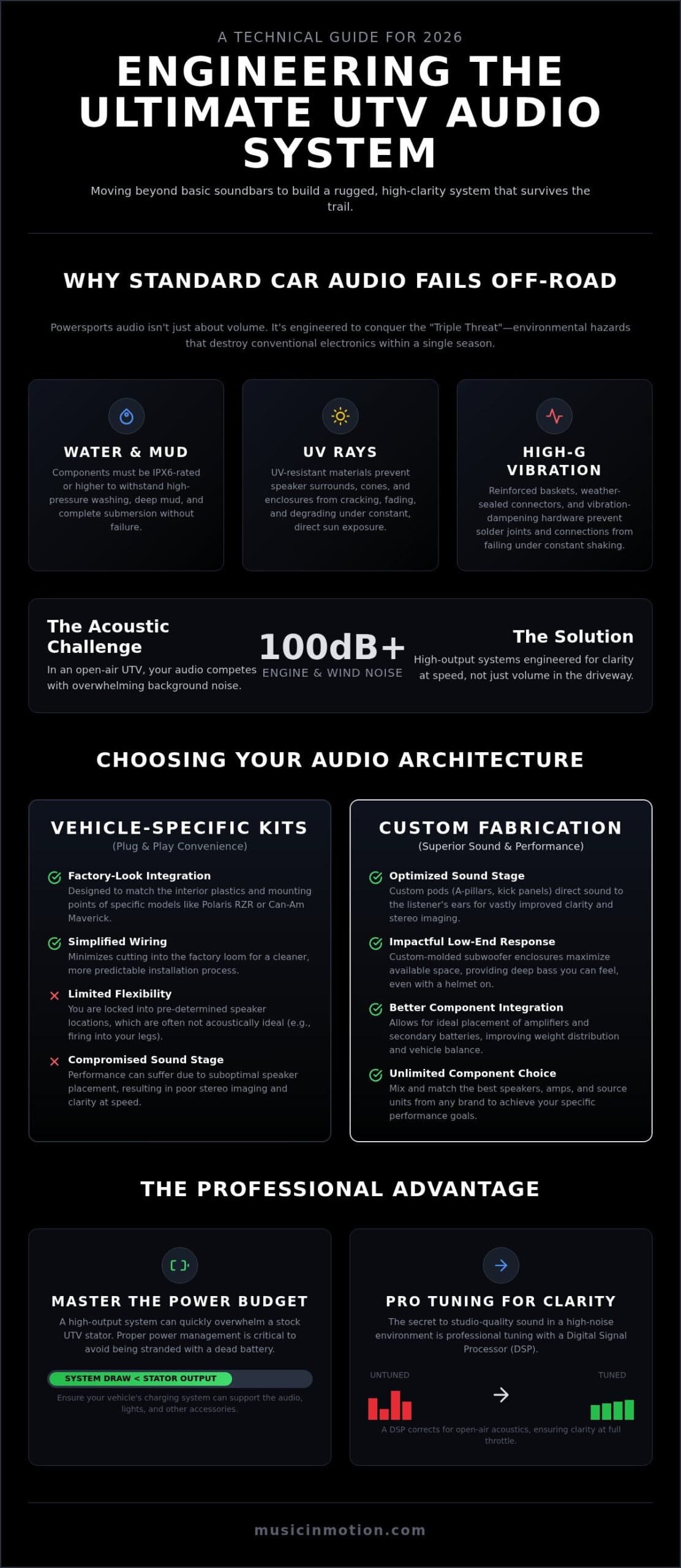
A standard car speaker lives a pampered life inside a sealed, climate-controlled cabin. In contrast, a powersports audio system for UTVs must endure a relentless assault from the environment. We define powersports audio as equipment specifically engineered to maintain structural integrity and acoustic performance while exposed to open-air conditions and extreme physical stress. If you install a traditional car audio speaker in your side-by-side, you’ll likely see it fail within a single season. The materials simply aren’t built to handle what we call the “Triple Threat”: water, UV rays, and constant high-G vibration.
The acoustic environment of an off-road vehicle is equally challenging. You aren’t just listening to music; you’re competing with wind shear and an engine roar that often exceeds 100dB. Without high-output components designed for open-air projection, your favorite tracks will disappear into a muddy mess of distortion before you even hit second gear. We focus on engineering systems that cut through this noise without sacrificing the “studio-quality” detail you expect.
Understanding IP Ratings for 2026
For 2026, we look for components that carry at least an IP67 or IP68 rating. An IP67 rating means the hardware is dust-tight and can survive being submerged in one meter of water for 30 minutes. IP68 goes further, offering protection against deeper, continuous submersion. However, a simple “marine” label isn’t always enough for a side-by-side. While marine gear handles salt spray, it doesn’t always account for the thick, abrasive mud and direct, overhead UV exposure common on the trails. It is helpful to remember that water-resistant gear is designed to survive a splash or light rain, while waterproof components are sealed to withstand actual pressure and immersion.
The Impact of Vibration on Audio Longevity
Vibration is the silent killer of mobile electronics. Standard car audio components use solder joints and mounting brackets that aren’t prepared for the violent shaking of a rocky trail. These constant high-G forces eventually fatigue the metal, causing joints to crack and connections to fail. High-quality powersports gear features reinforced baskets and weather-sealed connectors that stay locked in place. When we handle a professional integration, we utilize vibration-dampening mounting hardware to isolate sensitive electronics from the chassis. This ensures your system stays functional through the roughest terrain rather than shaking itself to pieces.
Kits vs. Custom: Choosing Your UTV Audio Architecture
When you decide to upgrade your powersports audio system for UTVs, you generally face two distinct paths. The first is a vehicle-specific kit designed for a “plug-and-play” experience. The second is a custom-fabricated installation built from the ground up. Both options have their place, but the right choice depends on whether you value convenience or the ultimate “finished result.” We find that many riders start with a kit and quickly realize its limitations when they want more depth or better clarity at high speeds.
When to Choose a Vehicle-Specific Kit
Integrated kits are popular for a reason. They offer a factory-look integration that matches the interior plastics of your machine. These systems usually include simplified wiring harnesses that minimize cutting into your factory loom. For 2026, major manufacturers have released impressive flagship kits for top models like the Polaris RZR Pro XP and the Can-Am Maverick X3. These kits, such as the Rockford Fosgate Stage 5 or MB Quart Stage 5, provide a cohesive look and predictable performance. The downside is flexibility. You’re often locked into specific speaker sizes and pre-determined mounting points. If the factory location for a speaker is blocked by your legs or a storage bag, the kit’s performance will suffer.
The Power of Custom Fabrication
Custom fabrication is the only way to achieve a truly superior sound stage in an open-air vehicle. By moving away from stock mounting points, we can optimize imaging using custom A-pillar pods or kick panel enclosures. This directs the high frequencies toward your ears rather than your knees. You can also achieve much more impactful low-end response by using custom subwoofer enclosures. These are designed to maximize every cubic inch of available space, providing bass you can feel even through a helmet. Custom builds also allow for better weight distribution. We can place heavy components like amplifiers and secondary batteries in lower, more central areas of the chassis to maintain your vehicle’s center of gravity.
We often recommend a hybrid approach for riders who want the best of both worlds. You might start with a high-quality source unit and wiring kit but opt for custom pods and enclosures to house premium drivers. This path allows your system to grow with your vehicle. If you’re ready to move beyond the limitations of a standard box of parts, our team can help you build a customized audio experience that outlasts the competition on every trail.
Essential Components of a 2026 Powersports System
Building a high-performance powersports audio system for UTVs requires more than just picking the loudest speakers on the shelf. In an environment where every component faces dust, moisture, and extreme vibration, the quality of your hardware determines whether your music survives the first trail ride. We focus on a holistic approach where each part of the signal chain is ruggedized and efficient. This ensures that your system doesn’t just play music; it delivers a finished result that remains crystal clear at 50 mph.
Multimedia Source Units and Integration
The days of simple Bluetooth receivers are behind us. For 2026, we prioritize multimedia source units that act as the command center for your entire machine. These advanced units often feature high-resolution displays and integrate directly with vehicle safety systems like backup cameras and dash cams. Modern units also utilize Bluetooth 5.4 for rock-solid connectivity and offer app-based tuning. This allows us to use Digital Signal Processing (DSP) to calibrate the audio for open-air environments, correcting for the specific acoustic hurdles of a UTV cabin. Multi-zone control is another essential feature, giving you the ability to adjust the volume of your interior speakers and exterior tower speakers independently.
Efficiency is the primary reason we exclusively use Class D amplifiers in our UTV builds. These amplifiers convert power into sound with minimal heat waste, which is critical when you’re working within the limited “power budget” of a factory stator. To cut through the 100dB+ roar of a high-performance engine, we often employ compression horn tweeters. Unlike traditional soft-dome tweeters, compression horns are designed for high-efficiency projection. They deliver the “snap” and clarity needed to hear your music over wind shear and exhaust notes without requiring massive amounts of wattage.
Speaker Technology: Cone Materials Matter
When it comes to durability, the materials used in your speaker cones are just as important as the IP rating. We generally recommend polypropylene or carbon fiber cones for UTV applications. Polypropylene is naturally resistant to moisture and mud, while carbon fiber offers the rigidity needed to maintain accuracy during high-excursion playback. We also look for bridge-mounted tweeters. In this design, the tweeter is suspended over the woofer cone rather than mounted on a center pole. This eliminates the hole in the center of the woofer, creating a completely sealed environment that prevents water and grit from reaching the sensitive voice coil. For those who enjoy social riding, adding tower speakers to the roll cage provides the perfect “basecamp audio” experience when the vehicle is parked.
Subwoofers present the final challenge in a side-by-side cabin. Air space is always at a premium, so we utilize high-excursion drivers specifically designed for small volumes. Whether we are using a vehicle-specific kit or a custom-fabricated enclosure, the goal is to move enough air to create tactile bass you can feel in your chest. By selecting components that balance efficiency with extreme environmental protection, we ensure your powersports audio system for UTVs remains the highlight of every adventure.
This balance of efficiency and protection is also a hallmark of other specialized electric vehicles, such as custom electric trikes from Xion Motors; find out more about how these platforms are built for heavy-duty use.
Power Management: Fueling Your High-Output System
A high-performance powersports audio system for UTVs is essentially a charging-system math problem. While we’ve discussed the components that create the sound, none of them matter if your electrical system can’t keep up with the demand. Many modern flagship systems, like the 1,500-watt Rockford Fosgate Pro XP Stage 5, draw significantly more current than a factory setup. When you add in the 2026 requirements for mandatory LED safety lights and high-output headlights, your vehicle’s power budget becomes very tight. We focus on stabilizing this power to protect your investment and ensure you never get stranded on the trail.
Voltage drop is the primary killer of powersports amplifiers. When an amplifier doesn’t receive enough current, it works harder and generates excessive heat, which leads to clipping and eventual hardware failure. We prevent this by using smart isolators and secondary batteries. A secondary AGM or Lithium battery provides a dedicated reserve for your audio, while the isolator ensures your engine-start battery remains protected. This setup allows you to enjoy music at basecamp without worrying about whether the machine will fire up when it’s time to head home.
Stator Limitations and High-Output Alternators
It is vital to understand that UTVs use stators rather than traditional car alternators. Stators are generally less efficient and provide very little output at idle, which is exactly when many riders want to crank their music. To calculate the total amperage draw for your audio system, divide the total RMS wattage by the vehicle’s charging voltage (usually 14.4 volts) and then divide that result by the amplifier’s efficiency rating. If your total draw exceeds your stator’s spare capacity, your system will begin pulling from the battery immediately. For extreme builds featuring multiple subwoofers and amplifiers, we often recommend a high-output alternator upgrade to provide a steady flow of current regardless of engine RPM.
Wiring and Connectivity Standards
We exclusively use Oxygen-Free Copper (OFC) wiring for every installation. Many budget kits use Copper-Clad Aluminum (CCA), which corrodes rapidly in the high-moisture environments typical of off-road riding. OFC wiring offers superior conductivity and handles the constant vibration of a UTV chassis without becoming brittle. We also prioritize waterproof fusing and strategic circuit breaker placement. These components must be easily accessible but shielded from direct mud spray. Finally, we often perform “big three” wiring upgrades, which involve replacing the factory ground and power cables with heavier gauge wire to improve the overall efficiency of the charging circuit.
If you’re planning a high-wattage build and want to ensure your machine can handle the load, contact our team for a power audit. We’ll help you balance your audio dreams with the practical realities of your vehicle’s electrical capacity.
The Professional Advantage: Why Integration Matters
We believe that a high-performance powersports audio system for UTVs is more than just a collection of expensive components. It’s a carefully engineered solution that must work in harmony with your vehicle’s mechanical and electrical systems. Our philosophy focuses on delivering a finished result rather than just a box of parts. While many manufacturers promise easy DIY installation, modern UTVs often utilize complex CAN-bus electrical architectures. Tapping into these systems without specialized knowledge can lead to electrical interference, dashboard error codes, or even damage to your vehicle’s computer. We prioritize a seamless integration that respects your machine’s factory wiring while maximizing its potential.
Professional tuning is the secret to maintaining studio-quality sound in the middle of the woods. In an environment where engine roar and wind shear are constant, a standard equalizer setting isn’t enough. We use real-time analyzers to calibrate your system for the specific open-air acoustics of your cabin. This ensures that the high frequencies remain crisp and the low-end stays tight, even when you’re pinned at full throttle. Beyond the sound, we focus on the tactile experience. We integrate audio controls into factory dash switches and ensure that your custom LED lighting syncs perfectly with your music for a cohesive, professional aesthetic.
Beyond Sound: A Complete Vehicle Upgrade
Your audio hub should serve as the central nervous system for all your electronics. We often combine audio upgrades with a professional remote start installation. This allows you to pre-condition your cabin’s climate while your favorite playlist cues up, ensuring your machine is ready the moment you climb in. Integration also means adding essential safety layers. We can route backup cameras, dash cameras, and blind-spot sensors directly through your multimedia source unit. This turns your audio system into a comprehensive safety hub, providing better visibility on technical trails where every inch of clearance matters.
Planning Your Custom Build
A professional consultation is the first step toward a successful build. We help you navigate the “power budget” of your machine so you don’t over-buy hardware that your stator can’t support. We also prioritize serviceability. In a custom off-road build, every component must be accessible for maintenance without tearing the whole vehicle apart. Before you hit the trail, we recommend this final checklist for your system:
- Verify all connections use waterproof, marine-grade heat shrink.
- Confirm the secondary battery isolator is functioning correctly.
- Check that all custom speaker pods and subwoofer enclosures are secured with vibration-dampening hardware.
- Test the DSP calibration at both idle and high RPM to ensure clarity.
Choosing a professional installation also protects your investment. We maintain detailed records of every project, which can be vital for warranty claims and insurance purposes. When you’re ready to transform your ride into a high-performance concert hall, we’re here to ensure the results are reliable, safe, and exciting.
Ready to Elevate Your Off-Road Experience?
Building a high-performance powersports audio system for UTVs is about more than just picking the loudest gear. It requires a strategic balance between rugged environmental protection and sophisticated power management. We’ve shown how choosing the right components, like Class D amplifiers and custom-fabricated enclosures, ensures your music survives the mud while cutting through engine roar. By prioritizing professional integration, you protect your vehicle’s electrical system and gain a safety hub that works as hard as you do. For riders in the Great Lakes region, keeping up with local news and trail updates through Thumbwind is a great way to stay connected to the community.
Our team has been specialized in ruggedized off-road electronics and high-output electrical systems since 1994. We take pride in delivering a finished result that enhances your lifestyle on the trail. We are custom fabrication specialists who focus on the practical needs of every rider. Design your ultimate UTV audio system with the experts at Music In Motion. Let’s build something that makes every ride unforgettable.
Frequently Asked Questions
Can I use marine audio speakers in my UTV?
You can use marine speakers, but we recommend choosing gear specifically rated for powersports. While marine equipment handles salt spray well, UTVs face thicker mud and more direct UV exposure. Look for components with an IP67 rating or higher. This ensures the internal voice coils are sealed against the grit and pressure typical of off-road environments. We prioritize hardware that survives the trail, not just the water.
Will a high-powered audio system drain my UTV battery?
A high-output powersports audio system for UTVs can quickly drain a factory battery if the engine is off or idling. Most UTV stators provide limited charging power at low RPMs. We solve this by installing secondary batteries and smart isolators. This setup allows you to play music at basecamp without risking a dead engine-start battery when it is time to head home. We focus on balanced power management for every build.
What is the best speaker placement for a Side-by-Side?
Optimal speaker placement depends on your vehicle, but we generally prioritize kick panels and A-pillars for the best imaging. Placing speakers near your feet or ears ensures the sound reaches you directly rather than getting lost in the wind. We often use custom pods to angle speakers toward the driver and passenger. This creates a clearer sound stage that cuts through engine noise more effectively than overhead bars alone.
Do I need an amplifier for my UTV soundbar?
Most modern UTV soundbars feature internal Class D amplifiers, so they don’t require an external power source. However, if you want to add subwoofers or additional tower speakers, you will likely need a separate amplifier to handle the extra load. We always check the RMS power ratings of your components to ensure the system remains efficient and doesn’t clip at high volumes. Proper amplification is the key to clarity.
How do I protect my UTV speakers when pressure washing?
You should never aim a high-pressure nozzle directly at the speaker grilles or cones. Even with an IP67 waterproof rating, the concentrated force of a pressure washer can tear the speaker surround or force water past the seals. We recommend using a low-pressure hose for the audio components and wiping them down with a damp cloth. This preserves the integrity of the weather-sealed connectors and cone materials over time.
Can I integrate a backup camera with my UTV audio head unit?
Yes, many of the 2026 multimedia source units we install feature dedicated video inputs for backup cameras. Integrating your safety tech with your audio hub makes your dash cleaner and more functional. We can wire the camera to trigger automatically when you shift into reverse. This provides a clear view of obstacles on technical trails, combining entertainment with essential vehicle safety in one finished result.
What is the difference between a UTV kit and a custom audio build?
A UTV kit is a pre-packaged set of components designed for a specific model, while a custom build is engineered from scratch. Kits offer a factory look and simpler installation. Custom builds allow us to use specialized fabrication for subwoofer enclosures and speaker pods. This tailored approach provides superior sound quality and better weight distribution. We help you decide which path fits your specific performance goals and machine.
Is it worth upgrading the factory speakers in my Polaris or Can-Am?
Upgrading your factory speakers is one of the most impactful improvements you can make to your machine. Original equipment manufacturers often use basic paper cones that degrade quickly when exposed to moisture and heat. A high-quality powersports audio system for UTVs uses durable materials like polypropylene or carbon fiber. These upgrades provide the clarity and volume needed to actually hear your music over the 100dB roar of your engine.