You’re cruising down the road at night when the heavy bass hits, and suddenly your headlights pulse in time with the music. It’s a common, frustrating experience that leaves many enthusiasts asking: what does a car audio capacitor actually do to fix this? We’ve seen this exact scenario countless times in our shop. You want a system that delivers deep, impactful sound without stressing your vehicle’s electrical health or causing your amplifier to clip. We believe your audio should be a source of excitement, not a drain on your peace of mind.
In this 2026 electrical guide, we promise to demystify how capacitors stabilize your voltage and protect your gear. You’ll discover the technical reality of these high-speed energy buffers and learn whether your high-performance setup actually requires one. We’ll take a look at the limits of your electrical system and provide a clear path toward achieving the stable, punchy bass response you’ve been looking for. Understanding these power requirements is the first step toward a reliable custom installation that performs exactly how you expect it to.
Key Takeaways
- Discover what does a car audio capacitor actually do by seeing how it acts as a high-speed energy buffer to bridge the millisecond power gaps your battery can’t handle.
- Clarify the difference between peak current and total current to understand why a capacitor is a refinement tool, not a cure for a failing electrical system.
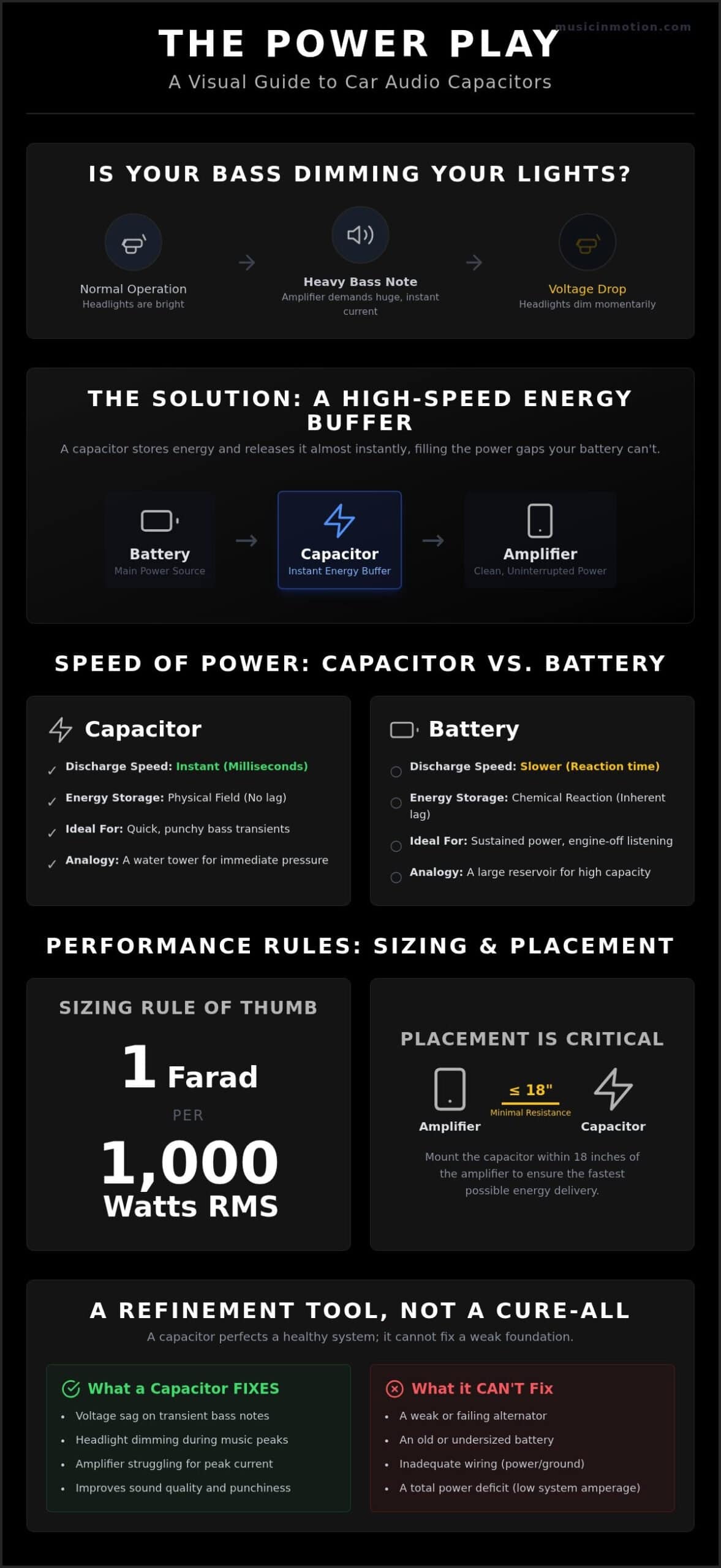
- Master the sizing and placement rules, including why we recommend at least 1 Farad per 1,000 Watts RMS and mounting within 18 inches of your amp.
- Learn how a holistic approach to your vehicle’s power, including high-output alternators and professional wiring, ensures your bass stays crisp and your lights stay bright.
The Science of Voltage: What a Car Audio Capacitor Actually Does
When you’re building a high-performance sound system, the hardware in your trunk is only as good as the power feeding it. A car audio capacitor is a specialized energy storage device designed to release its charge significantly faster than a standard battery. While your battery is great for long-term storage, it’s often too slow to keep up with the lightning-fast demands of a modern amplifier. We often explain to our clients that a capacitor acts as a high-speed buffer. It sits directly between your battery and your amplifier, waiting to fill millisecond-long power gaps that occur during heavy bass hits. By understanding what a capacitor is and how it functions, you can ensure your equipment performs at its peak potential.
Voltage stabilization is the primary goal here. If your amplifier doesn’t receive a steady stream of high-voltage current, it can’t produce its rated power. This leads to muddy sound and potential equipment damage. Many of our local customers ask us, what does a car audio capacitor actually do for my daily drive? The answer lies in its ability to keep the rail voltage high. Unlike a battery, which relies on a chemical reaction to create electricity, a capacitor stores energy on conductive plates. This physical storage allows it to move energy almost instantly, providing the “snap” your subwoofers need for crisp, punchy transients.
How Capacitance Works in a 12V Environment
We measure capacitance in Farads (F). In a 12V automotive environment, one Farad represents a substantial amount of storage, though it’s still tiny compared to your car’s battery. To visualize this, imagine your battery is a massive underground reservoir and the capacitor is a water tower sitting right next to your house. When you need a sudden, massive burst of water, the tower provides immediate pressure while the reservoir works to catch up. Equivalent Series Resistance, or ESR, is the internal resistance that dictates how efficiently that “water” flows out; lower ESR means the capacitor can deliver its energy to your amp with less heat and more speed.
Why Your Headlights Dim When the Bass Hits
Headlight dimming is a classic symptom of voltage drop. When your subwoofers demand a massive surge of current, your alternator simply can’t react in the 50 milliseconds it takes for a bass note to peak. This creates a temporary vacuum in your electrical system, pulling power away from your lights and other electronics. This isn’t just an aesthetic issue. When voltage drops, your amplifier may start clipping, which distorts the audio signal and generates excessive heat. We use capacitors to catch these transients, protecting your gear and keeping your lights steady while you enjoy your music.
Capacitor vs. Battery: Understanding the Speed of Power
Many enthusiasts assume that adding a second battery is always superior to installing a capacitor. While batteries are essential for total capacity, they have a fundamental speed limit. To understand what does a car audio capacitor actually do, you have to look at the physics of discharge. Batteries rely on internal chemical reactions to store electrical charge and energy. These reactions take time to occur. A capacitor uses a physical field to hold energy, allowing it to discharge in milliseconds. This is the difference between a slow, steady stream and a high-velocity blast of power.
Standard lead-acid and even high-end AGM batteries have higher internal resistance than capacitors. This creates a tiny but noticeable lag when your amplifier demands a sudden surge of current. If you’re building a system for high-fidelity competitions or extreme bass, this lag is your enemy. We often suggest a hybrid approach for high-wattage setups. A secondary battery provides the muscle for long, sustained notes, while the capacitor bank acts as the sprinter for quick transients. This combination ensures your system never feels starved for juice.
The Role of a Secondary AGM Battery
If you enjoy listening to your music with the engine off, a secondary AGM battery is the right choice. It provides the sustained current needed for long, low-frequency notes that would otherwise drain your primary starting battery. However, the health of this battery directly impacts your capacitor. A weak battery forces the capacitor to work harder to maintain voltage, which eventually limits its effectiveness. We ensure every component in our custom installations works in harmony to prevent these power bottlenecks.
Transient Response: Why Speed Matters for Sound Quality
Sound quality isn’t just about how loud you can go. It’s about precision. Stable voltage directly improves the attack and decay of your music. Think of a sharp, aggressive drum hit. A starved amplifier will struggle to reproduce that initial peak, resulting in a soft or muddy sound. A fed amplifier, backed by a high-speed capacitor, delivers that hit with crisp authority. This transient response is exactly why capacitors remain a staple in high-end sound quality builds.
We also consider the practical side of your build. Batteries are heavy and require significant space. For modern vehicles where room is at a premium, custom fabrication allows us to mount compact capacitor banks in tight spots where a second battery simply won’t fit. This balance of power and weight keeps your vehicle’s performance agile while your audio remains loud and clear. What does a car audio capacitor actually do for the average driver? it provides the finishing touch of stability that a bulky battery cannot match on its own.
Debunking the ‘Band-Aid’ Myth: When a Capacitor Is (and Isn’t) the Solution
A common misconception in the car audio world is that a capacitor can fix a dying battery or a weak alternator. It can’t. If your voltage stays low even when the music is off, a capacitor won’t help you. We often hear people dismiss these devices as a “Band-Aid” for poor electrical health. This reputation comes from users trying to use a Capacitor to solve a total current problem when it’s actually designed for peak current demands. Understanding what does a car audio capacitor actually do helps you identify if you’re treating a symptom or solving the root cause of your power issues.
Total current is the continuous amperage your alternator provides to keep the car running and the battery charged. Peak current is the sudden, violent draw from a heavy bass note. If your alternator’s total output is 80 amps but your system needs 120 amps continuously, you have a fundamental power deficit. No amount of capacitance will fix that. However, if your alternator is healthy but struggles with millisecond-long spikes, that’s exactly where a capacitor shines. It fills the temporary gap without taxing your battery. If you see your lights dimming only during the heaviest tracks, you’re likely dealing with a peak current issue rather than a total capacity failure.
The Big 3 Upgrade: Your First Step
Before adding any storage device, you must ensure your wiring can handle the load. The “Big 3” upgrade involves replacing factory wires with high-quality 0-gauge or 4-gauge cabling. We focus on three critical paths: alternator to battery positive, battery negative to chassis, and engine block to chassis. Our expertise in car audio fabrication allows us to create custom grounds that maximize current flow. Often, a proper wiring upgrade does more for voltage stability than a small capacitor ever could. Think of it as widening the pipes before you try to increase the water pressure.
When to Choose a High-Output Alternator Instead
If your system exceeds 2,000 watts RMS, you’ve likely moved past the point where a capacitor can help on its own. At this level, your factory charging system is simply outmatched. You need a high output alternator for car audio to provide the sustained current required for extreme builds. We calculate your total RMS draw against your factory output to determine exactly where your bottleneck lies. A capacitor is a finishing touch for a healthy system; it’s not a substitute for a robust power source. When you reach the limits of your vehicle’s stock equipment, we look at the system holistically to find the most reliable answer.
Sizing and Installing Your Capacitor for Maximum Performance
Getting the right size for your capacitor is just as important as choosing the right amplifier. We follow a standard industry baseline: 1 Farad for every 1,000 Watts of RMS power. However, in our experience, adding extra capacitance is usually a smart move. Modern Class D amplifiers are incredibly efficient, but they still require massive, instantaneous bursts of energy. If you’re wondering what does a car audio capacitor actually do in a real-world install, it acts as a localized energy reserve. If that reserve is too small, your system will still experience the same voltage sag you’re trying to avoid.
Proximity is everything. We always mount the capacitor within 18 inches of the amplifier. Electricity encounters resistance and inductance the further it has to travel through a wire. If the capacitor is in the engine bay while the amp is in the trunk, the speed advantage of the capacitor is lost. You also need to match your wire gauge to your system’s total draw. Using thin wire for a high-output system creates a bottleneck that prevents the capacitor from doing its job effectively. If you’re asking what does a car audio capacitor actually do for your specific vehicle, the answer is providing the immediate current your battery is too slow to deliver.
Safety is paramount because these devices store a significant amount of energy. A naked capacitor, one without a protective casing or circuit board, can be dangerous if a tool accidentally shorts the terminals. We always ensure our installations are fused properly and mounted securely to prevent any movement during spirited driving. This protects your gear and your vehicle’s interior.
The Resistor Charge Method: A Critical Safety Step
You can’t simply hook a new capacitor directly to your battery. Doing so creates a massive spark and can damage the internal components of the device. We use a resistor or a simple test light to slowly bridge the gap between the power wire and the capacitor terminal. This allows the internal plates to charge at a controlled pace. Once your test light goes out or your digital display matches the battery voltage, the system is safe for a permanent connection.
Mounting and Aesthetics in Custom Fabrication
A capacitor doesn’t have to be a hidden eyesore. We specialize in integrating these components into custom trunk audio setups that look as good as they sound. Many modern units feature digital voltage displays. These are fantastic tools for monitoring your system’s health at a glance, but they also add a high-tech aesthetic to your build. We also prioritize heat management, ensuring that even in tight custom enclosures, there’s enough airflow to keep the electronics cool. If you are ready to upgrade your power management, our team can help you design a professional audio system that handles every beat with precision.
Beyond the Capacitor: Building a Robust Electrical Foundation
We view your vehicle as a single, integrated ecosystem where every component relies on the next. While we’ve spent this guide explaining what does a car audio capacitor actually do in terms of transient response, it’s only effective when supported by a healthy foundation. A high-performance audio setup requires a holistic strategy that balances the battery, alternator, wiring, and storage devices. Without this balance, even the most expensive capacitor becomes a decorative piece of hardware rather than a functional tool.
Professional installation is the key to preventing common electrical headaches like “ghost” battery drains. These parasitic draws often stem from poor grounding or improper integration into the vehicle’s data bus. We use our 30 years of experience to ensure that every ground point is secure and every wire is routed to minimize interference. This attention to detail protects your investment and ensures your vehicle remains reliable for the long haul. When you plan your build, you also need to consider future-proofing for upcoming vehicle safety technology additions that will place even more demand on your electrical system.
System Tuning and Power Management
The way your system is tuned has a massive impact on its electrical efficiency. High-quality professional car audio tuning involves more than just making it loud; it’s about managing gain settings to prevent clipping and unnecessary current draw. Digital Signal Processors (DSPs) allow us to control dynamic peaks with surgical precision, ensuring the amplifier only pulls the power it truly needs. A properly tuned system requires less brute force capacitance because the energy is delivered with maximum efficiency. This refined approach reduces heat and extends the life of your entire audio chain.
The Long-Term Benefits of Professional Power Upgrades
Modern vehicles are packed with sensitive electronics like Engine Control Units (ECUs) and Body Control Modules (BCMs). These components are expensive and sensitive to voltage fluctuations. By stabilizing your power with the right combination of alternators and capacitors, you’re providing a safety net for your car’s brain. This stability is also vital for the reliability of remote start systems and other aftermarket safety tech that needs a consistent 12V signal to function correctly.
At Music In Motion, we don’t just sell parts. We deliver finished results that improve your daily life behind the wheel. Whether you’re building a competition-grade SQ rig or a simple daily driver upgrade, we have the specialized knowledge to enhance it. If you’re still wondering what does a car audio capacitor actually do for your specific vehicle, we’re here to help. Consult with our experts for a custom power solution that brings your audio vision to life with total reliability.
Power Your Passion with Precision
We’ve explored how a capacitor serves as a high-speed energy buffer to keep your voltage stable and your bass hitting with authority. It’s clear that while these devices are powerful tools, they work best as part of a holistic electrical strategy that includes robust wiring and healthy power sources. Understanding what does a car audio capacitor actually do allows you to move beyond temporary fixes and toward a truly high-performance system that respects your vehicle’s complex electronics.
Since 1994, our team has specialized in high-output electrical integration and custom fabrication for all vehicle types. We bring decades of expert knowledge regarding modern power management to every installation. Whether you’re cruising on land or water, we ensure your equipment is safe and your audio response is lightning-fast. We believe in delivering a finished result that exceeds expectations while maintaining the reliability you need for daily use.
Ready to upgrade your power? Contact Music In Motion for a custom consultation. Your dream audio experience is within reach, and we’re excited to help you build it the right way.
Frequently Asked Questions
Will a capacitor stop my car battery from dying?
No, a capacitor won’t stop a weak battery from dying because it doesn’t have the storage capacity to provide long-term power. Its job is to handle millisecond-long spikes rather than acting as a primary energy source. If your battery is failing or you’re listening to music with the engine off, you need a secondary battery or a high-output alternator instead of a storage buffer.
How many farads do I need for a 2000-watt amp?
For a 2000-watt RMS amplifier, we recommend at least 2 Farads of capacitance. The standard industry rule is 1 Farad per 1,000 Watts, but having extra headroom is always a smart move. Larger capacitor banks provide even more stability during extreme bass tracks without stressing your vehicle’s factory charging system.
Can a car audio capacitor catch fire or explode?
While extremely rare, a capacitor can fail or vent if it’s installed with reversed polarity or subjected to excessive voltage. Modern high-quality units include safety vents designed to prevent dangerous pressure buildup. We always use proper fusing and secure mounting in our custom installations to eliminate these risks and protect your vehicle.
Do I need a capacitor if I have a high-output alternator?
Yes, a capacitor is still beneficial even with a high-output alternator because it catches the fastest transients. Alternators are excellent for total current, but they have a slight mechanical delay in responding to sudden demands. To understand what does a car audio capacitor actually do in this setup, think of it as a high-speed bridge that fills the gap while the alternator ramps up its output.
Why does my capacitor have a digital voltage display?
The digital voltage display provides a real-time window into your electrical system’s health. It allows you to see exactly how much your voltage drops during heavy bass hits, which helps you identify if your alternator or battery is struggling. It’s a vital diagnostic tool that also adds a clean, technical aesthetic to your custom trunk enclosure.
How do I discharge a capacitor safely if I need to remove it?
You should never simply touch the terminals together to discharge a capacitor. Instead, use a resistor or a standard 12V test light to bridge the positive and negative terminals. Hold it in place until the voltage display turns off or the test light goes dark. This slowly drains the stored energy without creating a dangerous spark or damaging the internal plates.
Is a capacitor better than a second battery for deep bass?
A second battery is superior for long, sustained bass notes, but a capacitor is better for the immediate attack and punch of the music. Batteries provide the muscle for continuous draw while capacitors provide the speed for quick transients. In many high-end systems, we use a hybrid approach to ensure the system is both powerful and precise.
Does a capacitor improve sound quality or just stop light dimming?
A capacitor does both by preventing the amplifier from clipping during high-demand peaks. When your amp has a steady supply of high-voltage current, it can reproduce music with much more precision. This is what does a car audio capacitor actually do for the listener: it keeps the bass crisp and prevents the muddy distortion caused by sudden voltage sag.