Simply adding a bigger speaker to your trunk won’t fix a sound system that’s intentionally designed to cut low-end frequencies as you turn up the dial. We know the frustration of hearing your favorite tracks turn thin and hollow just when the beat should drop; it’s a common struggle for modern drivers who crave better performance but fear cutting factory wires or losing precious cargo space. You want your music to feel as powerful as it sounds without compromising the sophisticated electronics that make your vehicle run.
Finding the best way to add bass to a factory car stereo in 2026 requires a smarter, more integrated approach than just buying the loudest box on the shelf. We believe in delivering a finished result that prioritizes both high-end technology and daily reliability. In this guide, we’ll show you how to unlock deep, impactful bass without replacing your integrated dashboard. We’ll explore everything from compact powered solutions to custom-fabricated enclosures that look like they belong in your vehicle. You’ll learn how professional tuning and modern signal processing can transform a flat factory signal into a rich, sensory experience that makes every mile more enjoyable.
Key Takeaways
- Understand why factory systems cut low-end frequencies at high volumes and how to bypass these digital limitations for consistent, powerful sound.
- Discover why professional signal integration is the best way to add bass to a factory car stereo without sacrificing your vehicle’s integrated safety features or dashboard.
- Learn how to use Line Output Converters and DSP tuning to transform a weak factory signal into a high-fidelity output for your new amplifier.
- Explore how custom fabrication and stealth enclosures provide rich, punchy bass while preserving your trunk space and factory aesthetic.
- Shift your focus from simple hardware transactions to achieving a finished result that balances high-performance audio with the long-term reliability of your car’s electrical system.
Why Factory Stereos Struggle with Bass (and How to Fix It)
Your car’s factory stereo is programmed to lie to you. As you turn up the volume, the head unit quietly strips away the bass to protect its fragile components. This is why a simple speaker swap rarely solves the problem. Stock door speakers are usually made of thin paper and high-density foam, materials that simply can’t move enough air to create a physical impact. Even if you install high-end aftermarket speakers, the factory head unit still won’t send them the deep frequencies they need to shine. We see this mismatch often, where premium hardware is strangled by a weak, corrected signal from the dashboard.
Modern Signal Processing Hurdles
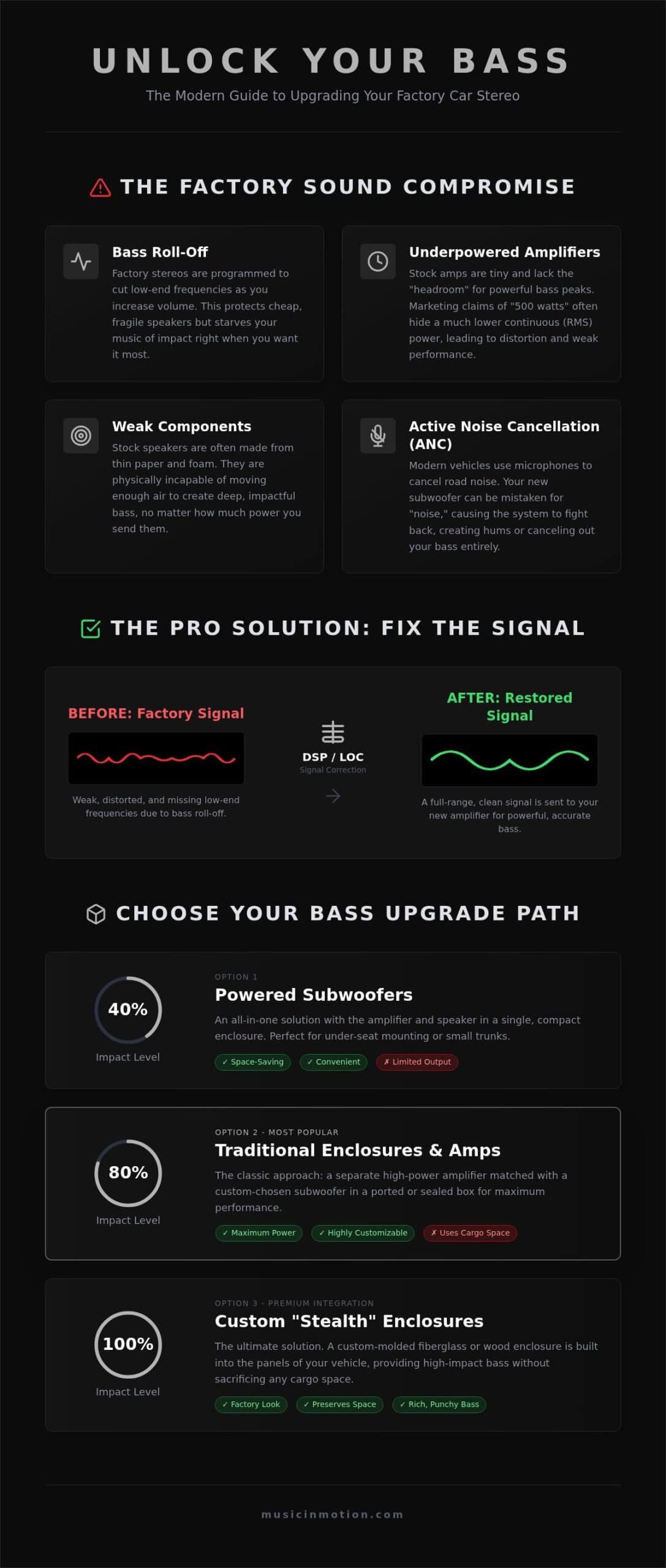
Modern vehicles use complex Digital Signal Processing (DSP) to make cheap speakers sound acceptable at low volumes. However, this software creates a flat or thin sound as you push the system harder. Factory bass roll-off is a protective software measure that reduces low-end output as the volume increases to prevent damage to stock speakers. This means that even if you add a subwoofer, the source signal is already compromised by the time it reaches your new equipment.
Beyond roll-off, the hidden enemy in many 2026 vehicles is Active Noise Cancellation (ANC). These systems use interior microphones to listen for engine drone and road noise. When you add a powerful subwoofer, the ANC system often identifies that deep, rhythmic bass as unwanted noise. It then generates an anti-noise signal to cancel it out, which can result in a frustrating hum or a total loss of bass performance. Bypassing these microphones or using a specialized integration module is a critical step in finding the best way to add bass to a factory car stereo without fighting your car’s own computer.
The Limitations of Stock Amplification
Most factory amplifiers are the size of a deck of cards and lack the headroom necessary for deep, punchy low-end. Headroom is the extra power an amp keeps in reserve to handle sudden musical peaks without distorting. While a car manufacturer might claim “500 watts of peak power,” the actual RMS (continuous) output is often a fraction of that. This marketing fluff doesn’t translate to the physical energy required to move a heavy subwoofer cone.
Identifying whether your vehicle has a dedicated factory subwoofer is a great starting point for an upgrade. While we can often tap into that existing signal, the factory amp still limits the potential of any new hardware. We prioritize professional integration because we understand that high-performance results come from correcting the source, not just adding more volume. Our team focuses on a few key areas to fix these stock limitations:
- Restoring the full-range signal that the factory EQ has suppressed.
- Adding dedicated amplification with high RMS ratings for consistent performance.
- Isolating the bass signal from ANC and safety chime interference.
By addressing these digital and physical barriers, we move from a simple hardware transaction to a custom solution that improves your daily life behind the wheel. We don’t just add parts; we fix the foundation so your music feels as good as it looks.
Comparing the Top 3 Ways to Add Bass
Finding the best way to add bass to a factory car stereo involves balancing your desire for deep sound with the physical reality of your vehicle’s layout. We categorize these upgrades into three main paths, each offering a different level of impact and integration. Whether you want a subtle boost or a concert-level experience, we focus on delivering a finished result that looks as good as it sounds.
Powered Subwoofers: Compact and Convenient
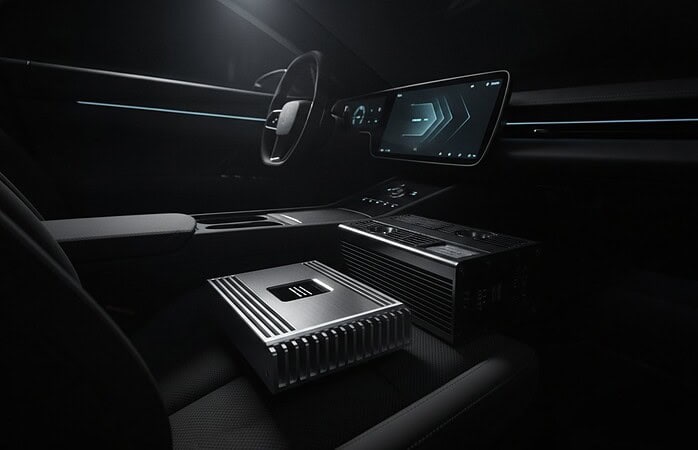
Powered subwoofers combine the amplifier and the driver into one pre-matched enclosure. These units are perfect for under-seat mounting in trucks or corner-loading in hatchbacks where cargo space is at a premium. They are an excellent car audio upgrade for stock stereo systems because they simplify the wiring process and provide a significant jump in quality over factory speakers. While they offer incredible convenience, their smaller physical size means they cannot produce the same earth-shaking volume as larger, dedicated component systems.
Traditional Enclosures and External Amps
For those who want maximum power and customization, a component subwoofer paired with an external amplifier is the way to go. This setup allows us to choose a specific driver and match it with a high-current amp that provides plenty of headroom. Your choice of enclosure significantly changes the internal experience of the user:
- Sealed Enclosures: These provide tight, accurate bass that is ideal for rock, jazz, and detailed listening.
- Ported Enclosures: These utilize a vent to increase output, making them the preferred choice for hip-hop and electronic music fans who want more volume.
In 2026, managing power draw is more important than ever. Modern vehicle electrical systems are highly efficient but can be sensitive to sudden loads. We use high-quality wiring and professional integration techniques to ensure your new system doesn’t drain the battery or interfere with sensitive onboard computers.
Custom Fabricated Enclosures: The Stealth Option
Custom fabrication is the ultimate solution for drivers who refuse to sacrifice their trunk space. We build these enclosures to fit into unused factory cavities, such as the side panels of a cargo area or under a rear seat. This approach provides the rich, punchy low-end of a large component system while maintaining a clean, factory-looking installation. While custom work requires more technical precision, the result is a seamless integration that preserves the utility of your vehicle. If you are curious about how we hide high-performance sound in plain sight, explore our custom installations to see what is possible for your specific vehicle.
Signal Integration: The Secret to Professional Sound
We believe that signal is king. You can spend thousands on the most powerful amplifiers and subwoofers, but if the signal coming from your dashboard is distorted or limited, the final result will always underwhelm. Finding the best way to add bass to a factory car stereo means looking past the speakers and focusing on the data moving through your wires. In modern vehicles, the audio signal is rarely “clean” because the factory computer has already processed it to suit cheap stock speakers. Our goal is to intercept that signal, fix the errors, and deliver a pure foundation to your new equipment.
Beyond the Basic LOC
A Line Output Converter (LOC) is the most common tool used to bridge the gap between a factory radio and an aftermarket amplifier. It converts high-level speaker wires into RCA inputs that your amp can understand. However, not all converters are created equal. Many basic, passive converters can introduce a noticeable hiss or ground loop noise that ruins the listening experience. We prioritize active integration pieces that provide higher voltage and better noise rejection.
In 2026, vehicles are smarter than ever. Many factory systems use load-sensing technology to verify that a speaker is physically connected to the circuit. If you simply tap into these wires without the right adapter, your car might “throw a code” or shut down the audio channel entirely. We use specialized load-sensing adapters to ensure your vehicle’s safety systems and diagnostics remain fully functional. To truly master the signal, we often recommend a more advanced solution. A Digital Signal Processor (DSP) is the brain that re-flattens a factory signal. This allows us to undo the aggressive EQ curves we discussed earlier, giving you a “blank canvas” for your music.
The Role of Professional Tuning
Even with the best signal, the physical layout of a car presents acoustic challenges. Because you sit closer to the left speakers than the right, the sound reaches your ears at different times. We use time alignment to delay the signal from the speakers closest to you by milliseconds. This creates a cohesive soundstage where the bass feels like it’s vibrating right on the dashboard instead of being isolated in the trunk. It’s a subtle change that makes a massive difference in how you experience your favorite tracks.
We also focus on precise crossover settings to protect your investment. By filtering out frequencies that a subwoofer isn’t designed to play, we ensure reliable performance and prevent mechanical damage. You can learn more about professional car audio tuning to see how these adjustments maximize your setup. Our team doesn’t just install hardware; we calibrate every component to work in harmony with your vehicle’s specific cabin acoustics.
Custom Fabrication: Bass Without Sacrificing Space
We believe you shouldn’t have to choose between a powerful sound system and a functional trunk. Many drivers think adding a subwoofer means losing half their cargo area to a bulky, carpeted box. However, the best way to add bass to a factory car stereo is to utilize the space your vehicle already provides. This approach allows us to deliver high-performance results without cluttering your interior or making your car look like a science project. We focus on creating a “factory-plus” look where the hardware performs beautifully but remains hidden from view.
Choosing between fiberglass and wood depends entirely on your vehicle’s layout. Wood is excellent for creating rigid, flat surfaces in trucks or under floor panels. Fiberglass allows us to mold an enclosure into complex, curved cavities like the corner of a trunk or a spare tire well. By combining these materials, we create a structure that is both space-efficient and acoustically superior to any universal box. This custom approach ensures the enclosure is perfectly tuned to the air volume requirements of your specific subwoofer.
The Art of the Stealth Box
A stealth installation is the gold standard for modern vehicle upgrades. By hiding the subwoofer in factory cavities, we maintain 100% of your trunk’s utility while adding the massive sound you crave. This is particularly important for luxury vehicles where maintaining the original aesthetic is a top priority. We use car audio fabrication techniques to match the textures and colors of your interior, making the upgrade look like it came straight from the assembly line. Whether it’s a side cargo panel or a hidden compartment under the rear seat, we find the “dead space” and turn it into a high-fidelity acoustic chamber.
Vibration Control and Sound Deadening
Adding bass requires adding mass to your car’s metal panels. Without proper sound deadening, your new subwoofer will cause thin factory metal to flex and rattle, which degrades the sound quality and creates an annoying external buzz. We apply high-density damping materials to the trunk and door skins to eliminate these vibrations. This process creates a more premium, quiet cabin experience even when the music is turned off.
Enclosure rigidity is just as important as the driver itself. A box that flexes under pressure wastes energy that should be reaching your ears as sound waves. We build our enclosures to be incredibly dense, ensuring that every watt of power from your amplifier is converted into accurate, punchy bass. If you are ready to see how we can hide a high-performance system in your vehicle, contact our fabrication team to discuss a custom solution for your car.
Expert Bass Integration at Music In Motion
At Music In Motion, we don’t view your vehicle as just a project; we see it as an extension of your lifestyle. We know that the best way to add bass to a factory car stereo isn’t found in a “one size fits all” package. Our philosophy centers on delivering a finished result that feels like a natural evolution of your car’s original design. While many shops focus on moving inventory, we prioritize the technical precision required to make aftermarket electronics work in perfect harmony with modern vehicle computers.
We choose to lead with professional signal integration because hardware is only as good as the data it receives. A powerful subwoofer is useless if it’s fighting a factory EQ curve or being muted by safety chimes. Our team treats every installation as a collaborative effort, focusing on your specific musical goals to ensure the final soundstage is rich, punchy, and balanced. From standard daily drivers to high-performance Marine Audio Systems, we bring the same level of versatile expertise to every medium of transport.
Specialized Knowledge for Modern Vehicles
Modern vehicles in 2026 present unique challenges that didn’t exist a decade ago. We have invested heavily in the specialized knowledge required to work with EVs and hybrid electrical systems. Adding a high-current amplifier to an electric vehicle requires a delicate touch to manage power draw safely without triggering system warnings. We also ensure that your new bass system doesn’t interfere with complex safety and sensor arrays, such as blind spot detection or parking alerts. You can check out our vehicle safety systems roundup to see how we round out your tech while keeping your property in safe hands.
The Music In Motion Difference
What sets us apart is our dedication to the “factory-plus” aesthetic. We take pride in our custom fabrication, creating enclosures that look like they belong in your vehicle rather than being an afterthought. This grounded and faithful attitude toward our customer base has allowed us to grow into a multi-faceted specialist capable of handling any custom project, no matter how complex. We remain focused on the practical needs of the user, ensuring that your system is as reliable as it is loud.
We invite you to experience the difference that professional authority and local-business warmth can make. Our process moves logically from a broad mission statement into a tailored solution designed specifically for your car, truck, or boat. Stop settling for thin, “tinny” sound and start enjoying the deep, sensory experience you deserve. Contact us today for a professional car audio consultation, and let our team show you the possibilities of customization.
Transform Your Sound Without Compromise
Upgrading your vehicle’s audio doesn’t have to be a compromise between deep, physical low-end and functional trunk space. We’ve seen that the best way to add bass to a factory car stereo involves a smart combination of signal correction, professional tuning, and custom-fit enclosures. By prioritizing integration over simple hardware swaps, you protect your vehicle’s complex electronics while unlocking a rich, sensory experience that factory systems simply cannot match. It’s about moving beyond thin, hollow sound and finally feeling the music the way the artist intended.
Music In Motion has been a trusted partner for drivers since 1994. We are specialists in integrated vehicle electronics and experts in custom fabrication, ensuring every installation looks like it came straight from the factory. Our collaborative team is passionate about finding the perfect balance for your specific vehicle and musical taste. We don’t just sell parts; we deliver finished results that improve your daily life behind the wheel. Ready for deeper sound? Contact Music In Motion for a custom bass consultation. We are excited to work together to create a soundstage that makes every drive feel more powerful and engaging.
Frequently Asked Questions
Will adding a subwoofer void my new car warranty?
Professional installation of a subwoofer will not void your new car’s factory warranty. A dealership can only deny a warranty claim if they can prove that the aftermarket component or its installation directly caused a specific failure. We prioritize professional integration to ensure your vehicle’s electronics remain safe and functional. This approach provides peace of mind while you enjoy a significantly improved listening experience behind the wheel.
Can I add bass to a car with Active Noise Cancellation (ANC)?
You can definitely add bass to vehicles equipped with Active Noise Cancellation. However, these systems use microphones to listen for road noise and may interpret your new subwoofer’s output as an unwanted sound to be canceled. We use specialized integration modules to bypass these microphones or filter the signal. This prevents the annoying hum or vibration that often occurs when a standard subwoofer is added to an ANC-equipped car.
What is the difference between a powered subwoofer and a separate amp and sub?
A powered subwoofer combines the amplifier and speaker into one compact enclosure, making it the best way to add bass to a factory car stereo when space is limited. Separate components involve a dedicated amplifier and a standalone subwoofer. While separates require more space and complex wiring, they offer much higher power levels and the ability to use custom-fabricated enclosures for a truly professional, tailored sound experience.
Do I need to replace my factory radio to get better bass?
You don’t need to replace your integrated factory dashboard to achieve deep, punchy bass. Modern integration technology allows us to tap into your existing wiring without losing steering wheel controls or safety alerts. By using high-quality line output converters or digital signal processors, we can extract a clean audio signal from your stock radio. This preserves your vehicle’s original look while delivering high-performance audio results that rival aftermarket head units.
How much trunk space will I lose when adding a subwoofer?
The amount of space you lose depends entirely on the installation method you choose. Traditional subwoofer boxes can take up significant room, but custom fabrication allows us to hide enclosures in factory cavities like side panels or spare tire wells. This stealth approach ensures you maintain 100% of your trunk’s utility. We focus on delivering a finished result that enhances your music without compromising your vehicle’s daily functionality or storage capacity.
What does a Digital Signal Processor (DSP) actually do for my bass?
A Digital Signal Processor acts as the brain of your audio system by undoing the aggressive tuning found in factory radios. It re-flattens the audio signal, corrects time alignment so the sound reaches your ears simultaneously, and manages precise crossover settings. This level of control is essential for achieving a professional soundstage. It transforms a basic upgrade into a high-fidelity experience that feels cohesive, powerful, and perfectly tuned to your cabin.
Is professional installation necessary for a factory stereo upgrade?
Professional installation is highly recommended for 2026 vehicles because of their complex data-bus networks and sensitive electrical systems. Modern cars use sophisticated software to manage everything from safety chimes to engine noise cancellation. Our team has the specialized knowledge to navigate these systems safely, preventing electrical codes or hardware damage. We focus on the long-term reliability of your vehicle, ensuring every component is calibrated for optimal performance and safety.
Can I add a subwoofer to a leased vehicle?
You can absolutely upgrade the audio in a leased vehicle. We use non-destructive integration techniques that don’t require cutting factory harnesses or making permanent modifications to the interior. This allows us to remove the subwoofer and restoration equipment at the end of your lease, returning the car to its original state. It’s a great way to improve your daily commute with premium sound without violating your lease agreement or damaging the car.