What if the biggest obstacle to your car’s sound quality isn’t the screen in your dash, but the hidden software processing the signal? Most of us have felt that frustration when the volume goes up and the bass suddenly disappears. You want a car audio upgrade without changing head unit components because your vehicle’s safety features, climate controls, and navigation are all tied to that factory screen. We understand the hesitation to tear apart a complex, modern dashboard. It’s a common pain point; factory systems often sound thin and lifeless, yet they’re too integrated to simply swap out.
The good news is that you don’t have to choose between modern convenience and high-fidelity audio. We’re here to show you how to achieve studio-quality sound while keeping your factory dashboard aesthetics and integrated vehicle controls perfectly intact. In this guide, we’ll explore how 2026 technology like Digital Signal Processors and high-resolution integration allow us to fix factory bass roll-off. You’ll learn the exact steps to get crystal clear audio and deep, impactful bass without losing a single steering wheel function. We’ll walk through the process of correcting the factory signal to deliver a professional, finished result.
Key Takeaways
- Modern dashboards integrate everything from safety sensors to climate controls, making the factory screen a permanent fixture you don’t need to remove.
- Learn how a Digital Signal Processor acts as the brain of your system, allowing for a professional car audio upgrade without changing head unit hardware.
- High-efficiency speaker replacements and multichannel amplification provide the power and clarity that factory components simply can’t match.
- Custom wiring harnesses and professional sound deadening protect your vehicle’s warranty while creating a silent foundation for your music.
- Our collaborative approach focuses on the finished experience, ensuring your new audio architecture works seamlessly with your vehicle’s existing electronics.
The Challenge of Modern Factory Infotainment Systems
Modern vehicle dashboards have evolved into highly complex command centers. Replacing the factory screen is no longer a simple matter of swapping a plastic bracket and plugging in a harness. Today, your head unit controls everything from your heated seats to your advanced driver assistance systems. If you remove it, you lose the brain of the vehicle. This deep integration is the primary reason why a car audio upgrade without changing head unit components has become the industry standard for 2026. We focus on working with these systems rather than fighting against them.
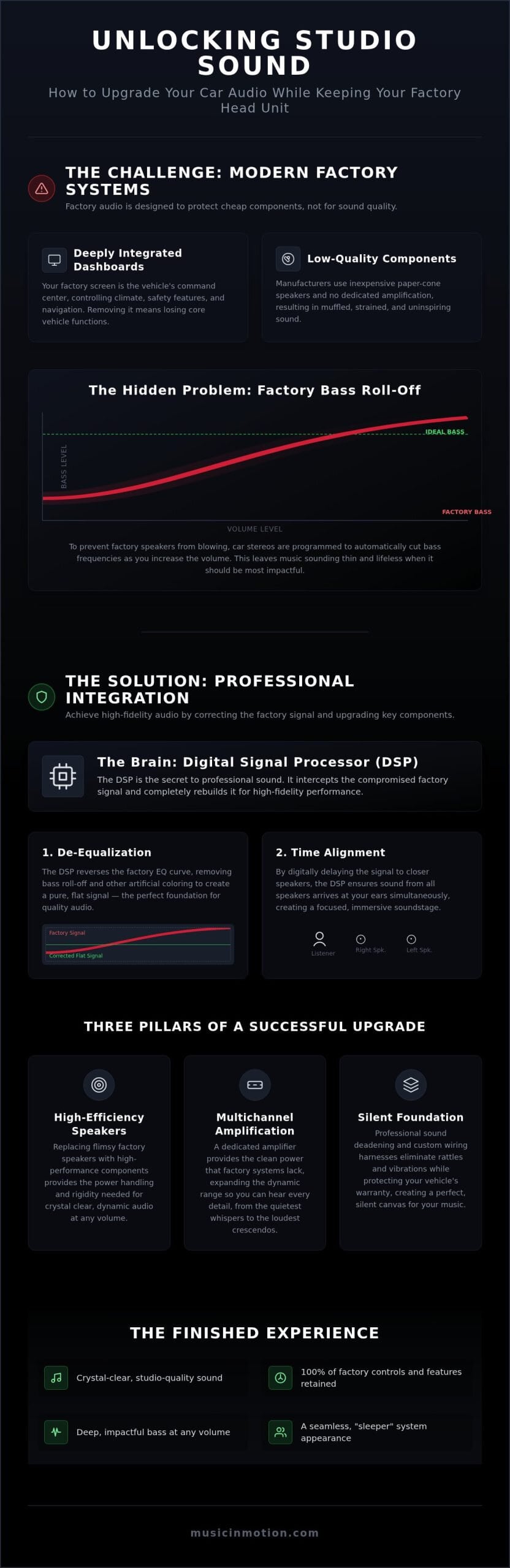
Beyond the physical integration, there is a hidden electrical hurdle known as Factory EQ. Car manufacturers know that the inexpensive speakers they install cannot handle high power. To prevent these components from failing, they program the head unit to automatically reduce bass frequencies as you turn up the volume. This trick, called bass roll-off, leaves your music sounding thin and hollow just when you want it to be most impactful. It is a protective measure for the hardware; however, it is a disaster for your listening experience. Our goal is to intercept that signal and restore the full range of your music.
Why the Factory Look Matters for Resale and Utility
Maintaining the original appearance of your dashboard is about more than just aesthetics. A sleeper system keeps your investment hidden from prying eyes, which significantly improves vehicle security. We also prioritize the preservation of every factory feature. You shouldn’t have to sacrifice your steering wheel controls, voice commands, or backup camera just to get better sound. By keeping the stock screen, you avoid the mismatched plastics and awkward gaps often found with aftermarket dash kits. This approach ensures your vehicle retains its full resale value and original utility while providing a car audio upgrade without changing head unit aesthetics.
Identifying the Weak Links in Stock Audio
The most common culprits for poor sound are the speakers themselves. Most factory systems rely on inexpensive paper-cone speakers with tiny magnets. These components lack the rigidity and power handling required for clear, dynamic audio. Additionally, stock systems rarely have dedicated amplification. This results in a narrow dynamic range where the quiet parts of a song are lost and the loud parts sound strained. When you combine low-quality materials with poor speaker placement and a lack of acoustic tuning, the result is a muffled, uninspiring performance. Our team identifies these specific weaknesses to design a system that bridges the gap between factory limitations and studio-quality sound.
Digital Signal Processing: The Secret to Professional Sound
The Digital Signal Processor (DSP) is the brain that makes a high-performance car audio upgrade without changing head unit components possible. It acts as a sophisticated translator between your vehicle’s factory electronics and your new high-fidelity hardware. While your stock radio outputs a signal that’s heavily processed and “colored” to protect cheap speakers, the DSP strips away those artificial layers. We use these processors to clean and refine the audio, ensuring the foundation of your system is pure and undistorted.
One of the most critical tasks of a DSP is de-equalization. This process reverses the factory radio’s pre-programmed tuning to create a flat, high-fidelity signal. In many modern high-voltage systems, we also utilize high-quality Line Output Converters (LOC) to safely step down the signal before it reaches the processor. This ensures that even the most complex factory amplifiers don’t overwhelm your new gear. Once the signal is flat, we can build a soundstage that actually sounds like a live performance. If you’re ready to hear the difference professional tuning makes, our collaborative team is ready to design your ideal system.
Time alignment is the final touch that creates a studio feel. In a car, you aren’t sitting in the middle of the speakers. Without adjustment, the sound from the left door hits your ears before the sound from the right. A DSP allows us to delay signals by fractions of a millisecond, making the music hit your ears at the exact same moment. This places the singer right on your hood, rather than in your lap. It creates a focused, immersive experience that factory systems simply can’t replicate.
DSP vs. Traditional Equalizers
A standard 3-band dash EQ is like trying to paint a masterpiece with a house-sized brush. It’s too blunt for high-performance audio. A professional DSP offers 31-band digital adjustment for every individual speaker in the car. This level of precision allows us to correct phase issues caused by factory wiring and cabin acoustics. We can target specific frequencies to eliminate “boominess” or harshness without affecting the rest of the music. It’s the difference between a simple volume adjustment and a professional acoustic tune.
Signal Summing and Integration
Many modern vehicles split the audio signal before it even reaches the speakers, sending high frequencies to the dash and low frequencies to the doors. Signal Summing is the process of merging split-frequency factory outputs into a unified audio stream. This is essential for creating a full-range signal for your new amplifiers. Crucially, this advanced integration maintains your factory chimes, parking sensors, and Bluetooth prompts. You get the sound quality you crave without losing the utility and safety features your vehicle provides. It’s a car audio upgrade without changing head unit functionality or safety.
The Three Pillars of a Successful Stock Stereo Upgrade
Building a world-class system around a factory radio requires a strategic framework. We don’t just throw parts at a car; we build a custom audio architecture. A successful car audio upgrade without changing head unit electronics rests on three specific pillars: high-efficiency speakers, multichannel amplification, and dedicated subwoofer integration. We balance these elements to match your specific musical preferences. If you love acoustic sets, we might prioritize speaker detail. If you prefer high-energy tracks, we focus more on the power and subwoofer pillars to deliver that physical energy.
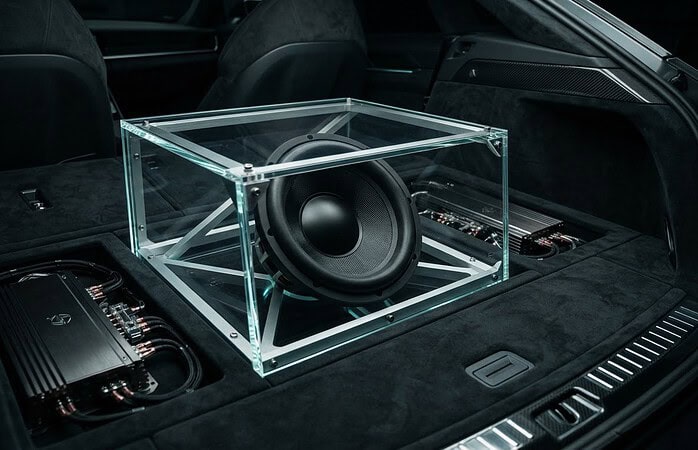
Multichannel power amplification is the often-overlooked hero of this process. It provides the clean current necessary to drive your new speakers without the distortion common in factory chips. Without a dedicated amplifier, even the best speakers will sound flat and uninspired at higher volumes. We use compact, high-efficiency amplifiers that tuck away behind factory panels. They remain completely invisible while providing the massive dynamic range your factory system lacks. This ensures your music stays crystal clear even when you’re cruising with the windows down.
Speaker Selection for Factory Locations
We prioritize choosing speakers that fit perfectly behind your factory grilles without any permanent modifications to your interior. This preserves the original look of your vehicle while dramatically improving vocal clarity and high-frequency detail. When we select these components, we look closely at sensitivity ratings. High-sensitivity speakers require less power to produce high volume, making them ideal for systems where we want to maximize efficiency and protect your vehicle’s electrical system. See our guide to car audio upgrades for stock stereos for more on speaker selection.
Stealth Subwoofer Solutions
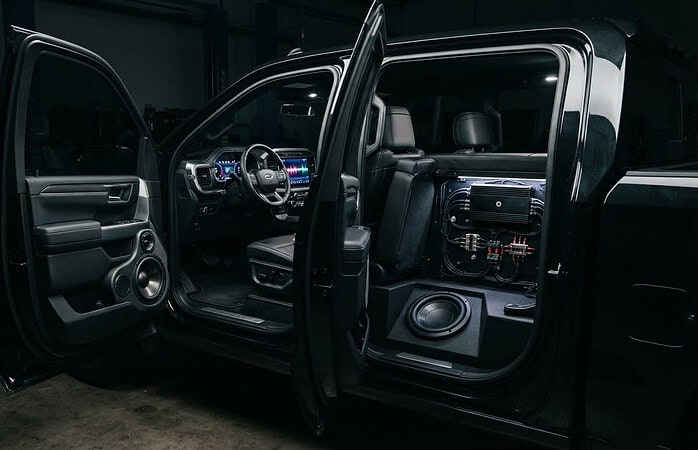
Many clients worry that adding a subwoofer means losing their entire trunk or cargo area. We solve this by utilizing unused spaces like under-seat cavities or spare tire wells. The benefit of custom subwoofer enclosures is that we can maximize every cubic inch of available space while keeping the equipment completely hidden. This adds the low-end “impact” your music is currently missing without sacrificing the utility of your vehicle. Whether you’re hauling groceries or gear for a weekend trip, your system stays tucked away and protected from damage.
Installation and Custom Fabrication: Beyond Plug-and-Play
Executing a successful car audio upgrade without changing head unit electronics requires more than just high-end gear. It demands a level of precision in the physical installation that goes beyond simple plug-and-play kits. We prioritize preserving your vehicle’s electrical integrity by using dedicated wiring harnesses that plug directly into factory connectors. This eliminates the need to cut or splice factory looms, which protects your manufacturer’s warranty. It’s a clean, reliable approach that ensures every connection is as secure as the day your car left the factory.
Modern vehicles often feature odd-shaped speaker apertures that don’t accommodate standard aftermarket sizes. To solve this, we fabricate custom mounting plates that provide a perfect, airtight seal. This attention to detail prevents air leaks that would otherwise ruin your mid-bass response. We also design our hidden installations with heat management in mind. Amplifiers and processors tucked behind panels need adequate ventilation to perform reliably over long drives. We ensure every component has the breathing room it needs to stay cool and efficient.
The Role of Sound Deadening
Acoustic treatment is a non-negotiable step for any high-quality upgrade. By applying specialized damping materials to the inner and outer door skins, we significantly lower your vehicle’s noise floor. This reduces the road and tire noise that usually competes with your music. Sound deadening also stops door panel vibrations that can make your audio sound muddy or distorted. Essentially, we are turning your hollow metal door into a rigid acoustic enclosure. This simple addition allows your speakers to perform at their full potential, delivering tighter bass and clearer vocals.
Custom Pods and Integration
Sometimes, factory speaker locations aren’t ideal for a perfect soundstage. In these cases, our team can create custom A-pillar or kick panel speaker pods to bring the music up to ear level. We take great pride in matching factory textures and colors so these additions look like they were designed by the original manufacturer. Safety is our absolute priority during this process. We ensure that every custom pod is positioned so that safety features like blind spot detection and airbag systems remain completely unobstructed. If you are ready to transform your driving experience, contact our team to start your custom project today.
Professional Integration: The Music In Motion Difference
Since 1994, our team has focused on one foundational goal: delivering a finished result that moves you. We don’t just sell boxes of speakers or amplifiers. We design custom audio architectures that respect the complex computer systems found in modern vehicles. Performing a car audio upgrade without changing head unit components requires a partner who understands the delicate balance between high-end performance and factory reliability. We take pride in our evolution as specialists, yet we remain grounded in our commitment to solving your specific needs through a collaborative design process.
Our approach is built on trust and technical mastery. We treat every vehicle as a unique environment with its own set of electrical requirements. Whether we are working on a standard daily driver or a complex custom build, our focus remains on the internal experience of the user. We bridge the gap between technical precision and the sensory joy of being behind the wheel. We are versatile experts who bring the same enthusiasm to every project, ensuring your vehicle’s safety and functionality remain perfectly intact while your sound quality reaches new heights.
System Design Consultation
Our process begins with a deep dive into your vehicle’s specific signal path. We analyze the electrical capacity of your car to ensure every new component operates safely and efficiently. This collaborative approach allows us to select hardware that complements your unique listening style. While we plan your audio system, we also consider how it integrates with other future additions like remote start systems or radar defense. We plan for the entire lifecycle of your vehicle, ensuring every detail of your property is in safe hands.
The Expert Tuning Process
The hardware installation is only the first step. The true transformation happens during our expert tuning process. We use Real Time Analyzers (RTA) to visualize exactly how sound behaves inside your specific cabin. Every interior has different acoustics; leather reflects sound differently than cloth or plastic. We fine-tune the Digital Signal Processor to create a custom sound signature that fits your ears perfectly. The final result is a car audio upgrade without changing head unit aesthetics that sounds like a world-class concert hall. You get the power and clarity of a high-end system with the seamless look of a factory interior.
Elevate Your Driving Experience Without Compromise
Modern vehicle integration shouldn’t be a barrier to high-fidelity sound. The path to superior audio lies in correcting the signal at its source rather than replacing the screen. By utilizing advanced digital signal processing and high-efficiency components, you can eliminate factory bass roll-off and restore the dynamic range your music deserves. This approach ensures that every safety feature and integrated control remains fully functional. Achieving a professional car audio upgrade without changing head unit components is the smartest way to enjoy studio-quality sound while preserving your vehicle’s original aesthetics and value.
Our team has provided specialized expertise in custom vehicle fabrication since 1994. We focus on seamless integration with factory safety and convenience technology, using advanced DSP tuning to create a listening experience that truly moves you. We believe that your car should be your favorite place to listen to music. Ready to transform your drive? Contact Music In Motion for a custom audio integration consultation. We look forward to helping you design a system that feels like a concert hall every time you turn the key.
Frequently Asked Questions
Will upgrading my audio system void my vehicle’s manufacturer warranty?
Professional integration protects your vehicle and your rights. The Magnuson-Moss Warranty Act prevents manufacturers from denying warranty claims simply because aftermarket parts were installed. We use vehicle-specific wiring harnesses that avoid cutting factory looms. This ensures your electrical system remains intact and your warranty stays secure. Our team prioritizes the safety and functionality of your vehicle’s standard systems while delivering the custom performance you desire.
Do I really need a DSP if I’m just replacing the speakers?
A Digital Signal Processor is essential for a true car audio upgrade without changing head unit components. Factory radios are programmed with specific EQ curves to protect cheap speakers. New high-quality speakers can’t overcome these baked-in audio limitations on their own. A DSP cleans the signal and restores a flat frequency response. It allows us to tune the system to your specific cabin acoustics for a professional result.
Can I keep my steering wheel controls with an aftermarket amplifier?
Your steering wheel controls remain fully functional. Since we are integrating with your factory dashboard rather than replacing it, the communication between your steering wheel and the radio is never interrupted. The new amplification and speakers simply receive the signal that the radio sends. You’ll still be able to adjust volume, skip tracks, and use voice commands exactly as you did the day you bought the car.
How much does a professional car audio integration typically cost?
Every project we undertake is a custom collaboration designed around your specific vehicle and listening goals. Factors like the number of speakers, the complexity of the signal path, and the level of custom fabrication required all influence the final investment. We focus on delivering a finished result that prioritizes your experience over a simple transaction. We recommend a consultation to discuss a solution that fits your practical needs.
What is the difference between an LOC and a DSP?
An LOC is a basic tool that converts speaker-level signals into a format amplifiers can use. It doesn’t change the sound quality or fix factory tuning. A DSP is a sophisticated brain that allows for precision tuning, time alignment, and signal de-equalization. While an LOC is a functional necessity in some basic setups, a DSP is the key to achieving studio-quality sound in a modern vehicle.
Can I add a subwoofer to my factory system without changing the radio?
You can definitely add impactful bass without touching the factory radio. We use specialized integration tools to grab the audio signal from your existing wiring. By pairing this with custom subwoofer enclosures, we can add deep, low-end performance that factory systems lack. This allows you to keep your integrated navigation and climate controls while enjoying the physical energy of a high-performance subwoofer system.
How long does a full integration and custom fabrication project take?
The duration of your project depends on the level of customization you choose. A straightforward integration of an amplifier and speakers typically takes one to two business days. Projects involving extensive custom fabrication, such as A-pillar pods or complex trunk enclosures, may require additional time for design and finishing. We provide a clear timeline during our collaborative design process so you know exactly what to expect.
Will adding an amplifier drain my car’s battery?
A professionally installed system won’t drain your battery. We use high-efficiency amplifiers and proper integration techniques that ensure the system turns off completely when you turn off the vehicle. We also analyze your car’s electrical capacity during the design phase to ensure your alternator can handle the new load. Our focus on reliability ensures your car starts every morning while delivering incredible sound every time you drive.