The most expensive subwoofer in the world will still sound like a rattling cardboard box if it’s trapped in the wrong enclosure. Many enthusiasts assume a bigger box automatically means better bass, but the truth is that your vehicle’s interior shape matters just as much as the wood and glue. Achieving the perfect custom subwoofer box design for sound quality isn’t about following a generic blueprint. It’s about understanding how air pressure and acoustic roll-off interact with your specific cabin to create a seamless listening experience.
We know how frustrating it is to hear sloppy bass that feels disconnected from the rhythm or to lose your entire trunk to a poorly planned setup. You shouldn’t have to decode confusing jargon like air spring just to get decent sound. This 2026 guide will teach you how to engineer an enclosure that works with your vehicle’s natural acoustics rather than fighting against them. We’ll walk through the differences between sealed and ported designs, explain the physics of cabin gain, and show you how to get that deep, impactful low-end you’ve been chasing.
Key Takeaways
- Learn why custom subwoofer box design for sound quality requires isolating opposing sound waves to prevent cancellation and capture the lowest frequencies.
- Compare the air spring precision of sealed enclosures against the high-efficiency output of tuned ported designs to find your ideal balance.
- Master the science of cabin gain to ensure your subwoofer works with your vehicle’s interior dimensions rather than against them.
- Discover how custom-fabricated enclosures outperform generic pre-fab options by maximizing internal volume and structural rigidity for cleaner sound.
The Quest for Deep Bass: Why Enclosure Design Dictates Sound Quality
Many people think a subwoofer is just a speaker that makes things loud. In reality, the driver is only half of the equation. Achieving a high-performance custom subwoofer box design for sound quality requires looking at the enclosure as a mechanical processor. Without a properly engineered box, the air around the speaker actually works against the music. We don’t just build boxes; we engineer environments. We focus on how the air inside the enclosure controls the subwoofer cone. This ensures every beat is intentional rather than accidental.
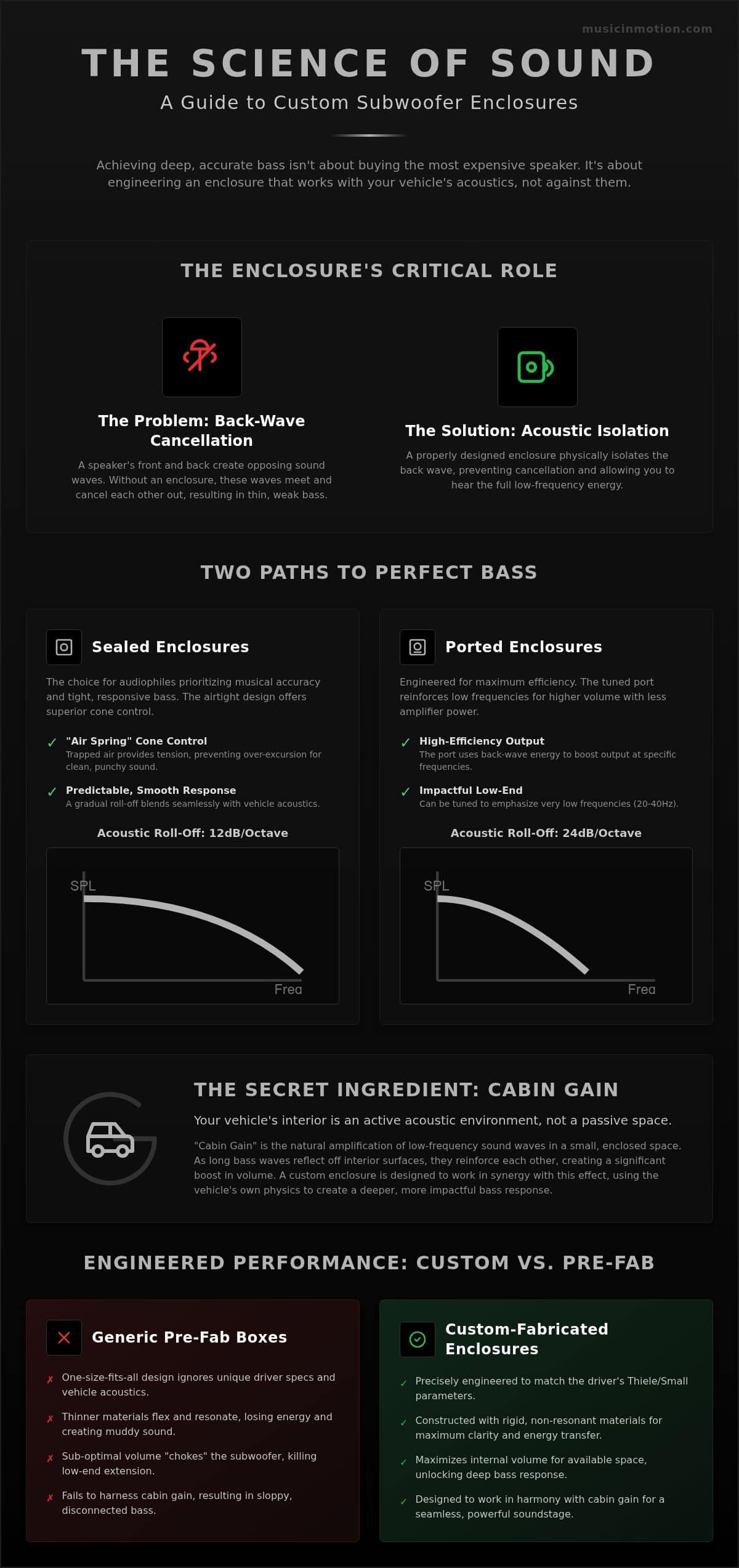
Reproducing “deep bass” between 20Hz and 40Hz is the most difficult task for any mobile audio system. These long sound waves require massive amounts of air movement to be felt and heard. Most off-the-shelf solutions fail here because they’re built for generic compatibility rather than acoustic accuracy. We weigh the benefits of air-tight sealed boxes, which typically offer a smooth 12dB per octave roll-off, against vented ported designs that provide a steeper 24dB per octave slope. We find the right solution for your specific goals based on these distinct acoustic behaviors.
Understanding Back-Wave Cancellation
When a subwoofer cone moves forward, it creates a positive pressure wave. At the same exact moment, the back of the cone creates an equal and opposite negative pressure wave. If these waves meet, they cancel each other out. This is why a subwoofer sitting on a workbench sounds thin and lacks any real punch. A well-built loudspeaker enclosure design acts as a physical barrier. It isolates that back wave, preventing phase cancellation so you actually hear the low-end energy the driver is capable of producing. This isolation is the first step in moving from generic noise to audiophile-grade bass.
The Relationship Between Box Volume and Low-End Extension
Every subwoofer has a unique set of technical specifications known as Thiele/Small parameters. These specs tell us exactly how much air the driver needs to perform its best. If a box is too small, the air inside becomes too stiff. This “air spring” effect chokes the speaker and kills the deep bass response. This remains true even if you throw thousands of watts of power at it. To hit the lowest notes accurately, the internal volume must match the driver’s specs perfectly. We use these parameters to bridge the gap between technical physics and the sensory experience of feeling the music. Whether we build a precision sealed box or a high-output ported design, the volume dictates the efficiency of the entire system.
Sealed Enclosures: The Precision Approach to Sub-Bass Accuracy
Sealed enclosures are the foundation of high-fidelity mobile audio. While some enthusiasts claim they’re only for specific genres like rock or jazz, we’ve found they offer the most predictable results for a custom subwoofer box design for sound quality. The design is elegantly simple: a completely airtight chamber. This simplicity is its greatest strength. It provides a level of cone control that other designs struggle to match, making it the gold standard for listeners who prioritize musicality over raw volume.
The primary characteristic of a sealed box is its gradual 12dB per octave roll-off curve. This means the bass doesn’t suddenly hit a “cliff” and disappear. Instead, it tapers off gently as frequencies drop. Because this roll-off is so predictable, it often meshes perfectly with the natural acoustics of a vehicle. The result is a smooth, balanced low-end that feels like a natural extension of your front speakers rather than a separate, booming box in the trunk.
The “Air Spring” Effect and Cone Control
The air trapped inside a sealed box acts as a mechanical spring. As the subwoofer moves, this internal air pressure provides constant tension on the cone. This “air spring” prevents the driver from over-extending or bottoming out during intense, high-output musical passages. For enthusiasts using modern high-excursion subwoofers, this protection is vital for longevity and clarity. It creates the “tight” and “punchy” bass that defines a high-end system. When we pair these enclosures with professional custom car audio fabrication techniques, we ensure the box is rigid enough to handle this internal pressure without any wall flex or energy loss.
Frequency Response and Low-End Extension
We evaluate every sealed design by looking at its F3 point, which is the specific frequency where the output has dropped by 3dB. This number tells us exactly where the bass starts its gradual descent. Because sealed boxes have such a shallow roll-off, they take better advantage of the acoustic technologies in cars that naturally boost low frequencies. This is why a sealed box can sometimes produce deeper, more natural-sounding sub-bass in a small car than a massive ported box would.
There is a trade-off for this precision. Sealed boxes are inherently less efficient than ported designs, meaning they often require more amplifier wattage to reach high volume levels. We frequently use Digital Signal Processing (DSP) to bridge this gap, allowing us to maintain the accuracy of a sealed enclosure while hitting the output levels you expect. If you’re looking for a system that balances space-saving design with audiophile accuracy, our team at Music In Motion can help you engineer the perfect fit.
Ported Enclosures: Maximizing Low-End Output and Efficiency
If sealed boxes are about surgical precision, ported enclosures are about raw efficiency and impact. A ported design, also known as a vented box, captures the back-wave energy that a sealed box traps and redirects it through a tuned opening to reinforce the front-wave. This creates a significant boost in output, often 3dB to 6dB louder than a sealed counterpart at the tuning frequency. For many enthusiasts, a custom subwoofer box design for sound quality in a ported configuration is the best way to get physical, chest-thumping bass without needing a massive, power-hungry amplifier.
The heart of this design is the Tuning Frequency, or Fb. This is the specific note where the air inside the box and the port resonate together. At this frequency, the system is at its most efficient. However, there is a trade-off. While a sealed box tapers off gently, a ported box hits a steep 24dB per octave roll-off below its tuning frequency. This is the “cliff” where output drops off almost instantly. We carefully calculate this point to ensure your music stays within the system’s sweet spot while protecting your equipment.
- Increased Efficiency: You get more physical “boom” out of less amplifier power.
- Deep Extension: Properly tuned ports can reach lower frequencies than many small sealed boxes.
- Thermal Management: The constant movement of air through the port helps keep the subwoofer’s voice coil cool during long listening sessions.
Helmholtz Resonance: How the Vent Reinforces Sound
To understand how this works, think of blowing across the top of a soda bottle. That deep whistle you hear is the air inside the bottle vibrating at a specific frequency. This is called Helmholtz Resonance. In a ported enclosure, the air moving inside the vent actually does more work than the subwoofer cone itself at the tuning frequency. The cone barely moves while the port produces the majority of the sound. We pay close attention to the port area during fabrication. If the port is too small, the air moves too fast, creating a distracting whistling sound known as “chuffing.” We ensure the vent is large enough to keep the air moving smoothly and silently.
The Trade-off: Size and Control
Performance always comes with a price. Ported boxes are significantly larger than sealed boxes because they require extra internal volume to house the vent and the air it moves. They also present a unique risk. Below the tuning frequency, the subwoofer loses its “air spring” protection and can move uncontrollably. We always insist on using a subsonic filter to cut off these dangerous low frequencies before they damage your equipment. This extra efficiency makes a ported box an excellent choice for a car audio upgrade for stock stereo. It allows you to get impressive results even when working with the limited power output of a factory system.
The Secret Ingredient: Cabin Gain and Vehicle Acoustic Physics
The single most overlooked factor in achieving a high-end audio experience isn’t the brand of the speaker or the power of the amplifier. It’s the vehicle itself. Every car acts as a pressurized chamber that naturally boosts low frequencies. We call this phenomenon Cabin Gain, or the Transfer Function. If you ignore this during your custom subwoofer box design for sound quality, you end up with bass that sounds bloated or overwhelming. We treat the vehicle interior as the final piece of the enclosure, ensuring the box and the cabin work in harmony.
Cabin gain doesn’t happen by accident. It starts at a specific frequency determined by the longest dimension of your vehicle’s interior. As sound waves become longer than the cabin can physically contain, the pressure increases, creating a natural boost of roughly 12dB per octave. This is the “Magic Match” for sealed enclosures. Since a sealed box rolls off at 12dB per octave, the car’s natural 12dB boost perfectly mirrors that loss. This results in a remarkably flat, linear, and deep bass response that sounds exactly like the artist intended.
Ported boxes require a more strategic approach. Because they have a steeper 24dB per octave roll-off, they don’t mirror the cabin gain as naturally. If we tune a ported box to a frequency that overlaps too closely with the vehicle’s natural peak, the bass becomes “one-note” or boomy. We carefully calculate these intersections to prevent that sloppy, disconnected sound. If you want a system that blends perfectly with your car’s unique acoustics, contact our team at Music In Motion to start your custom build.
Small Cars vs. Large SUVs: Acoustic Differences
The size of your ride completely changes the rules of engagement. In a small hatchback, cabin gain starts at a higher frequency, which is why a modest sealed 10-inch sub can often sound incredibly deep and powerful. In a large vehicle like a Suburban, the gain starts much lower. This means you need more displacement or a low-tuned ported enclosure to achieve the same perceived depth. We also account for trunk-loading versus cabin-loading. How the sound waves reflect off the rear hatch or trunk lid determines whether the bass feels like it’s behind you or vibrating through your seat.
Sealed vs Ported Comparison for Deep Bass
Choosing between these two designs depends on your vehicle’s volume and your listening goals. We use a clear framework to help you decide:
- Accuracy: Sealed boxes win. They offer the best transient response for fast music.
- Output: Ported boxes win. They produce more physical impact with less power.
- Size: Sealed boxes win. They maximize trunk space and fit in tight corners.
- Linearity: Sealed boxes win in small cars. Ported boxes win in large SUVs when tuned specifically for low-end extension.
We analyze these variables for every project. Our goal is to bridge the gap between technical physics and the emotional impact of your favorite tracks. By matching the enclosure’s roll-off to your car’s transfer function, we deliver a finished result that generic, off-the-shelf boxes simply cannot match.
Custom Fabrication: Engineering Performance for Your Specific Vehicle
Off-the-shelf “pre-fab” boxes are often the biggest obstacle to achieving high-fidelity sound. These generic enclosures are built to “average” specifications using thin materials to save on shipping costs. This leads to “box talk,” which occurs when the enclosure walls flex and vibrate, coloring the sound with unwanted distortion. A true custom subwoofer box design for sound quality requires a rigid, acoustically inert structure. We prioritize 3/4-inch MDF or high-grade Birch plywood to ensure the enclosure remains dead silent while the subwoofer does the work. This rigidity ensures that every ounce of energy from your amplifier is converted into clean, impactful bass rather than wasted on vibrating wood.
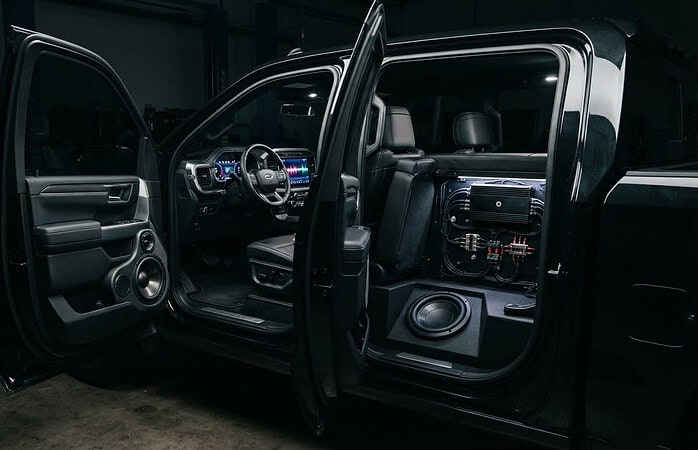
Custom fabrication also allows us to reclaim your trunk. Pre-fab boxes are bulky and awkward, often wasting valuable cargo space. We design our enclosures to follow the unique contours of your vehicle’s interior, tucking them into side panels or under seats. This approach maximizes internal volume while maintaining the utility of your car. We aren’t just selling you a piece of hardware; we are providing a finished result that integrates seamlessly into your life and your vehicle.
Engineering for the Driver and the Vehicle
We don’t start our builds with a saw; we start with a computer. Our team uses advanced modeling software to simulate the subwoofer’s response within the proposed enclosure volume before the first cut is made. This allows us to predict the frequency response and adjust for the cabin gain we discussed earlier. We incorporate strategic internal bracing to eliminate wall flex without choking the air volume the driver needs. We also take pride in the visual integration. By matching factory carpets, leathers, and trim pieces, we make the enclosure look like a factory-installed component rather than an aftermarket addition.
The Role of Professional Integration and DSP
A perfectly engineered box is only as good as the signal it receives. Even the best enclosure needs professional calibration to handle phase alignment and timing issues. We use Digital Signal Processing (DSP) to ensure the sub-bass frequencies reach your ears at the exact same millisecond as the high notes from your dashboard. This creates a cohesive soundstage where the bass feels like it’s coming from the front of the car rather than the trunk. We also take care to integrate these systems without compromising your vehicle safety systems or factory electronics.
At Music In Motion, we believe that bass you can truly feel is the result of a holistic design process. It’s about matching the physics of the driver to the acoustics of the cabin and the needs of the listener. When these elements align, the result is a deep, immersive experience that changes how you feel every time you get behind the wheel.
Transform Your Daily Drive with Precision Bass
Engineering the perfect low-end is about more than just picking a powerful driver. It’s about creating a synergy between the hardware and your vehicle’s unique interior. We’ve seen how a precise custom subwoofer box design for sound quality bridges the gap between generic noise and a true audiophile experience. Whether you choose the tight accuracy of a sealed box or the high-efficiency impact of a ported design, the result depends on how well the enclosure accounts for cabin gain and structural rigidity.
Since 1994, we’ve focused on delivering finished results that go beyond simple transactions. We use our three decades of custom fabrication experience to match audio performance to your specific vehicle acoustics, ensuring your system sounds exactly as the artist intended. You don’t have to settle for sloppy bass or wasted trunk space. Our team is dedicated to building systems that are as reliable as they are powerful.
Ready for bass you can feel? Contact Music In Motion for a custom enclosure consultation today. We’re excited to help you push the boundaries of what your audio system can achieve.
Frequently Asked Questions
Is a sealed or ported box better for deep bass?
Both designs can reach the lowest notes, but they do it in different ways. A sealed box offers a smooth, natural extension that often sounds deeper in small cars due to its 12dB roll-off. A ported box provides a massive peak in output at its tuning frequency. For a custom subwoofer box design for sound quality, we often choose sealed for accuracy or low-tuned ported for high-output depth in larger vehicles.
Do ported boxes sound “sloppy” compared to sealed?
Sloppy bass is usually a symptom of a poorly designed vent or a box that’s too large for the driver. When we engineer a custom enclosure, we calculate the exact port area needed to prevent air turbulence and chuffing. A well-built ported box delivers fast, impactful hits that remain musical. The sloppy reputation comes from generic pre-fab boxes that aren’t tuned to a specific subwoofer’s requirements or the vehicle’s unique interior dimensions.
What is the best tuning frequency for a ported box if I want deep bass?
For deep, low-end extension, we usually target a tuning frequency between 28Hz and 32Hz. This range allows the system to reproduce the lowest notes found in modern music while maintaining a balanced response. Tuning higher, like 40Hz, creates a loud hump in the mid-bass but sacrifices the deepest frequencies. We use software to model the response and ensure the tuning frequency aligns with your musical preferences and your vehicle’s natural acoustic properties.
Why does my sealed box sound deeper in my small car than my friend’s ported box in his SUV?
This happens because of the transfer function, or cabin gain. Small vehicles naturally boost low frequencies starting at a higher point than large SUVs. In your small car, the 12dB roll-off of the sealed box mirrors the 12dB boost from your cabin perfectly. Your friend’s SUV has a much larger interior volume. This means the cabin gain starts much lower, which can make a ported box sound peaky if it isn’t tuned specifically for that space.
Can I put any subwoofer in a ported box?
Not every subwoofer is a candidate for a ported enclosure. We look at the driver’s EBP, or Efficiency Bandwidth Product, to determine its ideal home. A sub with a low EBP is usually best suited for a sealed box, where the air spring provides necessary control. Putting a sealed-only sub in a ported box can lead to poor sound quality and potential mechanical failure. We always verify the Thiele/Small parameters before beginning any custom build.
Does a ported box require less power from my amplifier?
Technically, a ported box is more efficient, which means it produces more volume with the same amount of power. You can expect an increase of 3dB to 6dB in output at the tuning frequency compared to a sealed box. This makes ported designs an excellent choice for systems where amplifier power is limited. However, a custom subwoofer box design for sound quality still requires a high-quality amplifier with enough headroom to maintain control over the speaker’s movements.
What happens if I play music below the tuning frequency of a ported box?
Playing frequencies below the tuning point is dangerous for your equipment. Once the frequency drops below the port’s tuning, the air inside the box no longer provides resistance to the cone. The subwoofer begins to act as if it’s in free air, which can cause it to over-extend and bottom out. We prevent this by setting a subsonic filter on your amplifier or DSP to cut off those dangerous frequencies before they reach the speaker.
How much trunk space will I lose with a custom ported enclosure?
Ported boxes are typically 50 percent to 100 percent larger than sealed enclosures because they require extra volume for the vent. While you’ll lose more space, custom fabrication helps us minimize the impact. We can mold the box into the corners of your trunk or integrate it into a side panel to keep the main floor area clear. Our goal is to balance high-performance bass with the practical, daily needs of your vehicle’s cargo area.