You’re cruising down the open road, your favorite anthem starts to build, and you reach for the volume knob to capture that perfect moment. Instead of a crisp, immersive experience, your speakers begin to crackle, the bass loses its punch, and those high frequencies start to feel like needles in your ears. It is a common frustration that leaves many drivers wondering if they have already ruined their expensive equipment or if their system just isn’t up to the task. We understand that feeling of hesitation and the fear that one more notch on the dial might be the end of your audio investment.
At Music In Motion, we know that distortion is rarely a simple “broken speaker” problem. It is usually a sign that your signal and power are out of balance. This guide will teach you how to stop car speaker distortion at high volume by identifying the technical bottlenecks in your setup. We will explore how to diagnose clipping, tune your amplifier gain, and utilize 2026 advancements like 5.0-volt preamp outputs and integrated DSPs. You will walk away with the confidence to push your system to its limits while maintaining the studio-quality clarity you deserve.
Key Takeaways
- Understand that distortion is typically a symptom of signal imbalance rather than a mechanical failure, which helps you avoid replacing parts that aren’t actually broken.
- Master the relationship between your volume knob and amplifier gain to learn how to stop car speaker distortion at high volume without risking your equipment.
- Identify the difference between physical hardware damage and electrical clipping through simple, non-invasive diagnostic tests you can perform at home.
- Improve immediate audio clarity by flattening EQ presets and utilizing high-resolution wired connections to bypass common signal bottlenecks.
- Recognize when professional tuning and custom fabrication are necessary to overcome the complex acoustic limitations of modern factory-integrated systems.
Understanding the Root Causes of Audio Distortion
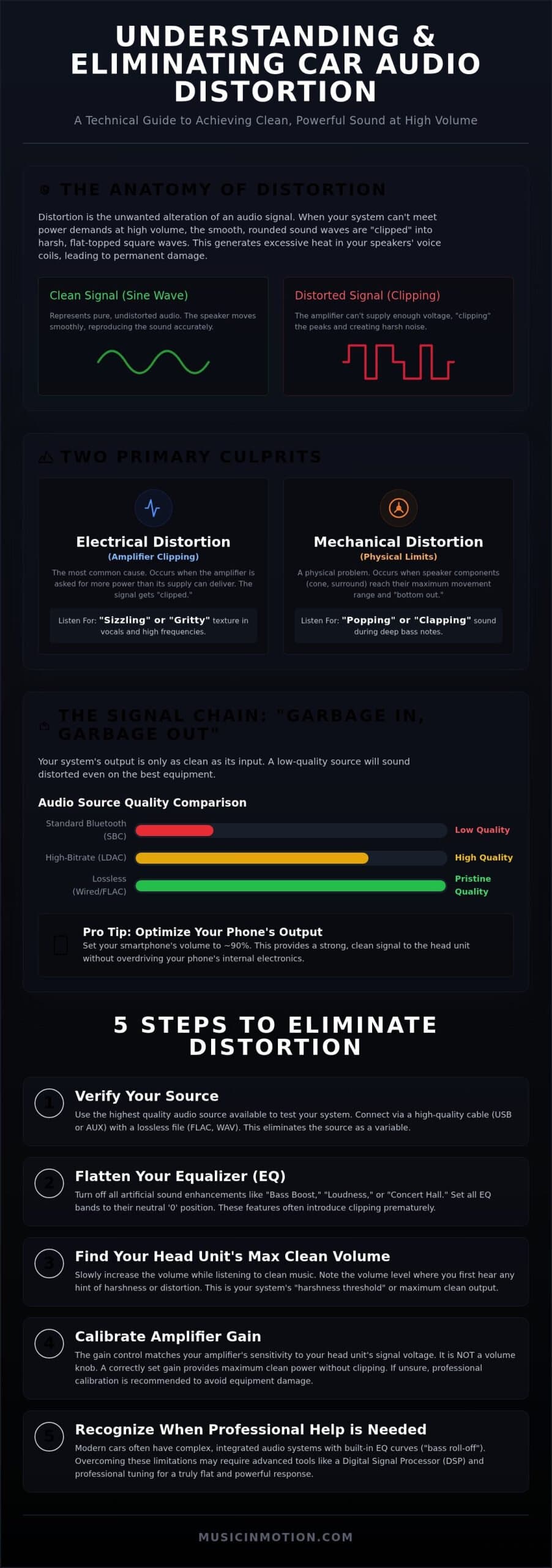
To understand how to stop car speaker distortion at high volume, we must first define what we are actually hearing. Distortion is the unwanted alteration of an original audio signal during reproduction. When your system is working correctly, the speaker moves in a perfect mirror image of the electrical signal it receives. As you turn the volume up, your system demands more power to move the speakers further and faster. If your components cannot meet this demand, the smooth, rounded sound waves flatten out. This creates the “harshness threshold,” the point where clean music transforms into painful noise.
Ignoring this sound is a recipe for disaster. Distortion generates excessive heat within the speaker’s internal components. While modern Class D amplifiers are highly efficient, converting up to 90% of their electrical draw into acoustic power, the remaining energy is lost as heat. In a distorted system, this heat builds up in the voice coil. Over time, the high temperatures melt the protective coatings on the wire or even warp the coil itself. This leads to permanent hardware failure that no amount of tuning can fix.
Mechanical vs. Electrical Distortion
We generally categorize distortion into two camps: mechanical and electrical. Mechanical distortion is a physical problem. It occurs when the speaker cone, surround, or spider reaches its physical limit. If you hear a “popping” or “clapping” sound specifically during deep bass notes, the speaker is likely bottoming out. Electrical distortion is usually the result of amplifier clipping. This happens when the amplifier is asked to provide more voltage than its power supply can deliver. You can identify this by listening for a “sizzling” or “gritty” texture in the vocals and high frequencies. Knowing this distinction is the first step in learning how to stop car speaker distortion at high volume.
The Role of Factory Head Units
Most stock stereos are designed with self-preservation in mind rather than high-fidelity performance. Factory head units often use inexpensive chip-based amplifiers that lack sufficient headroom. To prevent their basic speakers from blowing, car manufacturers program “bass roll-off” into the system. As you increase the volume, the stereo automatically reduces the low-end frequencies. This creates a thin, hollow sound profile. Many drivers try to compensate by boosting the bass on the EQ, which only forces the weak factory amp into deeper distortion. These baked-in EQ curves make it difficult to achieve a balanced sound without professional integration tools.
Mastering the Signal Path: Clipping and Gain Settings
Clipping is the most common enemy of clean sound. It happens when you ask your amplifier for more voltage than its power supply can provide. Instead of a smooth wave, the signal gets “clipped” into a square shape. This introduces various types of distortion that sound like harsh static or gravelly vocals. Many drivers assume the volume knob is a power throttle, but it is actually just a signal attenuator. If your gain is set too high, you might reach maximum clean output at level 20 out of 40. Pushing past that point won’t make the music louder; it just makes it dirtier. Avoid using “Bass Boost” or “Loudness” buttons on your head unit. These features artificially spike specific frequencies, which almost always leads to premature clipping and strained equipment.
The “Garbage In, Garbage Out” Principle
We often see clients frustrated with sound quality when the issue isn’t the hardware, but the source. This is the “Garbage In, Garbage Out” principle. Standard Bluetooth codecs like SBC compress audio heavily, stripping away detail and adding digital artifacts. By the time that signal reaches your speakers, it is already compromised. For a true test of your system, use high-bitrate streaming or lossless files. In 2026, many receivers support high-bitrate wireless streaming like Sony’s LDAC at 990 kbps. This is a massive jump from older standards. Also, ensure your smartphone volume is set to roughly 90%. This provides a strong, clean signal to the head unit without overdriving the phone’s small internal digital-to-analog converter.
Setting Amplifier Gains Correctly
Learning how to stop car speaker distortion at high volume starts with a properly set gain. Think of the gain control as a bridge between your head unit and your amplifier, not a volume slider. Modern high-end head units now feature 5.0-volt gold-plated RCA pre-outs, which require different gain settings than older 2.0-volt models. We prefer using a digital multimeter or an oscilloscope to find the exact voltage where a signal begins to square off. If you are tuning by ear, set your head unit to about 75% volume with a flat EQ. Slowly turn up the gain until the music sounds “grainy,” then back it off a hair. This ensures your amp is perfectly matched to the head unit’s output voltage. If your system still feels lackluster after these adjustments, our team at Music In Motion can provide a professional audio calibration to find the hidden potential in your gear.
Identifying Physical Speaker Limitations vs. Electrical Issues
Distortion is not always a sign of a bad signal. Sometimes, your hardware simply can’t keep up with the physical demands of the music. We recommend starting with a visual inspection of your drivers. Check for torn rubber surrounds or cracked paper cones. Even a tiny pinhole can cause air to leak, creating a flapping sound that mimics electrical noise. If the speaker looks intact, try the “Push Test.” With the system off, gently and evenly press the speaker cone inward. If you feel resistance or hear a “scratching” sound, the voice coil is likely warped or rubbing against the magnet. This indicates permanent damage that requires a replacement rather than a tuning fix.
We often find that “distortion” is actually just a loose mounting screw or a vibrating door panel. High-performance speakers move a lot of air. If they aren’t securely fastened to a solid baffle, they will rattle against the vehicle’s metal frame, creating a mechanical buzz. Similarly, thin factory wiring can act as a bottleneck. High-power systems require thick, oxygen-free copper wire to deliver current efficiently. If you use stock 18-gauge wire for a high-output speaker, you are starving the driver of the energy it needs to stay controlled. Solving audio clipping often begins with ensuring the physical path is as robust as the electrical one.
Crossovers: The Traffic Cops of Your Audio System
Sending deep bass to a small door speaker is a guaranteed way to create instant distortion. These speakers aren’t designed to reproduce the long, slow waves of a sub-bass track. We use High-Pass Filters (HPF) to block these frequencies, allowing the speaker to focus on the midrange and vocals it was built for. A professional car audio tuning session can perfectly align these crossover points. This protection ensures your speakers stay within their linear range, which is a vital step in learning how to stop car speaker distortion at high volume.
Power Inefficiency and Voltage Drops
Your amplifier is only as strong as your vehicle’s electrical system. If your headlights dim every time the bass hits, your amp is likely experiencing a significant voltage drop. When the battery and alternator can’t provide enough current, the amp’s internal power supply struggles, leading to a flat, compressed sound profile. For extreme systems, we might recommend a high-output alternator or a stiffening capacitor to bridge those peak power demands. Maintaining a steady voltage is essential for keeping your audio signal clean when you push the volume to its limit.
5 Practical Steps to Eliminate Distortion and Improve Clarity
Troubleshooting your system doesn’t have to be a guessing game. We follow a systematic process to identify where the audio signal is breaking down. If you want to know how to stop car speaker distortion at high volume, start by stripping your settings back to basics. This allows you to hear the true performance of your hardware without software interference. Follow these steps to audit your system:
- Step 1: Flatten your EQ. Turn off all “Bass Boost,” “Loudness,” or “Vocal Enhance” features. These settings often push an amplifier into clipping before the volume knob even reaches the halfway point.
- Step 2: Isolate the source. Test your system with a high-quality wired USB connection. This bypasses the compression issues common with Bluetooth and helps determine if the “distortion” is actually just a poor-quality digital file.
- Step 3: Audit the installation. Tighten every mounting screw and check for air leaks around the speaker baffle. A loose panel vibrating at 60Hz can sound exactly like a blown woofer.
- Step 4: Recalibrate your gains. Use a 1kHz test tone to find the maximum clean output level of your head unit. This is the only way to ensure your signal path remains linear at peak levels.
- Step 5: Apply acoustic treatment. Lowering the noise floor of your cabin is the most effective way to improve perceived clarity without buying new speakers.
The Power of Sound Deadening
A professional sound deadening installation does more than just quiet the cabin. It stops your door panels from “singing” along with your speakers. When a speaker moves, it creates energy that vibrates the surrounding metal and plastic. This resonance creates a muddy, distorted sound profile. By applying butyl-based damping material, we convert that kinetic vibration into low-level heat. This creates an airtight seal and lowers the noise floor. You won’t have to turn the volume up as high to hear fine details, which reduces the strain on your equipment.
Upgrading the Weakest Link
Sometimes, the factory hardware simply cannot meet your expectations. Moving from a basic car audio upgrade for stock stereo to a system with an external Digital Signal Processor (DSP) is a game-changer. In 2026, modern DSPs allow us to surgically fix the aggressive factory EQ curves that cause distortion. Additionally, adding a small powered subwoofer can actually make your door speakers clearer. By offloading the power-hungry low frequencies to a dedicated sub, your door speakers can play louder and cleaner with much less effort. If you’re ready to move beyond DIY troubleshooting, we can design a custom car audio installation that eliminates distortion at the source.
Why Professional Integration is the Ultimate Cure for Distortion
While DIY fixes can solve surface-level issues, achieving truly flawless sound requires a shift from simply replacing parts to comprehensive system engineering. We believe a high-performance audio system is more than just a collection of speakers; it is a carefully calibrated environment. When we approach a project, we use specialized tools like Real-Time Analyzers (RTA) to measure the unique acoustic response of your vehicle’s cabin. This data allows us to identify the specific frequency peaks that lead to perceived harshness. This scientific approach is the definitive answer to how to stop car speaker distortion at high volume.
Our team brings over 30 years of experience, having been founded in 1994, to every custom project. We don’t just install hardware; we engineer a finished result that accounts for the complex electrical networks of modern vehicles. Whether you are dealing with a standard utility truck or a high-end luxury sedan, we ensure that every component works in harmony with the factory computer systems. This prevents the signal conflicts that often lead to muddy audio.
The Art of Custom Fabrication
A speaker’s performance is heavily dictated by its mounting environment. Standard factory locations are often flimsy and prone to vibration, which introduces mechanical noise. Through car audio fabrication, we build rigid baffles and custom enclosures that provide a solid foundation for your drivers. This eliminates mechanical resonance before it even starts. We also optimize speaker placement for better off-axis response. By angling tweeters and mid-range drivers toward the listener, we reduce the need for aggressive EQ boosting. This level of customization allows us to integrate modern technology into complex interiors without compromising the vehicle’s aesthetic.
Long-Term Reliability and Protection
Professional integration is an investment in the longevity of your equipment. We utilize sophisticated protection circuits and precise digital tuning to ensure your amplifiers never enter a state of dangerous clipping. This proactive approach prevents the heat-related damage to voice coils that we discussed earlier in this guide. When you choose an expert installation, you aren’t just buying gear; you are buying the peace of mind that comes with a professional warranty and a system built to last. Our goal is to transform your daily commute into an immersive experience. Your car should sound like a world-class concert hall, not a construction site. By focusing on the technical details of the install, we deliver the ultimate solution for how to stop car speaker distortion at high volume, giving you clean power that never falters.
Achieve Studio-Quality Clarity on the Road
Distortion doesn’t have to be the soundtrack to your drive. The secret to how to stop car speaker distortion at high volume lies in balancing your signal path and respecting the physical limits of your hardware. Whether you are correcting amplifier clipping or sealing your door panels with professional sound deadening, every adjustment brings you closer to the perfect listening experience. You don’t have to settle for muddy bass or harsh highs when modern technology and proper tuning can unlock the full potential of your system.
Our team specializes in high-performance audio integration and expert custom fabrication for all vehicle types. We have built a national reputation for superior sound results by focusing on the finished result rather than just the hardware. If you are tired of guessing which setting is causing your audio to crackle, we are here to help. Get a professional car audio consultation from Music In Motion today and let us engineer a solution that brings your music to life. You deserve a system that delivers crisp, powerful sound every time you turn the key.
Frequently Asked Questions
Why do my car speakers crackle only at high volume?
Crackling at high volume is typically a sign of amplifier clipping or physical excursion limits. As you turn up the dial, your amplifier may run out of voltage, causing the audio waves to square off and create harsh noise. It could also mean the speaker cone is reaching its mechanical limit and hitting the frame. We recommend checking your gain settings first to see if the crackle disappears when you back off the power.
Can I fix distorted speakers without replacing them?
You can often fix distortion by adjusting your system’s signal path rather than buying new gear. If the issue is electrical clipping, recalibrating your amplifier gains or flattening your EQ settings will usually solve the problem. However, if the speaker has a physically torn surround or a warped voice coil, replacement is the only permanent solution. Professional tuning often reveals that “blown” speakers are simply being overdriven by poor head unit settings.
Is it possible to blow a speaker with a clean signal?
Yes, you can blow a speaker with a perfectly clean signal if you exceed its mechanical power handling limits. Even without clipping, too much raw power forces the voice coil to jump out of the magnetic gap or strike the backplate. This is why we emphasize matching your amplifier’s RMS output to the continuous power rating of your specific drivers. This balance ensures long-term reliability even when you push the system to its peak performance.
How do I know if my amplifier is clipping?
You can identify clipping by a harsh, “sizzling” sound in the high frequencies or a lack of punch in the bass. For a technical diagnosis, we use an oscilloscope to see if the sine waves are squaring off at the peaks. If your amplifier feels excessively hot to the touch after only a short listening session, it is likely working too hard to overcome a clipped input signal from your head unit.
Does a higher-quality head unit stop distortion?
A premium head unit is a major factor in how to stop car speaker distortion at high volume. High-end units in 2026 feature 5.0-volt gold-plated RCA pre-outs, which provide a much cleaner signal to your amplifiers than standard 2.0-volt factory decks. This increased voltage allows you to keep your amplifier gains lower. This significantly reduces the noise floor and prevents the signal from breaking up when you reach maximum output levels.
What are the best EQ settings to prevent distortion?
The best EQ setting is a “flat” response where all sliders are at zero. Boosting frequencies, especially the bass, consumes massive amounts of amplifier headroom and leads to premature clipping. Instead of boosting the low end on your EQ, we suggest using a High-Pass Filter to remove frequencies your door speakers weren’t built to handle. This allows them to play louder and cleaner without the strain of artificial software boosts.
Can poor wiring cause my speakers to sound fuzzy?
Poor wiring is a common cause of fuzzy, inconsistent audio. Thin factory wires or loose ground connections create electrical resistance, which leads to voltage drops at the amplifier. When an amp doesn’t receive steady current, the audio signal becomes compressed and distorted. We use thick, oxygen-free copper (OFC) wiring in our custom installations to ensure every watt reaches your speakers without interference or signal loss from the vehicle’s electrical system.
Why does my Bluetooth audio distort more than my USB connection?
Bluetooth audio often distorts because it relies on lossy compression codecs that strip away data to fit the wireless bandwidth. While 2026 standards like LDAC have improved quality, a wired USB connection still provides a direct, uncompressed digital signal. This bypasses the artifacts and “digital noise” introduced during wireless transmission. If you want to know how to stop car speaker distortion at high volume, switching to a high-resolution wired source is a vital first step.