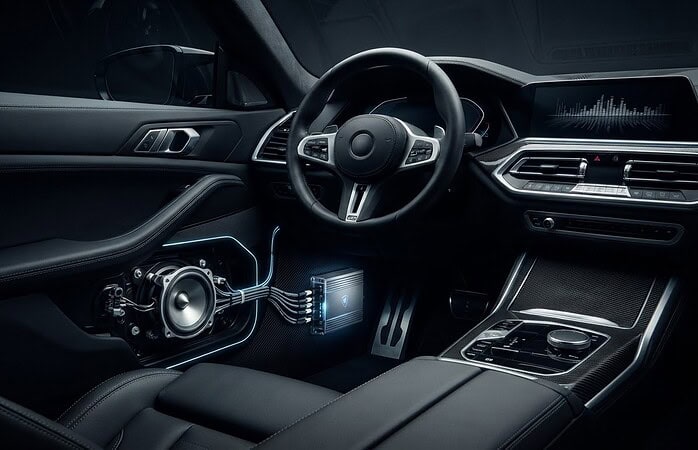
You didn’t buy a Polaris RZR to sit in silence, but you also didn’t buy it just to listen to the constant roar of the engine and the whistle of the wind. Most riders simply accept that high-speed trails mean sacrificing their favorite music to the noise of the machine. We understand the frustration of cranking the volume to the limit only to hear distorted vocals and thin, muddy bass that can’t compete with your exhaust. It’s a common struggle, and for many, the fear of water damage or a dead battery keeps them from ever truly upgrading their experience.
Finding the right Polaris RZR audio upgrade kit is about more than just buying the loudest speakers you can find. It’s about building an ecosystem that balances high-output performance with rugged, marine-grade durability. We’ve spent years perfecting these installations to ensure your electronics survive the deepest mud holes and the most aggressive pressure washings. In this 2026 guide, we’ll show you how to achieve studio-quality sound that integrates seamlessly with your dash tech. We’ll cover everything from efficient amplification that protects your battery to the latest speaker configurations designed to cut through the trail noise, ensuring your next ride sounds as good as it feels.
Key Takeaways
- Learn why factory setups struggle in open-air environments and how to select gear that’s truly built for the trail.
- Explore the core components of a professional Polaris RZR audio upgrade kit, including high-efficiency Class D amplifiers and seamless dash integration.
- Determine which audio stage fits your riding style to ensure your music stays crystal clear at any speed.
- Discover how custom fabrication and electrical upgrades provide powerful bass while protecting your vehicle’s charging system.
- Find out why we prioritize professional tuning and installation to deliver a finished result that outlasts the ride.
Why Factory Polaris RZR Audio Falls Short on the Trail
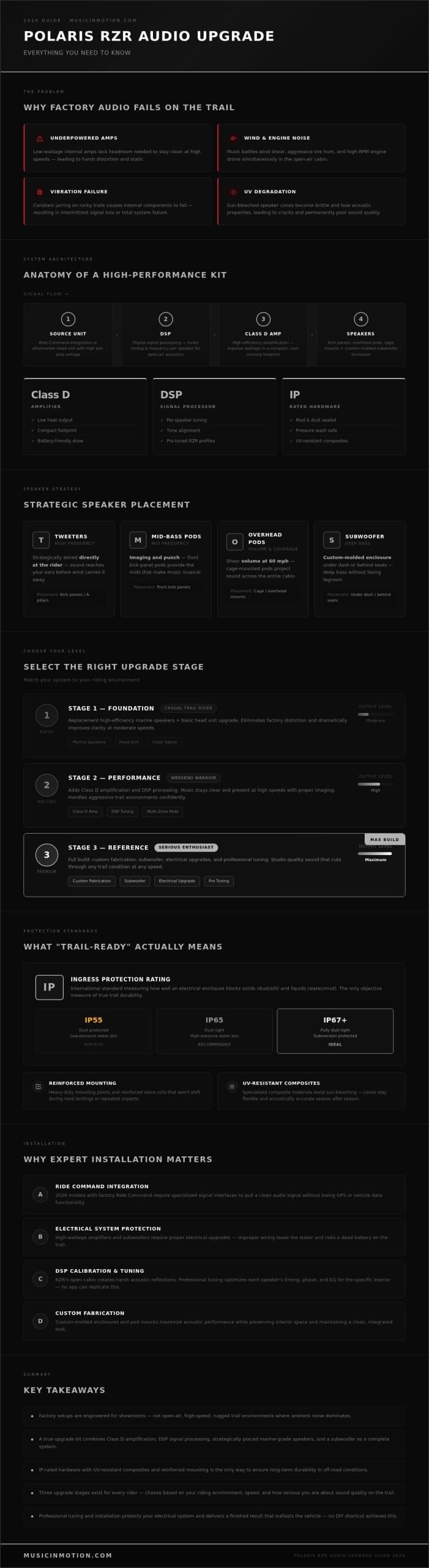
Most factory setups are built for a showroom, not the dunes. We’ve seen countless riders try to compensate for the mechanical roar of their machine by cranking the volume to the max, only to be met with harsh distortion and static. Standard vehicle audio systems simply aren’t engineered for the chaotic, open-air environment of a side-by-side. In a Polaris RZR, your music is constantly fighting against wind shear, aggressive tire hum, and the high-RPM drone of the engine. Factory head units typically feature low-wattage internal amps that lack the headroom needed to stay clean at high speeds. This is why a purpose-built Polaris RZR audio upgrade kit is the only way to achieve true clarity on the trail. Beyond power, factory units often lack the vibration resistance required for rugged terrain. Constant jarring on rocky trails can cause internal components in standard gear to fail, leading to intermittent signal loss or total system failure.
The Battle Against Ambient Noise
Simply turning up the dial won’t solve the clarity issue. When you push underpowered factory speakers, you lose the crisp highs and punchy mids that make music enjoyable. We focus on high-efficiency drivers that cut through ambient noise without straining your electrical system. Placement matters just as much as raw power. In an RZR cabin, high-frequency tweeters must be strategically positioned to fire directly toward the rider. This ensures the sound reaches your ears before the wind can carry it away. We don’t just want it loud; we want it sharp, balanced, and present even when you’re pinned in top gear. It’s the difference between hearing a noise and actually enjoying the song.
Durability Beyond the Splash
A “marine-rated” label is often just the beginning of what an off-road vehicle requires. While boat speakers handle light spray, your RZR faces thick mud, fine silt, and constant mechanical vibration that can shake standard electronics apart. We select hardware with reinforced mounting points and heavy-duty voice coils that won’t shift during a hard landing. UV exposure is another silent killer. Sun-bleached speaker cones quickly become brittle and lose their acoustic properties, leading to cracks and poor sound. A high-quality Polaris RZR audio upgrade kit uses specialized composites that resist both the sun and the pressure washer. To verify this protection, we always check the IP rating of our components. An IP (Ingress Protection) rating is an international standard that measures how effectively an electrical enclosure blocks out solids like dust and liquids like water.
Anatomy of a High-Performance RZR Audio Upgrade Kit
We view a Polaris RZR audio upgrade kit as a precision-engineered system where every component serves a specific purpose. It starts with the source unit. Many 2026 models come equipped with the Ride Command system, which offers excellent GPS and vehicle data but often lacks the pre-amp voltage needed for high-end sound. Integrating with this factory tech requires specialized interfaces to ensure a clean signal. For those seeking maximum control, an aftermarket head unit often provides better equalization and higher fidelity. If you’re planning to keep your factory dash intact, you can find more detail in our guide on car audio upgrade for stock stereo systems.
Once the signal leaves the source, it needs power. We rely on Class D amplifiers because they’re incredibly efficient and compact. In the tight confines of an RZR, traditional amps generate too much heat and pull too much current. Class D technology allows us to pack massive wattage into a small footprint without taxing your stator. From there, the sound travels to the speakers. Front kick-panel pods are excellent for mid-bass and imaging, while cage-mounted overhead pods provide the sheer volume needed to stay loud at 60 mph. Finding room for a subwoofer is the final piece of the puzzle. We often use custom-molded enclosures that tuck under the dash or behind the seats to deliver deep bass without sacrificing your legroom.
The Brain of the System: Signal Processing
Digital Signal Processing (DSP) is the secret to making an open-air cabin sound like a recording studio. An RZR has terrible acoustics; hard plastic surfaces and open sides create reflections and sound loss. A DSP allows us to tune the timing and frequency response of each speaker individually. Many of our pre-tuned kits come with these settings already optimized for the RZR’s unique interior. This ensures that the driver and passenger both experience a centered, clear soundstage despite the odd speaker placements.
Marine-Grade Amplification
Off-road amps face brutal conditions. We use hardware featuring conformal-coated circuit boards to prevent moisture from causing short circuits. Sealed heat sinks are also vital to keep dust and silt out of the internal components. A solid foundation for these systems starts with understanding electrical circuits and how they handle the high current demands of modern audio. We use high-quality, oxygen-free copper wiring harnesses to prevent signal interference and manage power draw. This prevents your lights from dimming when the bass hits. If you’re ready to see how these components fit your specific build, our team is here to help with custom installations tailored to your trail needs.
Selecting the Right Stage for Your Riding Environment
Choosing a Polaris RZR audio upgrade kit is a decision that should be based on your terrain as much as your musical taste. We categorize these upgrades into stages to help you find the balance between cost and performance. A Stage 1 or 2 setup is perfect for casual trail riding. It replaces weak factory speakers with high-efficiency drivers that offer a significant boost in clarity at low to moderate speeds. However, if you spend your weekends pinned in the dunes, these entry-level options might still get lost in the wind.
For high-speed environments, we recommend jumping to Stage 3 or 4. These kits introduce dedicated amplification and subwoofers to provide the “punch” needed to overcome wind shear and engine roar. If you want the absolute peak of performance, Stage 5 and 6 systems are the audiophile choice. These setups utilize multiple amplifiers and high-output speaker pods to create a massive wall of sound that stays crystal clear even when your machine is at its loudest. We believe in matching the gear to the machine’s modifications; if you’re running a loud aftermarket exhaust, you’ll need the extra headroom a higher stage provides.
Dunes vs. Deep Woods: Acoustic Differences
The acoustics of your favorite riding spot change how you hear your music. In the open desert, there are no trees or walls to reflect sound back to you. This means we have to prioritize high-frequency projection and raw power to ensure the audio reaches your ears. In contrast, wooded trails offer a more enclosed environment where sound can bounce off the surroundings. For these rides, we focus on a richer mid-bass response to create a full, warm soundstage that feels closer and more immersive. We tune these systems to account for your typical RPM range, ensuring the music remains the star of the show.
Mud and Water Protection Levels
If your RZR regularly sees deep water or thick mud, the physical design of the kit is non-negotiable. We look for fully sealed subwoofer enclosures that prevent silt and moisture from compromising the internal air space. Down-firing subwoofers are a smart choice for mud-heavy areas. Because the speaker faces the floor, gravity helps prevent mud from pooling on the cone. We also prefer speaker grilles that are easy to clean. A quick spray from the hose should be all it takes to clear the debris. To ensure these systems last, we adhere to the standards of the Mobile Electronics Certified Professional (MECP) program. This commitment to quality means your wiring and connections stay dry and secure through every season.
Beyond the Kit: Custom Fabrication and Electrical Stability
A high-quality Polaris RZR audio upgrade kit provides the essential hardware, but achieving a truly elite soundstage requires looking beyond the standard components. We often find that off-the-shelf plastic pods, while convenient, simply cannot match the acoustic performance of a custom-built solution. Generic enclosures tend to flex under heavy bass hits, which robs your music of its impact and clarity. By utilizing professional car audio fabrication techniques, we can create enclosures that are perfectly tuned to the specific air volume requirements of your subwoofers. This results in bass that is tight, punchy, and deep enough to be felt even through your seat and floorboards. We don’t just stop at the sound; we also integrate LED lighting into our custom pods to give your machine a unique, high-end look on the night rides.
Custom Subwoofer Enclosures for RZRs
In the tight confines of an RZR cabin, every cubic inch of air volume counts. We typically choose between sealed and ported enclosures based on your riding style and available space. Sealed boxes offer a smaller footprint and more accurate sound, making them ideal for technical trails where space is at a premium. Ported enclosures are larger and provide more raw output, which is perfect for dune riders who want to hear their bass over the wind. Custom pods allow us to angle the speakers precisely, ensuring the soundstage is focused directly on the driver’s ears rather than the floorboards. This level of precision is something a generic bolt-on kit rarely offers.
Power Management and Reliability
Your RZR’s factory electrical system wasn’t designed to power a 1000W+ audio system along with light bars and winches. A standard stator can quickly become overwhelmed, leading to a drained battery or even component failure. We recommend installing a high-output alternator or an upgraded stator to handle the increased current demand. A dual-battery setup is another essential upgrade for serious builds. By using a battery isolator, we ensure your audio system draws power from a secondary deep-cycle battery, leaving your starting battery fully charged and ready to turn the engine over. For systems with sudden, heavy bass hits, we also utilize capacitor banks to provide a quick burst of energy, preventing your lights from dimming and keeping your voltage stable. Protecting your investment is our priority, so we always use heavy-duty circuit protection and dedicated grounding points to prevent electrical noise. If you’re ready to build a system that outlasts the trail, explore our custom installations to see how we balance massive power with long-term reliability.
Professional Integration: Why Expert Installation Matters
We view every Polaris RZR audio upgrade kit as the foundation for a much larger experience. A box of high-end parts is just a start; the true value lies in the professional integration that turns those parts into a cohesive, reliable system. We prioritize the finished result over the simple transaction of goods, ensuring that your investment is protected by decades of specialized knowledge. Our team utilizes stealth installation techniques to keep your cab looking clean and uncluttered. We hide amplifiers and processors in secure, ventilated areas and route wiring through factory channels to maintain a factory-plus look. Every connection we make is weatherproofed and secured against the relentless vibration of off-road use. As a collaborative team of experts since 1994, we focus on the practical needs of the user while pushing the boundaries of what’s possible in a custom build.
Tuning for the Off-Road Environment
Out-of-the-box settings rarely translate well to the acoustic chaos of a side-by-side. We perform meticulous tuning to account for the specific speaker placements and cabin dimensions of your RZR. This includes setting precise gains and crossovers to ensure your speakers never reach the point of distortion or mechanical failure. Proper tuning allows your system to play louder and cleaner for longer periods without overheating. Once the installation is finished, we walk you through the controls. We explain how to manage your signal processing and source unit so you can easily transition from a quiet trail crawl to a high-speed desert run. Our goal is to make the technology feel simple and reliable, so you can focus on the trail ahead.
Safety and Convenience Integration
Your Polaris RZR audio upgrade kit shouldn’t exist in a vacuum. We often bridge the gap between entertainment and utility by integrating backup cameras, blind spot sensors, and high-definition dash cameras into your new display. These enhancements are featured in our vehicle safety systems roundup, highlighting how modern tech keeps you aware of your surroundings. We ensure these systems communicate perfectly with your RZR’s ECU to prevent any signal conflicts or electrical drain. By balancing technical precision with lifestyle-driven benefits, we provide a total coverage solution that enhances every aspect of your ride. The transition between your music and your safety tech is seamless, creating a narrative of total coverage for your vehicle. We remain a faithful partner in your vehicle’s evolution, ensuring every detail is in safe hands.
Ready to Redefine Your Next Ride?
Transforming your Polaris RZR into a high-performance concert hall on wheels requires more than just high-wattage components. It demands a balanced approach that pairs marine-grade hardware with professional tuning to overcome the relentless noise of the trail. We’ve explored how a dedicated Polaris RZR audio upgrade kit can cut through engine roar while standing up to mud, water, and vibration. From custom subwoofer enclosures that maximize bass impact to dual-battery systems that protect your vehicle’s starting power, every detail matters in a rugged environment.
Since 1994, we’ve focused on delivering a finished result rather than just a transaction. We are custom fabrication specialists who understand the unique electrical and acoustic needs of every Polaris RZR model. Our results-oriented approach ensures that your audio system is as reliable as the machine itself. Elevate your RZR experience with a professional audio upgrade from Music In Motion. We’re ready to help you build a system that makes every mile on the trail more memorable.
Frequently Asked Questions
Will a Polaris RZR audio upgrade kit void my factory warranty?
A professionally installed Polaris RZR audio upgrade kit does not automatically void your factory warranty. Under the Magnuson-Moss Warranty Act, a manufacturer cannot deny a warranty claim unless they can prove the aftermarket part directly caused the failure. We focus on non-invasive wiring and professional integration to ensure your vehicle’s systems remain safe and functional. Our goal is to work in harmony with your RZR’s existing electronics without compromising its reliability.
Can I integrate an aftermarket audio kit with my Polaris Ride Command system?
Integrating aftermarket gear with the Polaris Ride Command system is possible, but it requires specific adapters or interfaces. While some high-output kits from 2025 and 2026 are not compatible out of the box, we specialize in custom solutions that retain your factory screen and GPS functions. We use high-quality signal processors to take the output from your Ride Command unit and clean it up before sending it to more powerful amplifiers.
Do I need a second battery to run a high-powered RZR sound system?
If you are installing a high-powered system exceeding 1000 watts, we strongly recommend a second battery. High-output amplifiers pull significant current that can quickly drain your starting battery, especially when the engine is off. We use battery isolators to ensure your audio system draws from a dedicated deep-cycle battery. This setup protects your machine’s ability to start while allowing you to enjoy your music at the campsite without any worry.
What is the best speaker placement for a 2-seater vs. a 4-seater RZR?
In a 2-seater RZR, the best soundstage usually comes from a combination of front kick-panel pods and dash-mounted tweeters. For 4-seater models, we add cage-mounted rear pods to ensure the passengers have the same level of clarity as the driver. Correct placement is vital because open-air environments cause sound to dissipate quickly. We angle each speaker to fire directly toward the riders, which helps your music cut through the wind noise at high speeds.
How do I protect my RZR speakers when pressure washing my vehicle?
You should never spray water directly into the speaker grilles at close range, even with a high-quality Polaris RZR audio upgrade kit. While we use IP-rated, water-resistant hardware, the extreme pressure from a washer can force moisture past the seals. We recommend washing from a distance and using a soft cloth for the speaker faces. Ensuring your drain holes in the pods are clear will also help moisture escape if any gets inside during a ride.
Is a Stage 5 audio kit worth it if I mostly ride in the mud?
A Stage 5 kit provides the raw output needed to hear your music over the sound of tires churning through thick mud and heavy engine loads. However, the environment dictates the hardware choice. For mud riders, we prioritize fully sealed subwoofer enclosures and down-firing configurations. This prevents heavy debris from pooling on the speaker cones. The extra power of a Stage 5 system ensures your music remains clear even when you’re working the machine hard.
What is the difference between marine-grade and powersports-rated audio?
Marine-grade audio is primarily designed to resist salt air and light water spray, whereas powersports-rated gear is built for extreme vibration and mud. Powersports hardware features reinforced mounting points and sealed internal components that can handle the constant jarring of a rocky trail. We prioritize gear that carries both ratings to ensure your system survives both the rain and the rough terrain. This distinction is critical for long-term reliability in a modern side-by-side.
Can I add a subwoofer to my existing RZR factory audio setup?
You can absolutely add a subwoofer to a factory RZR setup by adding a dedicated amplifier. Most factory head units don’t have enough power to drive a sub on their own, so we use a line-output converter to tap into the existing speaker signal. We then install a custom subwoofer enclosure designed to fit the RZR’s floorboard or under-dash area. This is a common first step for riders who want more depth.