You spent hours selecting the perfect subwoofer and amplifier, but the moment the beat drops, your vehicle sounds more like a vibrating toolbox than a high-end audio machine. It is a common frustration for many enthusiasts; that embarrassing tin can rattle outside the car often drowns out the very clarity you worked so hard to achieve. We understand that you want to feel the music, not listen to your trunk lid and license plate fight for their lives against the pressure.
We believe that high-performance audio should be heard with absolute precision. In this professional guide, we will teach you exactly how to eliminate bass rattle in car trunk spaces using a systematic, multi-layer approach. You will learn how to identify hidden resonance points and apply specialized dampening materials to stop vibrations at the source. We are going to walk you through the professional techniques needed to secure loose trim and stabilize your trunk, ensuring your bass sounds clean, powerful, and completely distortion-free every time you turn the dial.
Key Takeaways
- Identify the critical difference between sheet metal resonance and mechanical noise to ensure you apply the right fix to the right problem.
- Master the professional multi-layer approach by using Constrained Layer Damping to stop metal flex and Closed Cell Foam to decouple vibrating panels.
- Discover exactly how to eliminate bass rattle in car trunk areas by securing high-vibration culprits like license plates, lock cylinders, and interior trim.
- Learn how custom subwoofer enclosures and strategic bracing prevent energy loss, keeping the vibration inside the box and out of your body panels.
- Understand when to transition from DIY fixes to professional integration to achieve a finished, studio-quality result that protects your vehicle.
Understanding Why Your Trunk Rattles: Resonance vs. Mechanical Noise
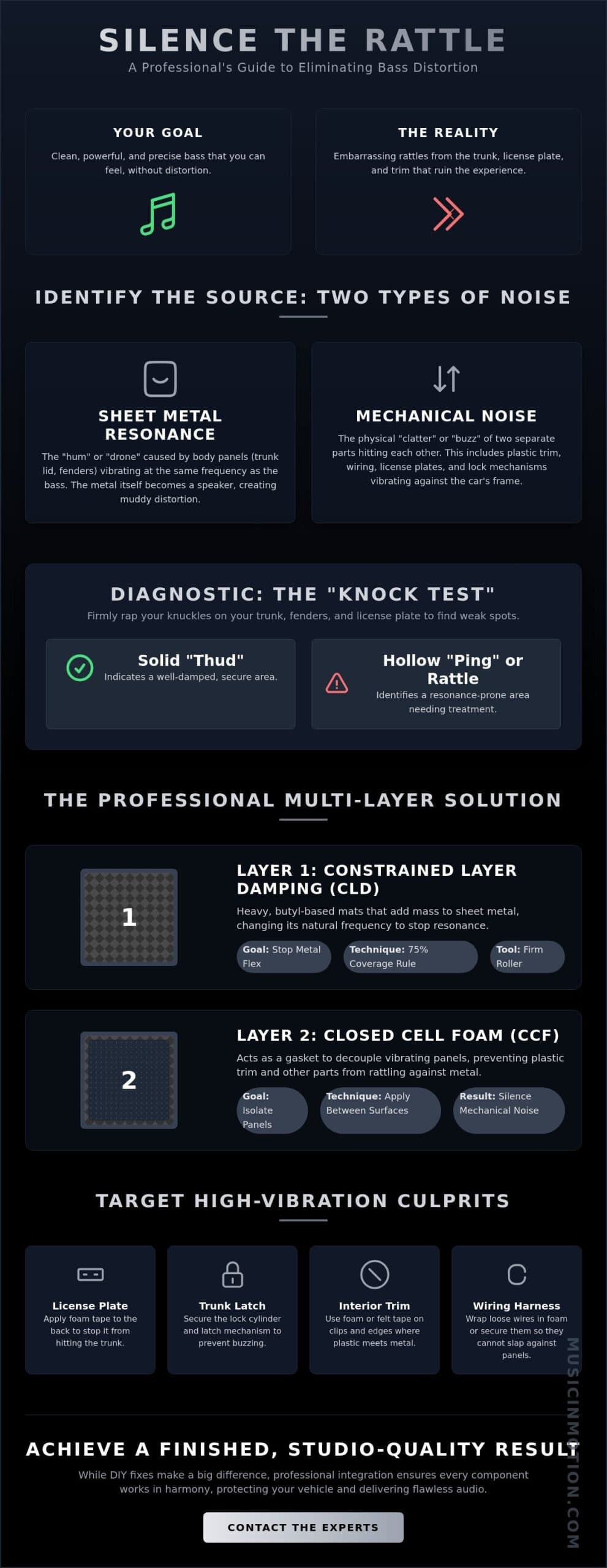
When we install a powerful subwoofer, we aren’t just adding sound to a vehicle. We are introducing a significant amount of kinetic energy into a space originally designed for groceries and spare tires. To learn how to eliminate bass rattle in car trunk areas, you first have to understand the two distinct enemies of clean audio: resonance and mechanical impact. These are two different physical problems that require two different professional solutions.
Resonance occurs when the sheet metal of your trunk lid or quarter panels begins to “sing” along with the music. Every material has a natural frequency where it vibrates most. When your subwoofer hits that specific note, the metal acts like a secondary speaker, creating a muddy, humming distortion. Mechanical noise is different. This is the physical clatter of two surfaces hitting each other, such as a plastic trim piece vibrating against the metal frame or a loose wiring harness slapping against the trunk floor.
We recommend the “Knock Test” as your first diagnostic step. Walk around your vehicle and firmly rap your knuckles against the trunk lid, the rear fenders, and the license plate. A solid, dead “thud” indicates a well-damped area. A hollow, metallic “ping” or a distinct rattle identifies exactly where the structure is weak. This test often reveals why factory insulation is never enough. Manufacturers build cars to block out road noise, but they don’t prepare them for the extreme internal pressure of a high-performance audio upgrade.
The Role of Sound Pressure Levels (SPL)
High-output subwoofers generate intense Sound Pressure Levels, or SPL. These pressure waves physically move the air inside your trunk, creating a “flex” effect where the sheet metal actually bows outward. Low-frequency notes carry massive amounts of energy and stay in the air longer than high notes. This is why they are so effective at finding every loose bolt or weak weld. By applying automotive soundproofing principles, we can stabilize these panels and force that energy back into the cabin. This ensures your bass sounds powerful rather than just loud and messy.
Sympathetic Vibrations in Vehicle Trim
Your car is held together by hundreds of small plastic clips, screws, and metal fasteners. When the bass hits, these components often experience sympathetic vibrations. They start moving because of the energy in the air, even if they aren’t near the speaker itself. This creates a chaotic environment where plastic clips buzz and harnesses click. If your car is constantly fighting your speakers, you lose the impact and clarity of your music. We focus on stopping these small culprits because louder is never better if the result is a symphony of plastic-on-metal noise. Total control over these vibrations is the key to a professional-grade listening experience.
The Professional Multi-Layer Approach to Sound Deadening
Stopping trunk rattle isn’t about covering every square inch of metal in silver tape. We approach sound deadening as a three-stage battle against resonance, impact, and airborne noise. If you only apply one type of material, you are only solving a third of the problem. Understanding the physics of sound is the first step, but the second step is knowing how to eliminate bass rattle in car trunk environments through a strategic, multi-layer application. We use specific materials for specific tasks to ensure your music stays inside the car and the rattles stay out.
Applying Butyl-Based Damping Mats
The first layer in any professional build is Constrained Layer Damping (CLD). These are the heavy, butyl-based mats that add mass to your trunk’s sheet metal. To get the best results, we always start by cleaning the surface with isopropyl alcohol to remove factory oils and dust. Adhesion is everything. Once the surface is prepped, we apply the matting and use a wooden roller to press it firmly into every contour. You must eliminate all air pockets for the material to work effectively. We often follow the “75% rule” for resonance control. You don’t always need 100% coverage to stop a panel from ringing; covering the center of a flat metal span is often enough to change its natural frequency and kill the vibration. Our team specializes in these custom installations to ensure your vehicle remains as quiet as a luxury sedan while the bass hits like a concert hall.
Decoupling with Foam and Liners
The second layer is all about decoupling. This is where we use Closed Cell Foam (CCF) to act as a gasket between two hard surfaces. If your plastic trunk trim is hitting the metal frame, a butyl mat won’t stop the clicking noise. You need a soft barrier to separate them. This is a vital part of how to eliminate bass rattle in car trunk setups because it stops the “buzz” that occurs when the trunk lid liner vibrates against the frame. We also apply these liners to the spare tire well and the rear deck. By understanding how sound deadening materials work, we can strategically place foam in high-stress areas like wheel wells to block road noise and mechanical chatter simultaneously.
The final professional touch is the addition of Mass Loaded Vinyl (MLV). While CLD stops vibration and CCF stops impact, MLV is a dense, flexible barrier that blocks airborne sound waves from escaping the trunk. We treat the trunk lid and the floorboards with this combination to create a sealed acoustic environment. This multi-layer system transforms your trunk into a solid, inert enclosure that allows your subwoofers to perform at their absolute peak without any distracting vehicle noise.
Silencing the Small Culprits: License Plates, Latches, and Trim
Even with heavy-duty matting applied to your trunk panels, your vehicle can still emit a distracting “tin can” buzz if you ignore the small hardware. These minor components are often the final hurdle in learning how to eliminate bass rattle in car trunk spaces. While the large metal surfaces create a low-frequency hum, it is the small plastic and metal parts that produce the sharp, high-frequency clicks that ruin your audio clarity. We focus on these fine details to ensure the exterior of your car sounds as solid as the interior.
License Plate Vibration Solutions
The license plate is the most notorious source of external noise. Because it is only secured by two or four bolts, the thin metal plate acts like a reed in a wind instrument when the bass hits. Many DIY guides suggest jamming a rag or a piece of cardboard behind the plate. We advise against this; these “hacks” trap moisture against your paint and eventually fail. We prefer a permanent, professional approach. We use high-quality silicone frames or adhesive foam gaskets to create a soft barrier between the plate and the trunk lid. If your vehicle only has two mounting holes at the top, we add rubber bumpers to the bottom corners to prevent the plate from flapping against the vehicle body.
Managing Internal Trunk Hardware
Inside the trunk, several mechanical parts can become noise generators under high pressure. The trunk latch and lock cylinder often have enough “play” to rattle during heavy bass tracks. We can frequently tighten these tolerances or apply a small amount of specialized lubricant to dampen the movement without affecting the safety of the mechanism. Another hidden culprit is the pair of torsion springs or tension bars that hold the trunk lid open. These long metal rods often vibrate against each other. We solve this by sliding a length of rubber tubing or foam over one of the bars to act as a buffer, effectively killing the metal-on-metal clatter.
We also pay close attention to the rear deck, also known as the parcel shelf. This area sits directly in the path of your subwoofer’s energy and is prone to bouncing. We secure loose factory wiring harnesses with Tesa tape or zip ties to prevent them from slapping against the underside of the deck. By applying thin strips of foam where the shelf meets the rear window, we stop the plastic-on-glass chatter. This level of detail is essential for anyone researching how to eliminate bass rattle in car trunk environments because it addresses the noises that are most audible from the driver’s seat. Treating these small hardware pieces is the difference between a loud car and a high-fidelity mobile audio system.
Custom Fabrication for Zero-Noise Bass
While sound deadening mats and foam treatments are critical, the foundation of your audio system is often the source of the most stubborn vibrations. If you want to know how to eliminate bass rattle in car trunk spaces, you have to look at the enclosure itself. A flimsy or poorly secured box acts like a drum, vibrating against the trunk floor and wasting energy that should be reaching your ears. We focus on building a stable environment where the subwoofer can perform without turning your vehicle into a rattling mess.
The Advantage of Custom Subwoofer Boxes
A custom subwoofer enclosure is a game-changer for noise control. Generic, pre-fabricated boxes are often built with thin, low-grade materials that flex under the intense pressure of high-output bass. This wall flex creates its own mechanical noise and significantly reduces the impact of the sound. We design custom solutions that direct bass energy forward into the cabin rather than letting it bounce uselessly around the trunk cavity. By integrating the enclosure into the vehicle’s structure, we ensure a rattle-free fit that stays silent even at high volumes. Whether you prefer a sealed box for tight accuracy or a ported design for maximum volume, the enclosure must be strong enough to handle internal air pressure without bowing.
Advanced Fabrication Techniques
We use high-performance car audio fabrication techniques to reinforce the entire system. Internal bracing is a vital part of this process; it prevents the enclosure walls from becoming secondary radiators of noise. We also decouple the box from the vehicle floor using rubber feet or specialized mounting brackets. This prevents the “walking” effect where a heavy subwoofer moves across the trunk, tugging on wiring and creating thumps. Beauty panels are another professional secret. They aren’t just for show; they provide extra structural integrity by securing loose interior trim pieces that would otherwise buzz against the box. This comprehensive approach is the best way to learn how to eliminate bass rattle in car trunk setups permanently.
We believe in delivering a finished result that improves your daily drive. If you are tired of the vibration and ready for clean, powerful sound, contact us to start your custom installation today.
Professional Integration: Taking Sound Beyond the DIY Level
There is a point in every audio project where the law of diminishing returns begins to take effect. You can apply layers of matting and secure every bolt you see, but some vibrations remain elusive. Learning how to eliminate bass rattle in car trunk environments often leads enthusiasts to a crossroad between DIY effort and professional precision. While basic dampening solves the obvious clatter, true acoustic perfection requires tools and techniques that go beyond the reach of a standard garage toolkit. We believe in providing a finished result that prioritizes your daily driving experience over the mere transaction of equipment.
Our team uses advanced diagnostic tools like Real-Time Analyzers (RTA) and oscilloscopes to see what the human ear might miss. These devices identify the exact frequencies where your vehicle’s specific panels reach their breaking point. Instead of guessing where to add more weight, we use data to apply surgical fixes. This scientific approach ensures your vehicle remains lightweight and efficient while maintaining a vault-like silence. We treat your property with the same care we would our own, ensuring that every modification respects the structural integrity and safety systems of the car.
The Value of Expert Tuning
One of the most effective ways to stop a rattle is to prevent the frequency from ever reaching the panel. Through professional car audio tuning, we use Digital Signal Processors (DSP) to “notch out” or reduce the specific notes that trigger vehicle resonance. This doesn’t mean losing your bass; it means refining it. We balance the output so the energy stays focused on the music rather than the trunk lid. This level of integration transforms the internal experience for the driver, creating a soundstage that feels expansive and clean. It is about harmony between the hardware and the vehicle’s cabin.
Next Steps for Your Audio Journey
If you have reached the limit of what home fixes can achieve, it might be time to consult a professional car audio specialist. We can help you plan a comprehensive upgrade that addresses everything from power delivery to final acoustic treatments. Before you consider your project complete, use this final rattle-free checklist:
- Verify that the license plate is secured with a silicone frame or foam backing.
- Check that all internal wiring harnesses are wrapped in Tesa tape.
- Confirm the subwoofer enclosure is physically bolted or mounted to the floor.
- Test the system with a frequency sweep to identify any remaining “sympathetic” vibrations.
We invite you to reach out for a custom consultation. Whether you are starting a complex custom build or simply want to know how to eliminate bass rattle in car trunk setups once and for all, we are here to help. Our goal is to ensure you spend less time chasing noises and more time enjoying the music. Let us help you find the perfect balance of power, clarity, and reliability for your vehicle.
Elevate Your Mobile Audio Experience
A truly high-performance system is about more than just raw power; it’s about the precision and clarity that only a rattle-free environment can provide. By distinguishing between panel resonance and mechanical noise, you can apply the strategic multi-layer damping and custom fabrication techniques needed to transform your vehicle’s trunk into a solid acoustic chamber. Once you master how to eliminate bass rattle in car trunk areas, you stop hearing the vehicle and start feeling the music exactly as the artist intended. This transition from a “tin can” buzz to a studio-quality soundstage is the ultimate reward for your efforts.
At Music In Motion, we have been dedicated to this craft since 1994. Our team specializes in custom fabrication and professional integration for cars, boats, and powersports. We focus on delivering a finished result that enhances your daily life behind the wheel. Ready for a rattle-free ride? Contact Music In Motion for a custom audio consultation today. We are here to help you push the boundaries of customization while ensuring the reliability and safety of your vehicle. Let’s build something incredible together.
Frequently Asked Questions
Will sound deadening make my car much heavier?
Modern sound deadening materials are designed to be highly efficient without adding excessive weight to your vehicle. A comprehensive trunk treatment typically adds between 15 and 30 pounds of material. This is roughly equivalent to the weight of a few gallons of gasoline; you won’t notice any measurable impact on your fuel economy or vehicle acceleration.
Do I need to cover 100% of the trunk in matting to stop rattles?
You don’t need total coverage to achieve professional results. We generally follow the 75% rule because resonance control is about changing the natural frequency of a panel. Focusing on the center of flat, ringing metal spans is often enough to kill vibrations. Over-applying material adds unnecessary weight and cost without providing a proportional benefit in sound quality.
What is the best material to stop license plate rattle?
Silicone frames or adhesive foam gaskets are the most effective materials for this task. These solutions create a soft, durable barrier between the metal plate and the vehicle body. Unlike DIY fixes like rags or cardboard, silicone won’t trap moisture or degrade over time. It provides a clean, finished look while permanently stopping that external buzz.
Can I use spray-on sound deadener instead of mats?
Spray-on deadeners are useful for specific applications but they aren’t a direct replacement for high-quality mats. We use sprays for hard-to-reach crevices and complex geometries like wheel wells. However, these liquids lack the mass of a constrained layer damping mat. For the large, flat panels in your trunk, butyl-based mats remain the gold standard for stopping resonance.
Why does my trunk rattle more with the windows down?
Lowering your windows changes the air pressure dynamics inside the cabin. When the windows are closed, the air acts like a cushion that provides a small amount of resistance to the subwoofer cone. With the windows down, that resistance drops; this allows the subwoofer to move more air and exert more physical force on your trunk panels and trim.
How much does it cost to professionally soundproof a trunk?
The total investment depends on the size of the vehicle and the depth of the multi-layer treatment required. While DIY material kits have a specific price range, professional installation covers the labor of removing interior trim and addressing hidden mechanical rattles. We recommend a custom consultation to evaluate your vehicle’s specific needs and provide an accurate scope of work.
Will sound deadening improve the sound of my speakers too?
Yes, sound deadening significantly improves the performance of your entire audio system. By lowering the noise floor and stopping panel resonance, your speakers don’t have to compete with vibrating metal. This is a vital part of how to eliminate bass rattle in car trunk spaces because it allows for much better mid-range clarity and overall musical detail.
Is it possible to stop all rattles in an older car?
It is absolutely possible to make an older vehicle feel as solid as a brand-new luxury car. Older vehicles often have thinner sheet metal and plastic clips that have lost their tension over time. We can replace those worn fasteners and apply modern dampening materials to eliminate even the most stubborn rattles. It is one of the most rewarding upgrades for any classic or high-mileage vehicle.