Imagine finally hitting the road after a major audio upgrade, only to hear a high-pitched squeal that rises and falls with your engine’s RPMs. It’s a gut-wrenching moment that makes a high-end system feel frustratingly cheap. We’ve seen many enthusiasts lose sleep over this noise, fearing they’ve damaged their new components or simply feeling lost in a sea of conflicting online advice. Troubleshooting alternator whine in car audio doesn’t have to be a guessing game of parts swapping and crossed fingers. It’s a technical challenge with a logical, repeatable solution.
We believe you deserve a listening experience that’s as clean and powerful as the equipment you’ve installed. This guide provides a professional framework to help you master the systematic process of identifying and eliminating annoying engine interference once and for all. We’ll show you how to trace the root cause of electrical potential differences and ensure your wiring integrity is beyond reproach. From checking ground loops to isolating signal paths, we are going to help you achieve that elusive, dead-silent audio floor and restore your confidence in your custom build.
Key Takeaways
- We’ll explain how alternator whine is actually AC ripple bleeding into your DC system so you can address the physics of the problem.
- Master our five-step isolation protocol for troubleshooting alternator whine in car audio to pinpoint the noise source without buying unnecessary hardware.
- Learn why we prioritize mechanical solutions, like sanding chassis grounds to bare metal, over electronic filters to preserve your system’s audio fidelity.
- Distinguish between ground loops and electromagnetic interference so you can apply the right solution for your specific vehicle’s needs.
- Understand how professional-grade wiring and custom fabrication integrate noise rejection at the design level for a truly silent foundation.
What is Alternator Whine and Why Does It Happen in 2026 Vehicles?
You’ve carefully selected every component of your sound system, from the amplifier to the custom enclosures. Then you start the engine, and a piercing, high-pitched squeal cuts through your favorite track. It feels like your premium investment has been downgraded to a budget setup instantly. We understand that frustration. Troubleshooting alternator whine in car audio is one of the most common requests we handle, and it usually starts with understanding that this noise is a parasitic signal, not a hardware failure.
At its core, alternator whine is caused by electrical interference. While your car’s battery provides Direct Current (DC), the alternator actually produces Alternating Current (AC). A set of diodes inside the alternator converts this to DC, but the process isn’t perfect. Small amounts of “AC ripple” can bleed into the vehicle’s electrical system. Understanding How an Alternator Works helps explain why this ripple becomes audible. In a high-performance environment, your audio system is designed to be highly sensitive. It picks up this tiny electrical variation and amplifies it just like it would a musical note.
The Symptoms: How to Identify True Alternator Whine
True alternator whine has a very specific “voice.” The most obvious sign is that the pitch of the noise mimics your engine. When you accelerate, the squeal gets higher and faster. This is different from the constant white noise or “hiss” you might hear from a poorly tuned amplifier gain. Another hallmark of this issue is that the noise often stays at the same volume even if you turn your head unit down to zero. Since the interference is often introduced in the signal cables or at the amplifier, the volume knob on your dash won’t stop it.
Why 2026 Vehicle Electronics Make Noise More Common
Modern vehicles are more complex than ever. The 2026 models we see in our shop are packed with CAN bus systems, high-current electric power steering, and sophisticated stop-start technology. These systems create a dense environment of electromagnetic activity. While Digital Signal Processors (DSPs) have revolutionized how we tune for sound quality, they can also act as double-edged swords. A DSP is incredibly powerful at shaping sound, but if the input signal has even a tiny bit of noise, the processor can inadvertently amplify that floor noise during the equalization process. This makes precise integration and proper grounding more critical today than it was a decade ago.
The Systematic 5-Step Isolation Protocol
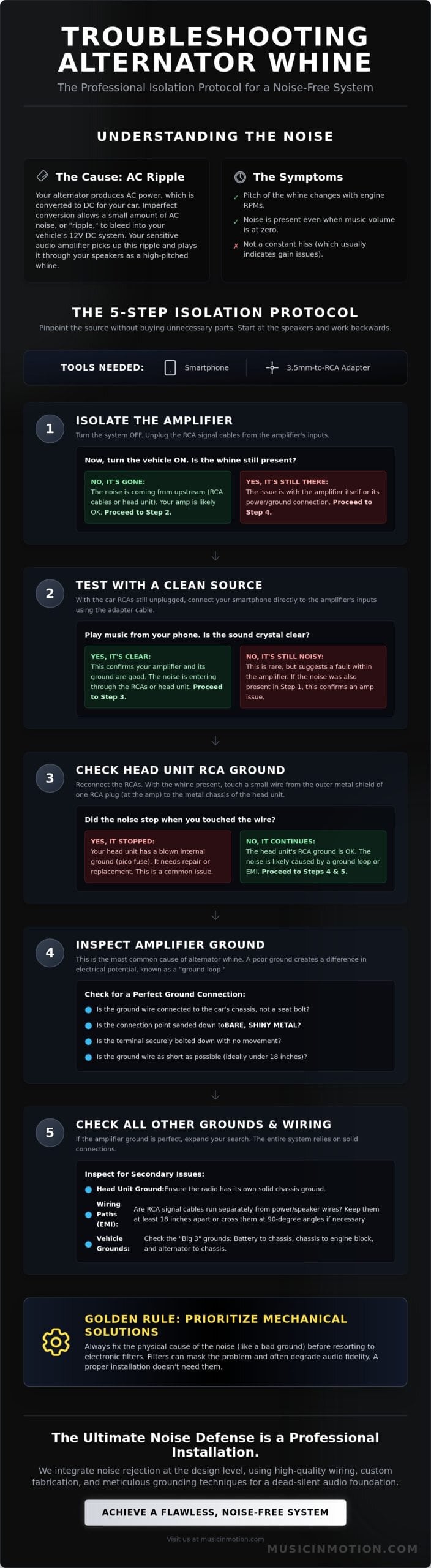
We don’t believe in guessing. While many online communities suggest buying filters immediately, this often masks the symptom rather than solving the underlying electrical causes of alternator noise. Throwing parts at a problem is expensive and rarely provides a permanent fix. Instead, our team uses a professional “Isolation Method” to pinpoint the exact failure point. This systematic approach saves you money and ensures you only replace what’s actually broken. To succeed in troubleshooting alternator whine in car audio, you must follow one simple rule: Start at the speakers and work back to the source.
Before you begin, gather two simple tools. You’ll need a smartphone and a 3.5mm-to-RCA adapter cable. If your phone doesn’t have a headphone jack, make sure you have the appropriate Lightning or USB-C dongle. These tools allow you to provide a clean, isolated audio signal that bypasses your vehicle’s head unit and RCA runs entirely.
Step 1 & 2: Testing the Amplifier and RCA Cables
Start by unplugging the RCA cables from your amplifier while the system is off. Turn the vehicle on and check for the whine. If the noise is still there with the RCAs disconnected, the issue is internal to the amplifier or related to its power ground. If the noise disappears, plug your smartphone directly into the amplifier’s RCA inputs using your adapter. Play some music. If the sound is crystal clear, you’ve just proven your amplifier and its ground are healthy. The noise is entering the signal path further “upstream” in the RCA cables or the head unit itself.
Step 3, 4 & 5: Checking the Head Unit and Ground Integrity
If the amplifier test was clean, it’s time to inspect the head unit. Some high-end head units are notorious for “blown” RCA ground traces, which happen if an RCA is unplugged while the system is powered. You can test this by temporarily touching a small wire from the outer shield of the RCA plug to the metal chassis of the radio. If the noise stops, the head unit needs repair.
Next, we look at the “Big Three” electrical connections. For high-performance Car Audio Upgrades, the factory wiring often can’t handle the current demand. We check the battery-to-chassis, engine-to-chassis, and alternator-to-battery cables for corrosion or loose fitment. Finally, ensure your power cables and signal RCAs aren’t running side-by-side for long distances. If they must cross, do so at a 90-degree angle to minimize electromagnetic transfer. This simple physical separation often solves the most stubborn interference issues.
Common Culprits: Ground Loops vs. Electromagnetic Interference (EMI)
“Noise” is a broad term that installers use to describe several distinct electrical headaches. When you’re troubleshooting alternator whine in car audio, you’re usually fighting one of two enemies: ground loops or electromagnetic interference (EMI). They sound similar, but their origins are completely different. A ground loop occurs when there’s a difference in electrical potential between two points in your system. For example, if your head unit is grounded to the factory harness in the dash and your amplifier is grounded to the trunk, they might not share the exact same voltage level. This difference forces current to flow through your RCA cables’ outer shields to “even out” the potential, which introduces that engine squeal directly into your music path.
EMI is a physical phenomenon where radiant energy from your vehicle’s high-current wiring is physically picked up by your audio cables. Think of your RCA cables as tiny antennas. If they are tucked too close to the fuel pump wiring or a high-output alternator lead, they will absorb the magnetic field generated by those wires. To combat both issues, we often recommend “star grounding.” This is a professional technique where every component in the system is grounded to a single, high-conductivity point on the chassis. It ensures every piece of equipment sees the same voltage and eliminates the common path for loop-based noise.
The “Pioneer Problem” and Blown RCA Fuses
One specific culprit we frequently encounter involves the internal circuitry of certain head units. Many units use tiny internal fuses, often called pico fuses, to protect the RCA ground path. If you “hot-plug” your RCAs, meaning you plug or unplug them while the system is powered, these fuses can pop instantly. Once blown, the RCA shield loses its ground connection, leading to a massive increase in noise. You can test for this by taking a short piece of wire and touching one end to the outer ring of the RCA plug and the other to the metal case of the radio. If the whine vanishes, you’ve found your problem. Don’t hot-plug your cables; it’s the fastest way to turn a silent system into a noisy one.
Cable Routing and Shielding Myths
How you run your wires matters just as much as the quality of the wires themselves. We follow the “90-degree rule” religiously. If a signal cable must cross a power wire, it should do so at a right angle rather than running parallel. Parallel wires act like a transformer, transferring noise through induction. When performing a car audio upgrade for stock stereo, this is especially vital because modern dashboards are already crowded with factory electronics. We also choose between twisted-pair RCAs, which use phase cancellation to reject noise, and shielded coaxial cables, which use a physical barrier. Neither is “better” in every case; the right choice depends on whether you’re fighting a ground loop or high-frequency EMI.
Proven Solutions to Eliminate Noise for Good
When we tackle noise issues, our priority is always a mechanical fix rather than an electronic band-aid. While many online forums suggest jumping straight to filters, these devices often degrade your audio fidelity by stripping out low-end frequencies and reducing signal clarity. Troubleshooting alternator whine in car audio requires a commitment to perfect conductivity. One of the most effective solutions is often the simplest: sanding your grounding point. We always sand the vehicle’s chassis down to bare, shiny metal before securing a ground terminal. Paint, primer, and rust are insulators that create resistance, and even a tiny amount of resistance can turn a ground point into a noise generator.
For systems with high power demands, a high output alternator for car audio plays a critical role in noise prevention. A factory alternator often struggles to maintain a consistent voltage floor when a high-performance amplifier starts pulling current. This fluctuation creates the very ripple effect we discussed earlier. By installing a high-output unit, you provide the system with the headroom it needs to stay stable. If you’ve tried every mechanical fix and still have a faint whine, a high-quality ground loop isolator can be a last resort. Look for units with high-quality isolation transformers that maintain a flat frequency response so you don’t lose the deep bass you’ve worked so hard to achieve.
Advanced Grounding: The Star Ground Method
We recommend the star grounding method for any multi-amplifier setup. Instead of grounding each amp to a different spot on the floor, run every ground wire to a single high-quality distribution block. This block then connects to the chassis with one large-gauge wire. This ensures every component shares an identical electrical potential, effectively killing ground loops before they start. It’s also vital to match your ground wire gauge to your power wire gauge. Using a smaller wire for the ground creates a bottleneck that forces noise back into the signal path.
Improving the Vehicle’s Electrical Foundation
The “Big Three” upgrade is the gold standard for stabilizing a vehicle’s electrical foundation. This involves upgrading three key cables: the battery negative to chassis, the engine block to chassis, and the alternator positive to the battery. These upgrades reduce the overall resistance of your car’s charging system. While a stiffening capacitor or a secondary battery can help with voltage drops during heavy bass hits, they aren’t magic erasers for alternator whine. They work best as part of a total system design rather than a standalone fix for noise. A stable voltage floor is the enemy of alternator whine. If you want a system that performs without compromise, let us help you design a Custom Installation that prioritizes electrical integrity from day one.
Why Professional Installation is the Ultimate Noise Defense
Troubleshooting alternator whine in car audio is a rewarding challenge for many enthusiasts, but there comes a point where the complexity of modern vehicles requires a specialized touch. While the isolation steps we’ve covered provide a logical path forward, the physical reality of today’s car interiors presents its own set of hurdles. Modern dashboards and trim panels are held together by intricate clips and hidden fasteners that are notoriously easy to break. A simple DIY attempt to reroute an RCA cable can quickly lead to permanent rattles or damaged factory components. We take the stress out of this process by delivering a finished result that is guaranteed to be silent, reliable, and aesthetically perfect.
Our approach to car audio fabrication involves more than just building custom enclosures. We design noise rejection into the system at the foundational level. By choosing a professional team, you aren’t just buying hardware; you’re investing in a philosophy that prioritizes the final experience over a simple transaction of goods. We focus on the tiny details, from precision wire tension to advanced heat management, ensuring your system performs without compromise. If your own diagnostic efforts haven’t yielded a clear culprit, it’s often because the issue is buried deep within the vehicle’s integrated electronics where only specialized tools can find it.
The Music In Motion Approach to Silent Systems
We don’t rely on guesswork or the “parts cannon” to solve electrical interference. Our shop utilizes advanced diagnostic tools like Oscilloscopes and Real-Time Analyzers (RTA) to visualize electrical noise that the human ear might miss until it’s already affecting sound quality. We also utilize premium integration harnesses that maintain the factory ground integrity of your vehicle’s complex CAN bus system. This expertise isn’t limited to standard cars. We bring the same dedication to universal applications, providing crystal-clear sound for marine audio, motorcycles, and powersports vehicles where electrical environments are even more hostile.
Next Steps: Get Your System Dialed In
If your isolation steps haven’t revealed a clear culprit, or if you simply want the peace of mind that comes with a master-level installation, we’re here to help. Our team understands how audio components interact with other vehicle safety systems, which often share the same electrical paths and grounding points. We can help you design a noise-free system from the ground up or perform a deep-dive diagnostic on a problematic existing setup. We take pride in our growth and evolution as specialists, but our focus remains on your daily experience behind the wheel.
Contact our team to schedule a professional diagnostic or upgrade and let us transform your vehicle into the silent, high-fidelity sanctuary it was meant to be.
Achieve the Silent Foundation Your Audio Deserves
Achieving a dead-silent audio floor is the hallmark of a truly high-performance system. We’ve explored how mechanical fixes like sanding grounds to bare metal and performing the “Big Three” upgrade provide a much stronger foundation than cheap electronic filters. By following our systematic isolation protocol, you can take the guesswork out of troubleshooting alternator whine in car audio and identify exactly where interference is entering your signal path.
Since 1994, we have served as custom fabrication specialists providing expert integration for cars, marine vessels, and powersports vehicles. Our team focuses on delivering a finished result that prioritizes long-term reliability over a simple transaction. Whether you’re battling a stubborn ground loop or planning a complex new build, we have the tools and experience to ensure your music is the only thing you hear.
Ready for a dead-silent, high-performance sound system? Contact Music In Motion today.
You now have the technical roadmap to move forward with confidence. We look forward to helping you get your system perfectly dialed in and hearing your music exactly as it was meant to be played.
Frequently Asked Questions
Why does my car audio whine only when I accelerate?
The pitch of the whine is directly tied to the alternator’s rotation speed. As engine RPMs increase, the frequency of the AC ripple generated by the alternator also increases, making the noise higher and more piercing. This is the classic signature of alternator whine. The parasitic signal fluctuates in perfect sync with your vehicle’s charging system output, which is why the sound mimics the engine’s revs.
Will a ground loop isolator reduce my sound quality?
Yes, many budget-friendly isolators can negatively impact audio fidelity. They often use small internal transformers that act as accidental high-pass filters, effectively stripping away the deep sub-bass frequencies and potentially introducing signal distortion. While they offer a quick fix, we prefer addressing the mechanical root cause. This ensures your high-performance system maintains its full dynamic range without compromising the low-end impact.
Can a bad alternator cause noise in my speakers?
A failing alternator is a common source of audio noise. If the internal diodes that convert AC to DC begin to leak, they allow significant “AC ripple” into the electrical system. Your audio components pick up this ripple and amplify it through the speakers. If troubleshooting alternator whine in car audio leads back to the charging system, you might need a high-output replacement to stabilize the voltage floor.
How do I know if my RCA cables are picking up engine noise?
You can test for RCA interference by temporarily running a spare set of cables outside the vehicle, draped over the seats from the head unit to the amplifier. If the noise vanishes when the cables are away from the vehicle’s internal wiring, your original RCAs are likely picking up electromagnetic interference. This usually happens when signal cables are routed too close to high-current power lines or fuel pump wiring.
Does a higher-quality amplifier prevent alternator whine?
Not necessarily, though premium amplifiers often have better internal noise rejection circuitry. Even the most expensive amplifier will produce noise if the input signal is already “dirty” or if the unit is improperly grounded to a painted chassis surface. A quality amplifier is a great investment, but proper installation and grounding remain the most critical factors for achieving a dead-silent system.
What is the “Big Three” upgrade and does it fix audio noise?
The “Big Three” involves upgrading the main charging cables: battery negative to chassis, engine block to chassis, and alternator positive to battery. By reducing the overall electrical resistance of your vehicle, you create a more stable voltage floor. This doesn’t always “fix” noise directly, but it provides the electrical headroom necessary for high-current systems to operate without introducing parasitic interference through the charging system.
Is it safe to drive my car if the speakers are whining?
It’s generally safe to drive, but the noise is a symptom of an electrical inefficiency that shouldn’t be ignored. While the whine itself won’t stop the car, it indicates that current is flowing where it shouldn’t, such as through your RCA shields. Over time, this constant electrical stress can lead to component failure, such as blown head unit fuses or damaged amplifier inputs, leading to more expensive repairs.
Can I fix alternator whine by just changing my spark plugs?
In rare cases, yes, if your vehicle requires resistor-type spark plugs and they’ve been replaced with non-resistor versions. Standard spark plugs can create “ignition noise,” which sounds like a rhythmic ticking rather than a smooth, high-pitched whine. If you hear a distinct “pop-pop-pop” that speeds up with the engine, checking your spark plugs and ignition wires is a smart diagnostic step to take.