You just installed a beautiful set of new components, you hit the open road, and you reach for the dial to really feel the music. Instead of a crisp, immersive experience, you’re met with a harsh crackle in the treble and a muddy thud where the bass should be. It’s a common frustration that makes many drivers fear they’ve already damaged their gear. Learning how to stop car speaker distortion at high volume isn’t about buying more expensive equipment; it’s about understanding how your system communicates. We’ve seen countless high-end setups held back by simple tuning errors that turn a premium ride into a noisy headache.
We understand that you want your audio to be loud, clear, and reliable. This guide reveals the professional secrets to eliminating that painful distortion while keeping your speakers safe from clipping. We’ll walk you through the critical difference between gain and volume, explain how to sync your components for maximum impact, and give you the confidence to push your system to its true limits. It’s time to explore the 2026 tuning techniques that transform a standard car stereo into a high-fidelity powerhouse.
Key Takeaways
- Start your tuning journey by neutralizing EQ and bass boost settings to provide your system with a clean, undistorted signal.
- Master the professional techniques for how to stop car speaker distortion at high volume by properly calibrating your gain structure from the head unit to the amplifier.
- Understand how your vehicle’s electrical health affects audio performance, as voltage drops are a primary cause of amplifier clipping.
- Upgrade beyond factory limitations with high-sensitivity materials and Digital Signal Processing (DSP) for a truly immersive, crystal-clear listening experience.
What Causes Car Speaker Distortion at High Volume?
At its simplest level, distortion is the unwanted alteration of the original audio signal. When you play a song, your speakers should move in a perfect mirror image of the electrical signal sent by your radio or amplifier. To understand the science behind the noise, we look at Total Harmonic Distortion (THD), which measures how much a system changes the original signal. When this percentage climbs too high, the audio loses its clarity and begins to sound fuzzy or harsh. We see this most often when a system is pushed beyond its intended design limits.
We generally categorize these issues into two types: mechanical and electrical. Mechanical distortion happens when the physical parts of the speaker, like the cone or the suspension, reach their physical limit and can’t move any further. Electrical distortion is more common and happens when the signal itself is corrupted. This usually involves three main culprits: a weak source unit, an improperly tuned amplifier, or a speaker that simply cannot handle the power being forced into it. If you want to know how to stop car speaker distortion at high volume, you must first identify which part of this chain is failing.
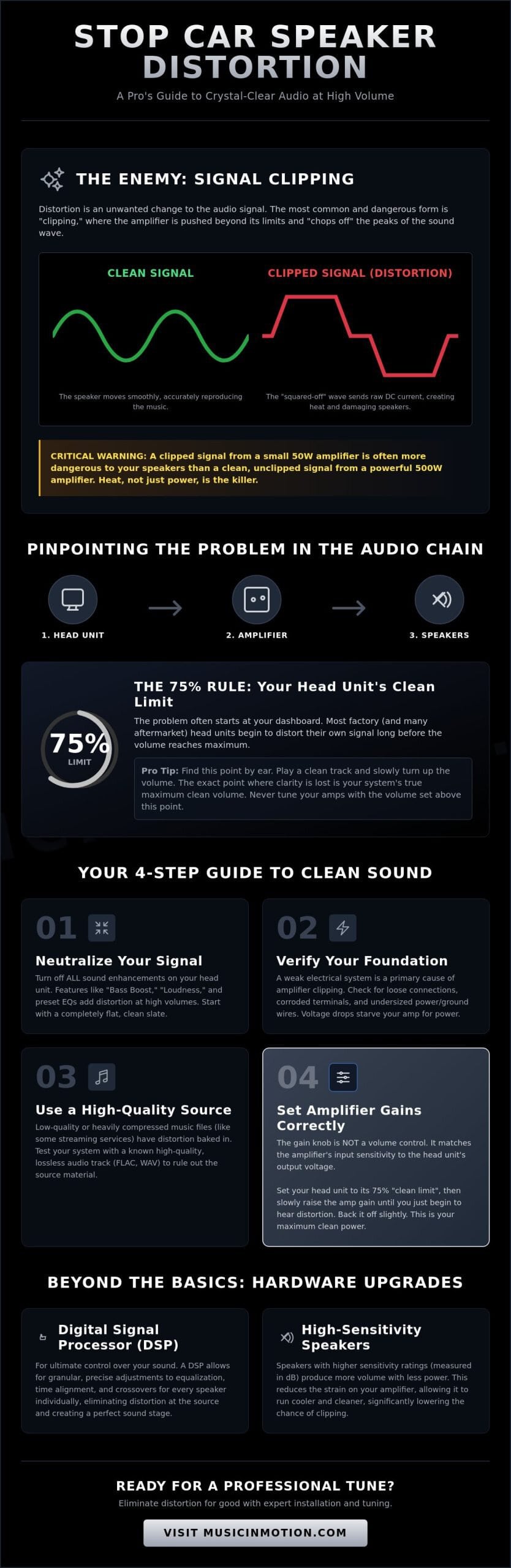
One of the easiest ways to visualize this is the “square wave” concept. A healthy audio signal looks like a smooth, rolling hill. When you push a system too hard, the top of that hill gets chopped off because the equipment lacks the power to complete the curve. This creates a flat, “square” plateau. Instead of a smooth musical note, your speaker receives a jagged burst of energy that sounds like static or popping.
The Danger of Audio Clipping
Clipping occurs when an amplifier attempts to deliver more voltage than its internal power supply can actually provide. When you see those “chopped off” peaks on a sound wave, you’re seeing a signal that has turned into pure heat. This heat is the primary enemy of your equipment. It quickly builds up in the delicate wire of the voice coil and can eventually melt the components entirely. This is why a “clipped” signal from a small amplifier is often more dangerous to your speakers than a clean signal from a much more powerful one.
Source Unit Limitation: The 75% Rule
Many drivers struggle with how to stop car speaker distortion at high volume because they don’t realize the problem starts at the dashboard. Most factory head units are built for basic functionality, not high-performance output. They often begin to distort their own signal long before the volume bar hits the maximum setting. We typically follow the 75% Rule during our custom installations. This means that if your radio volume goes to 40, the signal likely becomes “dirty” once you pass 30. You can find this point by ear; play a familiar track and slowly increase the volume. The moment the vocals lose their crispness or the bass becomes a flat thud, you have found the limit of your clean volume range.
Step-by-Step: How to Stop Speaker Distortion Today
Fixing audio issues requires a systematic approach. We always start by neutralizing the signal. This means turning off every “Bass Boost,” “Loudness,” or preset EQ setting on your head unit. These features are designed to make cheap speakers sound fuller at low volumes, but they become the primary common causes of speaker distortion once you crank the dial. They force your amplifier to try and reproduce frequencies it simply cannot handle. By starting with a flat EQ, you ensure that every component in the chain receives a clean, unadulterated signal. It’s the most effective first step for anyone learning how to stop car speaker distortion at high volume.
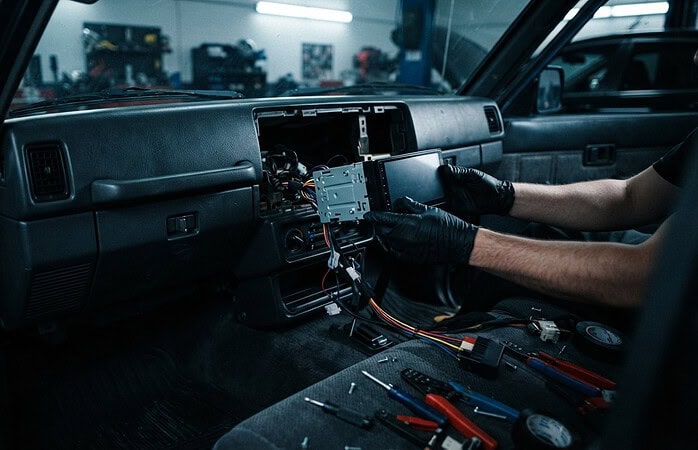
Once your settings are zeroed out, you must verify your wiring integrity. Loose connections or undersized power cables create resistance. This resistance causes voltage drops that trigger immediate clipping in your amplifier. We also recommend testing your system with high-quality, lossless audio files. Compressed streaming services often introduce digital artifacts that sound exactly like speaker failure. If your source material is poor, no amount of tuning will fix the grit you hear in the tweeters. We want to ensure that the music reaching your ears is exactly what the artist intended.
Setting Amplifier Gains Correctly
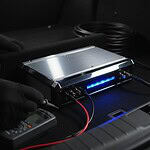
We cannot stress this enough: your amplifier’s gain knob is not a volume control. It is a sensitivity match. Its job is to align the amplifier’s input level with the output voltage of your radio. To set this by ear, turn your radio to about 75% of its maximum volume. Slowly increase the gain until you hear the music begin to “break up” or lose clarity. Back the knob off slightly until the sound is crystal clear again. While professionals use tools like an oscilloscope for precision, this ear method is a reliable starting point. Remember that “Bass Boost” is the number one cause of immediate system distortion; it’s best to leave it at zero and use your gain correctly instead.
Using Crossovers to Protect Your Speakers
Crossovers act as traffic cops for your audio frequencies. A High Pass Filter (HPF) is essential for door speakers because it blocks deep, sub-bass frequencies that small drivers cannot physically reproduce. For most 6.5-inch door speakers, we recommend a crossover point around 80Hz. This allows the speaker to focus on the mid-range and vocals where it excels. Conversely, a Low Pass Filter (LPF) ensures your subwoofers only handle the deep notes. By removing the “impossible” low notes from your smaller speakers, you allow them to play significantly louder without the cone over-extending. If your system still feels a bit thin after these adjustments, a professional Car Audio Upgrade can help you find the perfect balance between power and clarity.
The Role of Power: Why Your Electrical System Matters
We often see enthusiasts spend thousands on premium drivers only to be disappointed by the results. The truth is that your car audio system is an extension of your vehicle’s electrical grid. When you demand high output, your amplifier pulls massive amounts of current. If your electrical system cannot keep up, the voltage drops. This drop is a primary reason for how to stop car speaker distortion at high volume. Without steady power, the amplifier cannot maintain a clean signal, leading to immediate clipping and that dreaded fuzzy sound.
You might notice your headlights flickering in time with the kick drum. This is a clear warning sign. It means your amplifier is starving for energy and stealing it from other vehicle systems. This instability doesn’t just sound bad; it’s hard on your alternator and can eventually lead to component failure. To achieve truly crystal-clear audio, we have to look beyond the speakers and focus on the backbone of the system.
Voltage Stability and Sound Quality
Amplifiers are only as strong as the current they can pull. Most high-performance amps are designed to operate at 14.4 volts, which is the typical output of a healthy alternator while the engine is running. When that voltage dips below 12 volts during a heavy bass note, the amplifier’s internal power supply struggles. It tries to compensate by working harder, which generates heat and distortion. Using high-quality, Oxygen Free Copper (OFC) wiring is essential. Cheap, thin power cables have high internal resistance. They act like a kink in a garden hose, preventing the necessary current from reaching your gear. A steady signal keeps your music sounding tight and punchy.
When to Consider a High-Output Alternator
Modern vehicles are packed with electronics, from heated seats to complex safety sensors. This leaves very little leftover amperage for a high-powered sound system. Factory alternators are often built to handle the car’s stock needs with only a small margin for extra accessories. For those pushing extreme volume, high output alternators provide the necessary headroom to keep the music clear. We also frequently recommend the “Big Three” wiring upgrade. This involves replacing the factory wires between the alternator and battery, the battery and chassis, and the engine block and chassis with heavy-gauge cables. It is a foundational fix that ensures your system has a clear path for the power it needs to perform without distortion.
Hardware Upgrades: Moving Beyond Factory Limitations
Sometimes, even the most meticulous tuning cannot overcome the physical limitations of factory-installed equipment. Most standard vehicle speakers are constructed from lightweight paper and foam. While these materials are cost-effective for manufacturers, they lack the structural integrity to handle high-volume demands. Over time, heat and humidity cause these paper cones to warp or tear, leading to a permanent loss of clarity. If you want to know how to stop car speaker distortion at high volume once and for all, you must consider the materials inside your doors. Upgrading to speakers with synthetic cones, such as polypropylene, carbon fiber, or silk, provides the rigidity needed to move air without bending under pressure.
We also emphasize the importance of sensitivity ratings. If you’re keeping your stock head unit, you need speakers with a high sensitivity rating, typically 90dB or higher. These drivers are more efficient, meaning they can produce more sound with less power. However, simply buying “bigger” speakers isn’t always the answer. A high-wattage speaker paired with a weak factory radio will actually distort sooner because the radio has to work too hard to move the heavy cone. In many cases, adding a dedicated external amplifier is the most effective way to achieve clean, loud audio. It provides the necessary headroom to keep the signal pure even when you’re pushing the volume to its limit.
Component Speakers vs. Coaxial Designs
In a standard coaxial speaker, the tweeter is mounted directly in the center of the woofer. This is convenient for space, but it often leads to a muddled sound stage. Component sets separate these parts, allowing us to place the tweeter higher up in the cabin for better “on-axis” listening. These systems also include external crossovers that are far superior to the tiny capacitors found on factory speakers. This separation is a massive leap forward for anyone looking into a car audio upgrade for stock stereo systems. By isolating the high and low frequencies, each driver can operate within its ideal range without interference.
The Impact of Sound Deadening
We frequently find that what a customer perceives as speaker distortion is actually “panel rattle.” When a speaker moves, it creates vibrations that travel through the metal of your car door. These vibrations create a secondary noise that ruins the clarity of your music. Applying professional sound deadening material lowers the noise floor of your vehicle. This makes your music sound louder and clearer without needing to turn the volume up as high. Sound treatment also prevents the “back wave” of the speaker from reflecting off the outer door skin and canceling out your bass. If you’re ready to hear the difference that high-quality gear can make, our team is ready to help you plan your next Car Audio Upgrade.
Professional Integration: The Music In Motion Approach
We have covered the basics of gain settings and the necessity of a strong electrical backbone. However, the most advanced hardware in the world will still fail if it isn’t properly integrated into your vehicle’s specific acoustic environment. Modern factory infotainment systems are notoriously difficult to work with because they include permanent, pre-set equalization. These factory settings often “roll off” the bass or spike the treble as you increase the volume to protect cheap paper speakers. To truly master how to stop car speaker distortion at high volume, we must use professional tools to strip away these factory limitations and reclaim control of the audio signal.
Our team focuses on the total outcome rather than just the individual components. We utilize Real Time Analysis (RTA) microphones to visualize the sound waves inside your cabin. This allows us to identify exactly which frequencies are clashing with your interior materials. By using data-driven calibration, we can eliminate the “muddy” or “harsh” characteristics that many users mistake for speaker failure. This professional approach ensures that your system remains stable and clear, providing the longevity you expect from a high-end installation.
Why a DSP is a Game Changer
A Digital Signal Processor (DSP) is the brain of a modern high-performance system. It allows us to “flatten” the signal coming from your factory radio, removing the manufacturer’s protective EQ curves. Once we have a clean slate, we use precise 31-band equalization to surgically remove harsh peaks that cause perceived distortion. We also implement time alignment, which delays the sound from the speakers closest to you by a few milliseconds. This ensures the music from every driver hits your ears simultaneously. It creates a vivid, centered soundstage that makes your dashboard feel like a live concert front row.
Custom Fabrication for Sound Stage
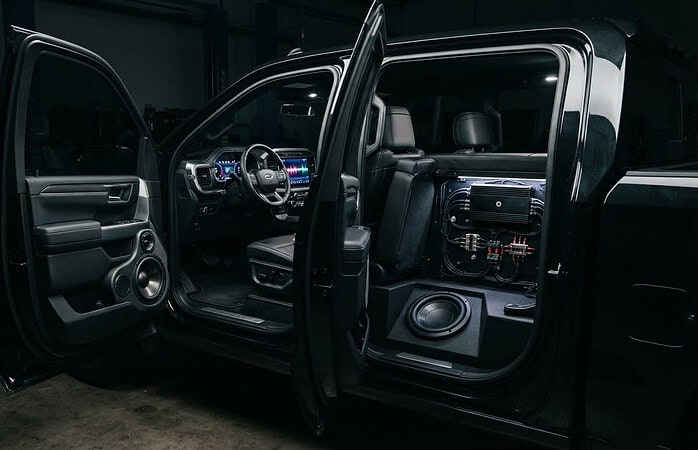
Speaker placement is often the final hurdle in the fight against distortion. Factory locations are usually chosen for manufacturing ease, not for sound quality. Our specialized car audio fabrication allows us to create the perfect acoustic environment within any vehicle. We often build custom A-pillars or kick panels to house tweeters and mid-range drivers in an “on-axis” position. This means the sound travels directly to your ears rather than bouncing off the windshield or getting lost in the floor mats. This direct path reduces the amount of power needed to achieve high volume, which in turn keeps the signal clean and distortion-free. We believe a system is only as good as its weakest link and its final tune.
Take Control of Your Soundstage
Achieving a high-fidelity listening environment requires more than just high-end components; it demands a balanced approach to the entire signal chain. We’ve explored how neutralizing your EQ settings and properly matching your amplifier gains provides the foundation for clarity. By addressing voltage stability and moving beyond factory material limitations, you now have the essential knowledge for how to stop car speaker distortion at high volume. Whether you’re cruising on the open road or the open water, your system should deliver emotion and impact without the interference of harsh, clipped signals.
Since 1994, we’ve specialized in high-performance marine and vehicle audio through expert custom fabrication. Our team utilizes professional RTA tuning and advanced DSP integration to ensure every note is perfectly aligned with your vehicle’s unique acoustics. We focus on delivering a finished result, ensuring your investment provides years of reliable, crystal-clear performance. Ready for crystal-clear sound? Contact Music In Motion for a professional audio consultation. We are excited to help you transform your daily drive into a premium listening experience.
Frequently Asked Questions
Can underpowering my speakers actually cause them to distort?
Yes, underpowering is a primary cause of distortion because it forces your amplifier to work beyond its clean operating limits. When an amp lacks the power to move a speaker cone accurately, it clips the audio signal and creates a jagged “square wave.” This clipped signal sends excessive heat to your voice coils, which is often more damaging than using a more powerful, clean amplifier.
What is the difference between gain and volume on a car amplifier?
Gain is a sensitivity adjustment that matches your amplifier’s input to your radio’s output, while volume is the user control for loudness. Think of gain like a doorway; you want it open just wide enough for the signal to pass through without hitting the frame. If you treat the gain like a volume knob, you’ll likely introduce signal clipping before you even reach your desired loudness.
Why do my car speakers crackle only when the bass hits?
Crackling during bass hits usually signals that your amplifier is running out of current or your speakers have reached their physical mechanical limit. Bass frequencies require the most energy to reproduce. If your electrical system dips in voltage during a heavy hit, the amp cannot maintain a clean wave. This is a common sign you need to investigate how to stop car speaker distortion at high volume through better power management.
Is it possible to stop distortion without buying new speakers?
You can often eliminate distortion by recalibrating your existing system and neutralizing aggressive EQ settings. Many drivers find that simply backing off the “Bass Boost” and properly setting the amplifier gain solves the problem immediately. Before you invest in new hardware, try our “75% Rule” for your head unit and verify that your wiring connections are tight and corrosion-free to ensure maximum signal flow.
How do I know if my car speakers are blown or just distorting?
Blown speakers typically crackle or pop at all volume levels, while distortion usually only appears as you turn the sound up. If you hear a scratching sound when you gently press the speaker cone by hand, the voice coil is likely damaged. If the sound is crystal clear at low levels but gets fuzzy as you increase the dial, the issue is likely a tuning or power problem.
Will a better car battery stop my audio from distorting at high volume?
A high-quality battery helps stabilize your system, but it only stops distortion if your current power supply is causing voltage drops. If your lights flicker during bass notes, your amp is starving for current. A battery with a higher discharge rate provides the quick bursts of energy needed for loud passages. For extreme systems, we often recommend a high-output alternator to keep the charging voltage steady.
What is the best volume level to set my head unit to for clean sound?
We recommend setting your head unit to approximately 75% of its maximum range to maintain a clean signal. For example, if your radio goes to 40, try to stay at or below 30 for the best results. Most factory radios begin to distort their own internal signal at higher levels. By staying in the “clean zone,” you ensure the amplifier receives a pure signal that is much easier to manage. This is a vital step in how to stop car speaker distortion at high volume.
Does the quality of my music file (Spotify vs. Tidal) affect distortion?
Higher quality files from services like Tidal provide more data, which reduces the digital “grain” often mistaken for speaker distortion. Low-bitrate files on standard streaming settings are heavily compressed. This compression removes subtle details and can add a metallic, harsh quality to the high frequencies. Switching to a lossless format provides an immediate improvement in clarity, especially in high-performance systems with sensitive tweeters.