What if the secret to perfect bass isn’t actually the biggest box you can fit in your trunk? We’ve all been there; you turn up your favorite track only to find the low end sounds thin or completely disappears over the road noise. It’s frustrating when your factory speakers just can’t keep up with your expectations. When you start looking for an upgrade, the debate of underseat subwoofer vs trunk subwoofer usually takes center stage. You want that rich, impactful sound, but you probably don’t want to sacrifice every inch of your grocery space or deal with a messy wiring nightmare that leaves your interior looking like a science project.
We’ve helped countless drivers find the right balance between performance and practicality. In this guide, we’ll show you how to choose the perfect bass solution for your specific vehicle and lifestyle. You’ll discover the technical differences in sound pressure, the reality of installation footprints, and which option delivers the best value for your investment. Whether you’re looking for a hidden, OEM-style boost or a deep, ground-shaking roar, we’ll help you make a confident decision that transforms your daily commute into a high-fidelity experience.
Key Takeaways
- Learn why factory speakers struggle with low frequencies and how a dedicated subwoofer completes your vehicle’s soundstage.
- Compare the high-output performance of traditional trunk enclosures with the stealthy, space-saving design of underseat units.
- Assess the underseat subwoofer vs trunk subwoofer debate based on your specific needs for cargo space and bass intensity.
- Understand the wiring and integration requirements needed to achieve a clean, professional installation that looks like a factory option.
- Discover our solution-oriented approach to matching high-end audio technology with your practical daily driving needs.
Understanding the Bass Gap: Why Factory Systems Fall Short
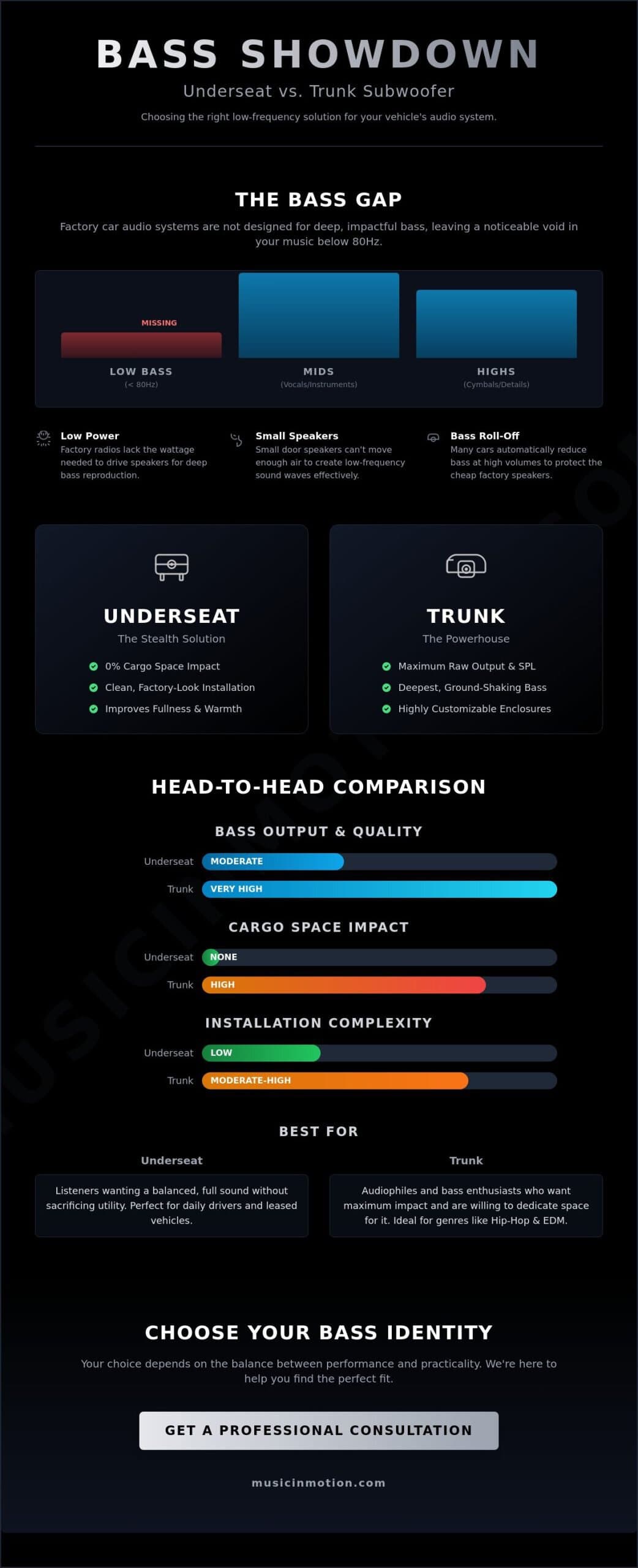
Most factory car audio systems are built for efficiency and budget; they aren’t built for your soul. When you listen to your favorite track, you might feel like something is missing. That missing piece is the bottom octave of music, typically everything below 80Hz. Standard door speakers, which are usually made of lightweight paper or thin plastic, simply don’t have the surface area or the throw to move the massive amounts of air required for deep bass. They’re designed to handle voices and guitars, but they fail when the beat drops.
We see this every day in our shop. A customer wants more impact, but their factory speakers are already distorted. To understand why, you have to look at what is a subwoofer and why it’s a specialized tool. It’s the only way to get true low-end performance. When deciding between an underseat subwoofer vs trunk subwoofer, we look at your specific vehicle’s layout and your listening habits. A subwoofer is designed to handle only the lowest frequencies, freeing up your door speakers to focus on the mid-range and high notes. This creates a balanced, rounded out soundstage where every instrument has its own space.
Dedicated power is the other half of the equation. Subwoofers are power-hungry components. While a factory radio might push 15 to 20 watts to a speaker, a subwoofer often needs hundreds of watts to overcome the physical resistance of its own suspension. Without a dedicated amplifier, you aren’t just losing volume; you’re losing clarity and control. This leads us to the two primary paths for your upgrade: the stealthy, compact underseat unit or the traditional, high-output trunk enclosure.
The Physics of Low-Frequency Sound
Deep bass isn’t just about sound; it’s about physical energy. To reproduce a 40Hz note, a speaker must move a significant volume of air. Small door speakers try to do this by vibrating faster, but they eventually reach a physical limit called excursion. This is why you hear a clacking or muddy sound when you turn the bass up too high. Adding an underseat subwoofer vs trunk subwoofer introduces that missing warmth to your music, making it feel rich and full even at low volumes. It’s the difference between hearing a kick drum through a wall and feeling the vibration in your chest.
Acoustic Challenges in the Modern Vehicle
Your car is a hostile environment for audio. Road noise, tire hum, and engine rumble are all low-frequency sounds that naturally cancel out your music’s bass. To make matters worse, many modern vehicles use bass roll-off in their factory EQ settings. As you turn the volume up, the car’s computer automatically lowers the bass to prevent the cheap factory speakers from blowing out. Our mission is to bypass these limitations. An aftermarket upgrade restores that missing octave, ensuring your music sounds exactly how the artist intended, regardless of how fast you’re driving.
Trunk Subwoofers: The Gold Standard for Raw Output
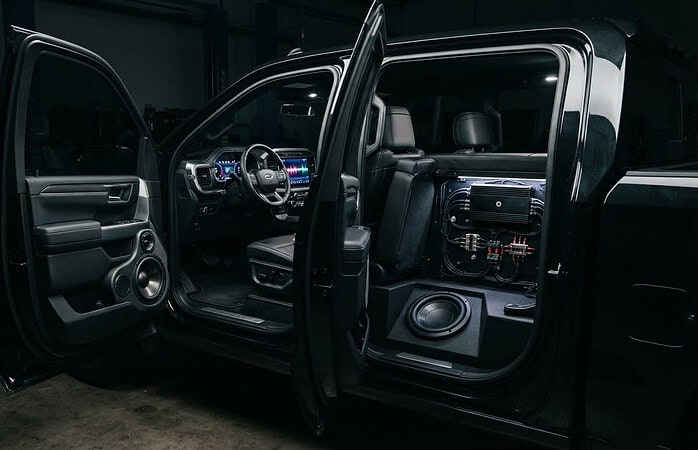
Trunk subwoofers are the go-to choice for drivers who want to feel every beat in their bones. The primary advantage here is simple physics: displacement. Larger driver sizes, such as 10, 12, or even 15-inch models like the Skar Audio EVL-12 D2, have a massive surface area that moves a high volume of air. This movement creates the deep, low-end pressure that smaller units simply can’t replicate. When we weigh the underseat subwoofer vs trunk subwoofer debate, the trunk option wins on raw acoustic power every single time.
The “flavor” of your bass is largely determined by the enclosure type. We typically offer two main paths for trunk installations:
- Sealed Enclosures: These are perfect for audiophiles who prioritize accuracy and “tight” bass. The air inside acts as a spring, helping the driver stop and start with surgical precision.
- Ported Enclosures: These use a tuned vent to redirect sound from the back of the cone. This results in much louder output at specific frequencies, making them ideal for hip-hop, EDM, or anyone who wants their presence known.
External amplifiers provide the necessary muscle for these systems. Unlike compact units, trunk subs require dedicated power to move their heavy magnets and stiff suspensions. Gaining a foundational perspective on Understanding Car Audio Systems helps you see how a trunk sub acts as the heartbeat of a high-performance setup. We match the amplifier’s RMS wattage to the subwoofer’s requirements to ensure total control and prevent distortion.
Custom Enclosures vs. Pre-Loaded Boxes
While pre-loaded boxes are a quick fix, we often recommend a custom subwoofer enclosure for our clients. Custom fabrication allows us to match the box volume perfectly to the driver’s parameters, which maximizes efficiency. We can also mold these enclosures into the side panels or spare tire wells. This approach saves your cargo space while making the upgrade look like a factory-installed component. If you aren’t sure which fit is right for your vehicle, reach out to our team for a personalized recommendation.
Sound Quality and Acoustic Pressure
The trunk itself acts as a secondary chamber for sound development. This helps in achieving the extreme low-end extension that compact units struggle to reach. However, this massive pressure can lead to rattling panels or vibrating license plates. We solve this by applying professional sound deadening materials to the trunk lid and floor. This simple step keeps the music inside the cabin and ensures your underseat subwoofer vs trunk subwoofer decision results in clear, impactful sound rather than a noisy trunk lid.
Underseat Subwoofers: The Stealth Solution for Modern Drivers
While trunk enclosures focus on moving air throughout the entire cabin, underseat subwoofers prioritize a more intimate, efficient experience. These compact units are often referred to as “all-in-one” solutions because they house the speaker, the enclosure, and the amplifier in a single, slim chassis. This design is perfect for drivers who want to keep their cargo space entirely open for groceries, gear, or strollers. When comparing an underseat subwoofer vs trunk subwoofer, the underseat option is the clear winner for anyone seeking a stealthy, OEM-style upgrade that remains completely hidden from view.
We often recommend these systems for lease vehicles or newer cars where the owner is hesitant to make permanent modifications. Because they don’t require massive custom boxes, they are significantly easier to remove when it’s time to trade in your vehicle. You get the benefit of premium sound today without worrying about the resale value tomorrow. It’s a practical, high-tech way to bridge the gap between factory audio and a full custom build.
The Tactile Advantage
There is a unique physical component to these systems that a trunk box can’t match. Because the speaker is mounted directly beneath your seat, the low-end frequencies travel through the seat frame and into your body. This tactile sensation, sometimes called bone conduction, makes the bass feel much more powerful than its actual volume level suggests. It’s an efficient way to “fill in” the bottom end of your music in smaller cabins like pickup trucks or sports coupes where every inch of space is at a premium. You don’t need massive acoustic pressure to enjoy a rich, warm soundstage.
Limitations of the Compact Format
Physics dictates that smaller enclosures have specific limits. You won’t get the ultra-low sub-bass notes that rattle windows from a block away. Most underseat units are limited to 8-inch or shallow 10-inch drivers, which means they excel at punchy mid-bass rather than deep, rolling lows. Professional mounting is also critical here. These units generate heat, and placing them in a confined space requires careful positioning to ensure longevity. We prioritize proper airflow and secure mounting to prevent the unit from shifting or overheating during long drives. If you want the deepest lows possible, the trunk is still your best bet, but for balanced daily listening, the underseat unit is hard to beat.
Head-to-Head: Underseat vs Trunk Subwoofer Comparison
Selecting the winner of the underseat subwoofer vs trunk subwoofer debate depends on your specific vehicle and how much of it you’re willing to share with your audio gear. A traditional 12-inch trunk enclosure offers a deep, resonant sound that fills large cabins. However, it demands a significant footprint. In contrast, a slimline underseat unit is punchy and tight, disappearing into the floor plan of your car. It’s a choice between the physical pressure of a trunk box and the focused, rhythmic pulse of a compact driver.
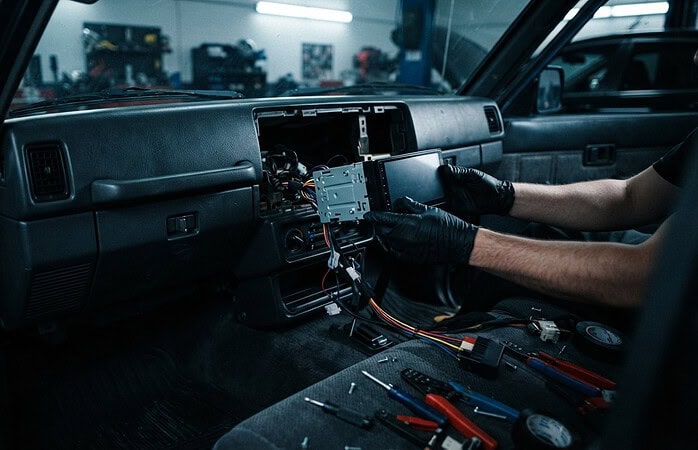
Installation complexity varies significantly between these two formats. Underseat models often feature integrated amplifiers, which simplifies the wiring process. Trunk-based systems require mounting a separate amplifier and running heavier gauge power cables. Regardless of the path you choose, integrating these systems usually starts with a car audio upgrade for stock stereo. This ensures your new bass solution receives a high-quality signal without the factory EQ rolling off the low end as we discussed earlier. We prioritize clean integration to keep your dashboard looking original while the sound remains anything but stock.
The “Electric” Problem: EVs and Hybrids
Modern vehicle architecture introduces new challenges. Many electric vehicles (EVs) and hybrids house massive battery packs or intricate HVAC ducting directly under the front seats. This can make an underseat installation physically impossible. We also have to manage the electrical load on the 12V system. In an EV, it is often recommended to limit the power of a subwoofer to around 300 watts RMS to avoid impacting the vehicle’s range. If your car has a high-tech electrical backbone, a low-draw underseat solution might be the safest way to gain better sound without stressing the vehicle’s sensitive electronics.
Cost vs. Performance Value
Your total investment isn’t just about the hardware on the receipt. While a budget-friendly trunk subwoofer might have a lower entry price, the cost of losing half your trunk space for groceries or sports gear is a daily tax on your lifestyle. Custom enclosures can mitigate this, but they require more specialized labor. We also consider the second life of your gear. Underseat units are remarkably easy to remove and move to your next vehicle, making them a better long-term value for drivers who change cars every few years. If you want to see which solution fits your trunk and your budget, contact our team for a professional consultation.
Choosing Your Bass Identity: The Music In Motion Approach
We don’t just sell speakers; we deliver a finished result that changes how you feel when you’re behind the wheel. Choosing between an underseat subwoofer vs trunk subwoofer isn’t a one-size-fits-all decision. It’s a collaborative process where we match high-end technology to your specific musical taste and vehicle layout. Our team prioritizes reliability and safety, ensuring that every wire is hidden and every component is securely mounted. DIY wiring often leads to messy interiors or, worse, electrical shorts that can damage your car’s sensitive computers. We also utilize Digital Signal Processing (DSP) to bridge the gap between hardware and acoustics. A DSP acts as the brain of your system. It allows us to tune the output to your cabin’s unique shape, correcting for timing errors and frequency peaks that a simple box can’t fix on its own.
Tailoring the Sound to Your Genre
Your playlist should dictate your hardware. For fans of Rock and Jazz, the tight, rhythmic response of an underseat unit often provides the best experience. It keeps up with fast double-bass drums and walking basslines without sounding muddy or bloated. However, if your heart is in Hip-Hop or EDM, you need the massive air movement of a trunk enclosure to handle those heavy sub-bass drops. Only a larger driver in a tuned box can give you that chest-thumping energy. For Classical and Acoustic listeners, we use subwoofers to add subtle warmth and depth, creating a realistic soundstage that makes it feel like the orchestra is sitting on your dashboard. This precision ensures you hear every nuance of a cello or the low rumble of a concert hall.
Next Steps for Your Vehicle
The first step is auditing your current system to find the weakest link. Sometimes the issue is power; other times, it’s just the physical inability of factory speakers to perform. We recommend a professional consultation to measure your specific underseat clearances or trunk dimensions. Modern vehicles have tight tolerances. A few millimeters can be the difference between a clean install and a compromised one that interferes with seat movement or cargo access. If you need to keep your trunk clear for gear, an underseat installation provides the answer without compromise. We’re here to guide you through the technical details so you can focus on the music. Bass is the foundation of every great drive. Let’s build yours together.
Elevate Your Sonic Experience
Deciding on the perfect low-end solution is about more than just picking a speaker; it’s about matching your lifestyle with your listening habits. We’ve explored how the underseat subwoofer vs trunk subwoofer debate pits raw acoustic pressure against stealthy, space-saving efficiency. Both paths offer a significant jump over factory sound when they’re integrated with precision. With over 30 years of custom car audio expertise, we’ve mastered the nuances of custom fabrication and OEM integration. We focus on the finished result, ensuring your system is safe, reliable, and perfectly tuned to your vehicle’s unique cabin acoustics.
Don’t settle for a thin, uninspired soundstage. Our expert team is here to guide you through every technical hurdle, from power management to digital signal processing. We treat every project as a partnership, prioritizing your practical needs alongside high-end performance. Ready to feel the bass? Contact Music In Motion for a custom audio consultation today! We’re excited to help you transform your vehicle into a premium listening environment. Your next great drive starts with the right foundation.
Frequently Asked Questions
Will an underseat subwoofer rattle my car seat?
An underseat subwoofer is designed to provide tactile vibration, but it won’t cause annoying rattles if we mount it securely to the vehicle’s floor. You’ll feel the rhythm through the seat frame, which enhances the listening experience even at lower volumes. We use high-quality fasteners and vibration-damping materials to ensure the only thing you feel is the music, not loose hardware or vibrating plastic panels.
Can I install a trunk subwoofer and still keep my spare tire?
Yes, you can absolutely maintain your spare tire access with a custom installation. We specialize in building custom subwoofer enclosures that fit into the side pockets of your trunk or are molded to sit flush against the rear seats. By using specialized fabrication techniques, we maximize your acoustic output while keeping your emergency equipment fully accessible for when you need it most.
Do I need a new head unit to add a subwoofer to my car?
You don’t need to replace your factory dashboard radio to enjoy better bass. We use advanced integration tools like Line Output Converters or Digital Signal Processors to tap into your existing audio signal. This allows us to add a subwoofer to almost any modern vehicle while keeping your factory steering wheel controls and touchscreen features perfectly intact and functional.
Is an underseat subwoofer powerful enough for a large SUV?
While an underseat unit provides great fill, it might struggle to pressurize the massive cabin air of a full-sized SUV. In larger vehicles, the underseat subwoofer vs trunk subwoofer choice usually leans toward the trunk. The increased distance and air volume often require the higher output of a 10 or 12-inch driver to ensure the bass reaches every passenger comfortably without sounding thin.
How much trunk space will I actually lose with a custom sub box?
The amount of space you lose depends entirely on the design of the enclosure. A standard pre-made box might take up a quarter of your cargo area, but our custom enclosures are designed to be as unobtrusive as possible. We often utilize unused cavities in the vehicle’s body panels to house the sub, leaving your main trunk floor open for groceries and gear.
Will adding a subwoofer void my new car warranty?
Adding an aftermarket subwoofer won’t void your entire vehicle warranty. Under federal law, a dealership can only deny a warranty claim if they can prove that the specific audio installation directly caused a mechanical or electrical failure. We follow strict safety protocols and use vehicle-specific harnesses to ensure your car’s factory systems remain protected and your warranty stays intact.
What is the difference between a powered subwoofer and a passive one?
A powered subwoofer contains its own internal amplifier, making it a compact, all-in-one solution. A passive subwoofer is just the speaker in a box and requires an external amplifier to provide power. Powered units are common in the underseat subwoofer vs trunk subwoofer debate for their simplicity, while passive setups offer more customization and raw power for high-end trunk builds.
Can I put two underseat subwoofers in my car for more power?
You can certainly install two underseat units if your vehicle has enough clearance under both the driver and passenger seats. This setup doubles the tactile impact and helps balance the soundstage within the cabin. It’s an excellent way to get more punch without sacrificing any trunk space, provided the vehicle’s electrical system can handle the combined power draw safely.