Imagine you’re cruising down the highway or heading out on the water, and your favorite track comes on. You turn it up, expecting a deep kick, but all you get is the thin, tinny vibration of factory speakers that usually only put out about 20W of power. It’s a common letdown for many drivers and boaters. When you’re looking to fix that, the debate usually boils down to a powered subwoofer vs component sub and amp. We understand the hesitation. Nobody wants to lose all their cargo space or worry about mismatched components draining their battery or failing during a trip.
Our team believes the right bass solution is about more than just hardware. It’s about matching the sound to your specific environment. In this guide, we’ll help you discover the critical differences between all-in-one powered subwoofers and custom component systems. You’ll learn which setup delivers the deep, clear bass you crave while respecting your vehicle’s limits. We’re going to compare cost, space, and performance to ensure you get a reliable result that makes every drive or voyage feel like a front-row experience.
Key Takeaways
- Learn how to choose between the compact “all-in-one” convenience of powered units and the unmatched performance of custom component systems.
- Understand the trade-offs in a powered subwoofer vs component sub and amp setup regarding cargo space, power delivery, and your vehicle’s electrical limits.
- Discover how we use specialized integration tools to add premium bass to your factory head unit without sacrificing safety or modern dashboard features.
- Identify the best audio solutions for unique environments, from space-saving motorcycle pods to rugged, marine-grade systems designed for open water.
- Gain the confidence to select a reliable system that delivers finished results and improves your daily experience behind the wheel.
Understanding the Bass Battle: Powered Subwoofers vs. Component Sub and Amp Systems
Bass is more than just a sound. It’s a physical force that you feel in your chest. However, reproducing those deep frequencies in a moving vehicle is a constant battle against physics. Low-end sound waves are massive. They need to move a lot of air to be heard over road noise, engine vibrations, and wind. In the confined space of a car, boat, or RV, this requires a strategic approach to power and displacement. When we help you decide between a powered subwoofer vs component sub and amp, we aren’t just looking at a catalog. We’re looking at how to achieve a finished result that balances your desire for deep sound with the practical realities of your vehicle’s layout.
The Powered Subwoofer: Convenience in a Box
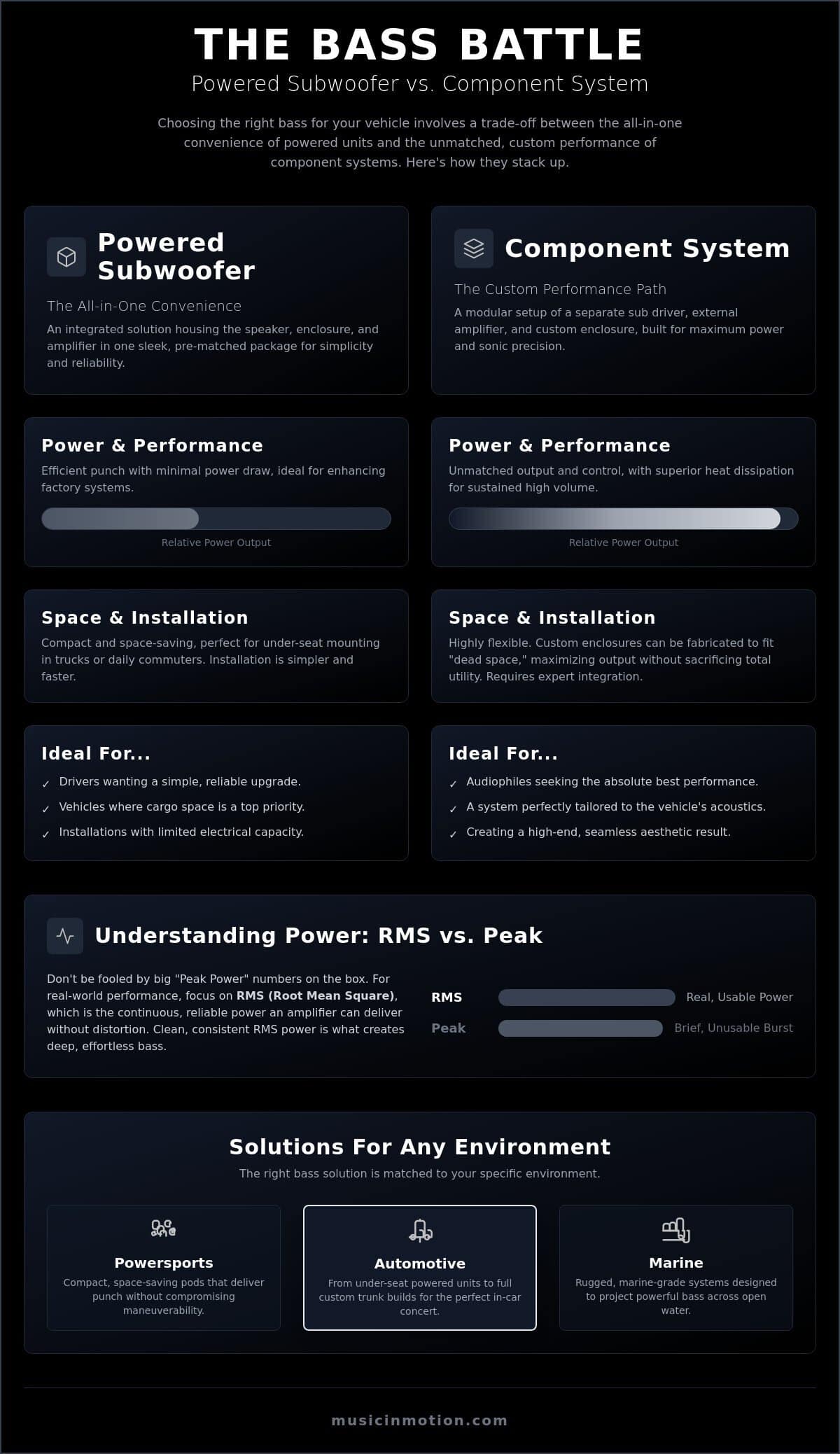
A powered subwoofer is an all-in-one solution that houses the speaker, the enclosure, and the amplifier in one sleek package. We often recommend these for drivers who want to enhance their factory system without losing their entire trunk or cargo area. Most of these units utilize highly efficient Class D amplifiers. These amps are designed to provide surprising punch while drawing minimal power from your battery. Because the internal components are pre-matched by engineers, these systems offer incredible reliability. They are the ideal choice for under-seat installations in trucks or adding a layer of rich sound to a daily commuter where simplicity is key.
The Component System: The Custom Performance Path
If you’re looking to push the boundaries of what your audio system can do, the component path is the answer. This setup consists of a separate subwoofer driver, a dedicated external amplifier, and a specialized enclosure. This modular approach allows us to leverage Subwoofer technology to its fullest potential. By choosing separate parts, we can prioritize heat management and raw power. External amplifiers have more surface area to dissipate heat, which means they can play louder and longer without hitting thermal limits during a long summer drive or a day on the lake.
The real secret weapon here is custom fabrication. Since 1994, our team has specialized in creating custom enclosures that fit into the “dead space” of a vehicle. This ensures you get maximum air displacement without sacrificing all your utility. Whether we’re building a stealthy fiberglass enclosure for a boat or a high-output ported box for a luxury sedan, the component system offers a level of precision and custom aesthetics that an all-in-one box simply can’t match. It’s the ultimate way to ensure your audio system is as unique as the vehicle it’s in. We focus on the installation details so the final result looks as good as it sounds.
Technical Comparison: Power, Space, and Performance Trade-offs
Choosing between a powered subwoofer vs component sub and amp often comes down to how much work you want your vehicle’s electrical system to do. While both systems aim to improve your low-end, they handle power and heat in very different ways. Component systems typically win the “volume war” because they allow for much higher RMS output. However, this extra power places a larger load on your alternator. It’s a balance of performance and practicality. We always look at the vehicle’s total electrical capacity before recommending a high-output system to ensure your battery stays healthy and your lights don’t flicker when the bass hits.
RMS vs. Peak Power: What Actually Moves the Air
Don’t get distracted by the “Max Power” or “Peak” numbers printed in bold on the packaging. These figures represent a burst of energy the equipment can only handle for a fraction of a second. For real-world performance, you must focus on RMS. RMS stands for the continuous power delivery standard an amplifier can maintain without distorting. To ensure longevity, we match the amplifier’s RMS output to the subwoofer’s power handling. This prevents the “clipping” that often leads to blown speakers. Understanding subwoofer design and performance helps you realize that consistent, clean power is what creates that effortless, deep sound.
External amplifiers in component systems handle sustained high volume better than integrated units. They have larger surface areas and dedicated heat sinks to dissipate the warmth generated during heavy use. If you’re unsure about your alternator’s capacity for a high-powered setup, our team at Music In Motion can help you calculate the right load for your specific vehicle.
Enclosure Dynamics: Sealed vs. Ported in Each System
The box is just as important as the speaker itself. Powered subwoofers use fixed enclosures that are mathematically optimized to get the most out of a small footprint. They are excellent at providing “fill” bass that rounds out your music. On the other hand, component systems offer total flexibility. We can design a sealed box for tight, accurate “punch” or a ported enclosure for maximum boom at specific frequencies. This is where Custom Car Audio Fabrication: The Art and Science of Superior Sound becomes a game changer. We can build a solution that maximizes air displacement while fitting perfectly into the unique contours of your trunk or cabin.
Space requirements are often measured by “footprint” versus “displacement.” A powered sub has a small footprint, taking up very little floor space. A component system might have a larger footprint, but the custom box allows for greater air displacement, which is necessary for those truly ground-shaking frequencies. We’ll help you find the sweet spot where you get the performance you want without losing the utility of your vehicle.
Installation Complexity: DIY vs. Professional Integration
Your vehicle’s dashboard is a masterpiece of modern engineering. We respect that. When our team approaches an installation, our goal is to enhance your experience without compromising the factory safety or utility systems. The debate between a powered subwoofer vs component sub and amp often centers on ease of installation, but the reality is that both paths require professional precision to deliver a reliable, finished result. Modern vehicles are rolling computers, and tapping into their electrical systems requires more than just a pair of wire strippers and some electrical tape.
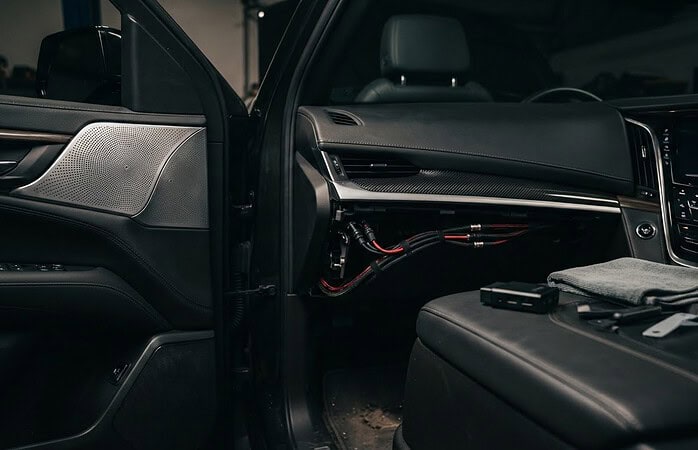
Both systems require three core connections: power, ground, and signal. Most factory head units today lack the RCA outputs found on aftermarket stereos. To solve this, we use high-quality Line Output Converters (LOCs). These devices take the high-level signal meant for your door speakers and transform it into a clean, low-level signal your new amplifier can use. Without this professional integration, you risk introducing “alternator whine” or annoying pops every time you turn the key. We focus on the details of signal processing to ensure your music remains crystal clear.
The ‘Plug and Play’ Myth of Powered Subs
Some retailers suggest that powered subwoofers are simple plug-and-play upgrades. We’ve found this is rarely the case. Even an integrated unit needs a heavy-gauge power wire run safely through the firewall directly to the battery. It also requires a rock-solid ground connection to the vehicle’s chassis. Mounting security is another critical factor. A twenty-pound enclosure sitting loose in your trunk becomes a dangerous projectile in a sudden stop. Our experts prioritize car audio upgrades for stock stereos that are bolted down securely and integrated seamlessly into your existing wiring harness.
The Custom Fabrication Advantage
Component systems offer a level of “stealth” that all-in-one boxes cannot match. Since we are dealing with separate parts, we can hide the amplifier under a seat or behind a side panel. We often fabricate custom enclosures that fit into spare tire wells or unused corner cavities. This preserves your cargo space while delivering massive sound. Once the hardware is in place, the real work begins with tuning. We adjust gain settings, crossovers, and subsonic filters to account for your vehicle’s “cabin gain,” which is the natural acoustic boost provided by your car’s interior. We use specific wire gauges and proper fusing to protect your electrical system, ensuring your upgrade is as safe as it is powerful. This professional touch preserves your vehicle’s warranty and ensures your system performs reliably for years to come.
Choosing for Your Medium: Car, Marine, and Powersports Applications
The choice between a powered subwoofer vs component sub and amp changes significantly when you move from the driveway to the dock or the trail. Every vehicle presents a unique acoustic environment. A compact sedan handles sound waves differently than a center-console boat or a high-performance motorcycle. Our team evaluates these environmental factors, such as UV exposure, salt air, and moisture, to recommend hardware that doesn’t just sound great on day one but survives for years to come. We prioritize the finished result by selecting the right tool for your specific medium of transport.
Rugged Sound for Open Water
Boats present the ultimate challenge: the “infinite baffle” environment. Unlike a car, a boat lacks a sealed cabin to trap and reflect sound waves. Bass often disappears into the open air. Because of this, we frequently recommend component systems for our clients. By using separate, high-powered marine-grade amplifiers, we can provide the raw energy needed to cut through wind and engine noise. We integrate premium marine audio systems that feature sealed enclosures to protect against freshwater and saltwater intrusion. This modular approach allows us to tuck amplifiers into dry storage lockers while placing the subwoofers exactly where they will be most effective.
High-Performance Bass on Land
On land, your vehicle’s body style dictates the best path. In a sedan, a component system in the trunk often needs more power to “punch” through the rear seats. In an SUV, a powered subwoofer can be an excellent choice because the open cabin allows the sound to travel freely. Cabin gain is the natural acoustic reinforcement provided by the interior of an enclosed vehicle, which naturally boosts low frequencies. This effect helps a smaller powered sub sound much larger than it actually is. For motorcycle enthusiasts, we face the extreme space-saving challenge of saddlebag subs. These require highly specialized component drivers and custom fabrication to ensure you get deep bass without losing your storage capacity.
RV and fleet vehicle owners often prioritize long-distance reliability. We focus on balancing cabin sound with systems that won’t drain house batteries during an overnight stay. Whether you are looking for a stealthy under-seat upgrade or a ground-shaking custom build, our specialists at Music In Motion have the expertise to enhance any vehicle you own. We bridge the gap between technical precision and the lifestyle-driven benefits of a world-class audio system.
The Verdict: Which System Delivers the Results You Need?
Choosing between a powered subwoofer vs component sub and amp isn’t a matter of which is objectively better. It’s about which one fits your life and your vehicle. We see it every day. A customer wants ground-shaking bass but drives a compact hatchback. Or a boater wants a simple upgrade but has an environment that swallows small speakers. The right system is the one that meets your performance goals while respecting the utility of your ride. We believe in delivering a finished result that makes you want to take the long way home every single time.
Choose a powered subwoofer if you prioritize space and want a noticeable, moderate reinforcement of your factory sound. These units are perfect for adding warmth and “fill” to your music without a complex build. On the other hand, choose a component system if you demand high output, custom aesthetics, and the ability to fine-tune every frequency. If you plan on evolving your audio system over time, the modular nature of separate components offers the flexibility you’ll need for future upgrades. We recommend considering your long-term goals before making a purchase. A system that sounds “good enough” today might feel lacking in six months.
The Decision Matrix: Space vs. Sound
Evaluating your vehicle’s real estate is the first step in our collaborative design process. We use a simple checklist to help you decide. First, look at your cargo needs. If you carry groceries, strollers, or gear daily, a compact powered sub or a custom-fabricated stealth enclosure is essential. Second, consider the “hidden” costs. Every high-performance system requires a professional wiring kit and, often, sound deadening materials to prevent rattles. These additions are what transform a collection of hardware into a premium experience. A finished result is always more than just the sum of its parts; it’s about the harmony between the equipment and the cabin.
Next Steps for Your Audio Evolution
Our team doesn’t just sell boxes. We design experiences around your specific listening preferences. Whether you want the tight punch of a jazz kick drum or the deep swell of an electronic bassline, we have the specialized knowledge to make it happen. We bring nationwide authority to every localized project we handle. This ensures your vehicle receives the same level of care and technical precision as a high-end custom build. We take pride in our craft and remain focused on your practical needs. Don’t settle for a mismatched system that might drain your battery or fail when you need it most. Contact Music In Motion to design your custom bass solution today and feel the difference that professional integration makes.
Elevate Your Driving Experience with Custom Bass
Finding the winner in the powered subwoofer vs component sub and amp debate depends on your specific vehicle and how much air you want to move. We’ve explored how the compact efficiency of an all-in-one unit serves space-constrained daily drivers, while modular component builds offer the raw power needed for open-water marine environments. The most important factor is matching the hardware to your unique listening environment and long-term goals. A finished result should provide deep, clear sound without compromising your vehicle’s safety or utility.
Since 1994, our team has applied national-level expertise to every custom project we handle. We specialize in marine, motorcycle, and vehicle audio integration, bringing decades of custom fabrication experience to your dashboard or cabin. We are here to bridge the gap between technical precision and the internal experience of the user, ensuring your system is as reliable as it is exciting. You don’t have to settle for thin factory sound or mismatched components that risk your electrical health.
Ready for superior sound? Explore our custom audio installation services.
We look forward to helping you find the perfect low-end solution that makes every journey sound incredible.
Frequently Asked Questions
Is a powered subwoofer loud enough for a truck?
A powered subwoofer provides plenty of volume to fill a truck cabin with rich, punchy low-end. Because trucks have smaller internal cabin volumes compared to large SUVs, you don’t need massive air displacement to feel the impact. We often recommend these units for truck owners who want to keep their under-seat storage clear while still enjoying a significant upgrade over factory sound.
Can I add a component sub to my factory stereo without replacing the head unit?
You can absolutely add a component system to your factory stereo by using a high-quality Line Output Converter (LOC). This device taps into your existing speaker wires and creates a clean signal for your new amplifier. Our team specializes in these integrations, ensuring your modern dashboard features and steering wheel controls remain fully functional while your bass performance reaches new heights.
Do powered subwoofers overheat more easily than separate amps?
Powered subwoofers can reach thermal limits faster than separate amplifiers because their electronics are housed inside the enclosure. External amplifiers have larger surface areas and dedicated heat sinks designed to move heat away from the circuitry. When deciding between a powered subwoofer vs component sub and amp, we consider how loud you plan to play your music to ensure your system remains reliable.
What is the difference between a loaded enclosure and a powered subwoofer?
The main difference is the inclusion of an internal amplifier. A loaded enclosure is simply a subwoofer pre-installed in a box, which still requires you to buy and wire a separate external amp. A powered subwoofer is a truly integrated, all-in-one solution where the amplifier is built directly into the cabinet. This simplifies the wiring process and ensures the components are perfectly matched for reliability.
Will adding a high-power component sub drain my car battery?
A high-power component system won’t drain your battery if the electrical load is properly managed and the vehicle is running. We evaluate your alternator’s output and use the correct wire gauges to protect your electrical system. For extreme builds, we might suggest a capacitor or a battery upgrade, but standard high-performance systems are perfectly safe when integrated by our experienced team.
Can I install a powered subwoofer under my seat?
Many compact powered subwoofers are designed specifically for under-seat installation to save cargo space. These slim-profile units are excellent for adding bass to vehicles with limited trunk space or for owners who want a completely hidden look. We ensure these units are bolted down securely and wired professionally so they don’t interfere with your seat movement or factory safety sensors.
Is it cheaper to buy a powered sub or a separate sub and amp?
A powered subwoofer is generally the more budget-friendly option because you are purchasing one piece of hardware instead of three separate items. However, when comparing a powered subwoofer vs component sub and amp, the component path often offers better long-term value. If a component fails or you want more power later, you can replace a single part rather than the entire system.
How much space does a custom component subwoofer box really take up?
The space required for a custom box depends entirely on the subwoofer’s size and your specific performance goals. A 12-inch sub typically needs between 1.5 and 3.0 cubic feet of air space to perform correctly. Our custom fabrication experts can often reclaim “dead space” in your vehicle’s side panels or floor to minimize the impact on your usable cargo area.