You just spent a weekend installing the best speakers money can buy, yet the lead singer sounds like they’re trapped in your floorboards and the bass feels completely detached from the rest of the music. It’s a common frustration that leads many enthusiasts to the ultimate crossroads of professional car audio DSP tuning vs DIY calibration. We understand the hesitation; staring at a complex parametric EQ screen is intimidating, especially when you’re worried that one wrong crossover setting might send your expensive tweeters to an early grave. You want the hardware to work, but you also want your investment to stay safe and reliable for years to come.
In this 2026 guide, we’ll help you discover whether you should calibrate your own digital signal processor or trust a specialist to unlock your system’s true acoustic potential. We believe a DSP is just a tool, but the tune is the actual instrument. We’ll show you how to move past muddy transitions and finally achieve a soundstage that places the performer right on your dashboard. By comparing the technical precision of modern software-defined DSPs against the learning curve of home-tuning, we’ll give you the clarity needed to reach the finish line of your audio journey.
Key Takeaways
- Learn why vehicle acoustics often ruin high-end hardware and how digital signal processing fixes the “cabin curse” caused by glass and plastic reflections.
- Compare the accuracy and equipment requirements of professional car audio DSP tuning vs DIY to decide which path fits your system’s complexity.
- Discover the secrets to creating a perfectly centered soundstage where vocals appear on the dashboard rather than stuck in the floorboards.
- Identify the “value threshold” to determine when the cost of your speakers justifies the precision of a specialist’s educated ear and professional-grade RTA tools.
- Understand how professional phase correction and custom fabrication combine to deliver a finished result that exceeds a simple equipment transaction.
Why Your Premium Car Audio Hardware Needs Precision DSP Tuning
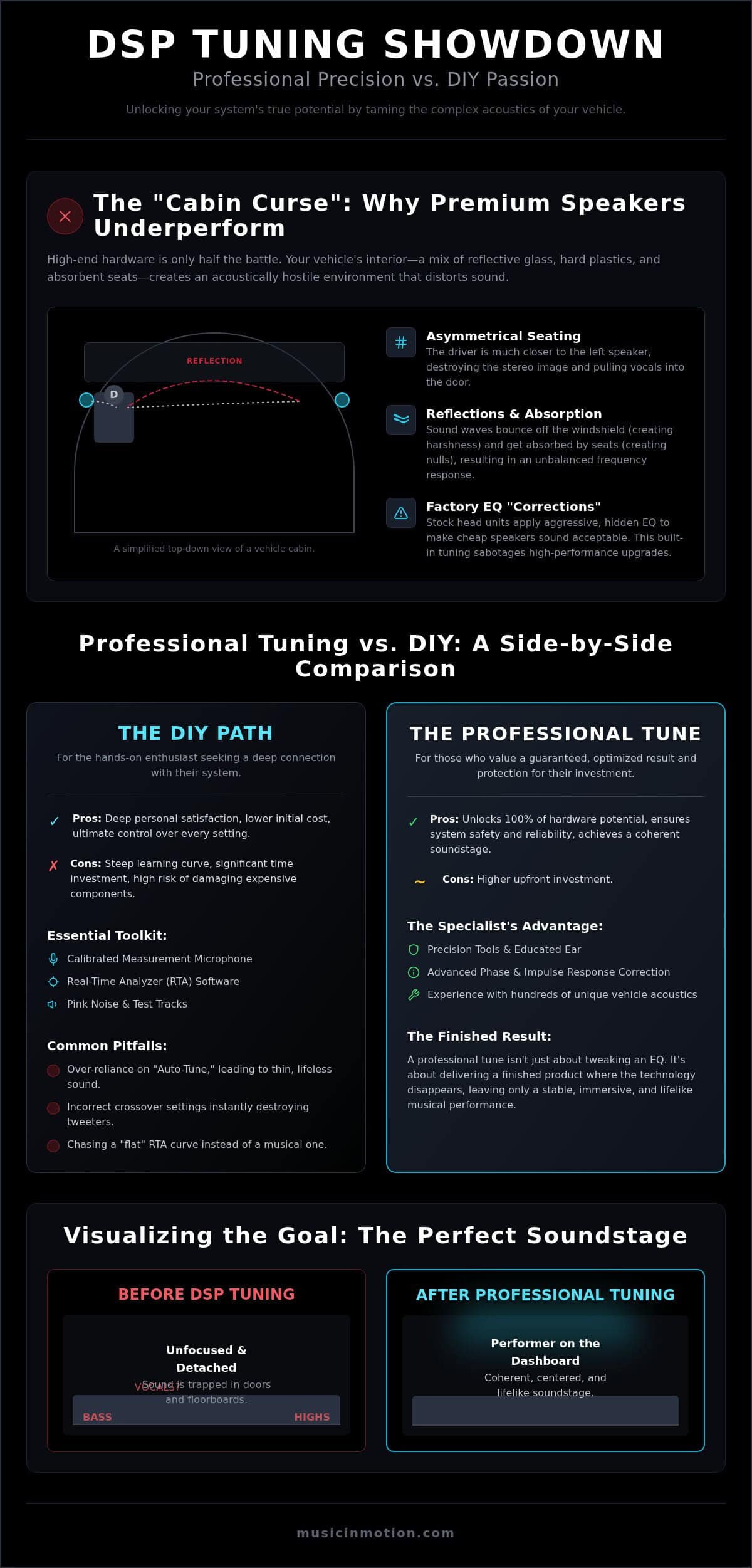
High-end hardware is only half the battle. You can buy the most expensive drivers on the market, but the moment you bolt them into a car door, they’re at the mercy of the “Cabin Curse.” This is the reality of vehicle acoustics where glass, hard plastic, and soft upholstery conspire to destroy frequency response. We see many enthusiasts struggle with this when deciding between professional car audio DSP tuning vs DIY setups. Without a digital signal processor (DSP) acting as the brain of the system, your premium speakers are just making noise in a hostile environment.
A car audio upgrade for stock stereo involves more than just swapping parts. Modern factory head units use aggressive equalization and phase shifts to make cheap paper speakers sound acceptable. When you add high-performance gear, these factory “corrections” become glaring flaws. We focus on delivering a finished result where the equipment disappears, leaving only a coherent, lifelike soundstage. Choosing between professional car audio DSP tuning vs DIY is ultimately about how much control you want over that final acoustic outcome.
The Acoustic Challenges of the Modern Vehicle
The driver’s seat is inherently the worst place to listen to music. You sit inches away from the left speaker while the right one is several feet away. This asymmetry kills the center image. Additionally, sound waves bounce off the windshield and get absorbed by the seats, creating massive peaks and dips in what you hear. We often see the “Rainbow Effect,” where the soundstage seems to dip toward the floor in the middle of the dash. Precision tuning fixes this by using time alignment to trick your ears into thinking you’re sitting perfectly centered between the speakers.
Correcting Factory Limitations Digitally
Factory systems often hide “All-Pass” filters that mess with phase or “Loudness” curves that change based on volume. A professional-grade DSP allows us to strip these away. We sum the different frequency signals from your factory amp into one clean, full-range output. This process doesn’t just improve sound; it protects your investment. By setting precise crossovers and limiters, we ensure your speakers never see clipped signals or frequencies they weren’t designed to handle. This reliability is a cornerstone of our philosophy at Music In Motion.
The DIY DSP Tuning Process: Tools, Techniques, and Common Pitfalls
Taking the DIY route is an attractive challenge for many enthusiasts. It promises a deep connection with your music and the satisfaction of building something yourself. However, when comparing professional car audio DSP tuning vs DIY, the equipment list is just the starting line. You’ll need a calibrated microphone, Real-Time Analyzer (RTA) software, and a steady supply of pink noise. The learning curve is steep. One wrong mouse click in the parametric EQ settings can instantly vaporize a high-end tweeter if the crossovers aren’t locked down first. We’ve seen many great speakers meet an early end because of a simple setup error.
Step 1: Setting Safe Crossovers and Levels
Before playing a single note, we establish electrical safety. This means setting crossovers that match your speakers’ physical limits. Slopes like Linkwitz-Riley or Butterworth aren’t just technical terms; they determine how frequencies blend between drivers. We prioritize steep slopes for tweeters to prevent low-frequency damage. Level matching is equally vital. You don’t want your subwoofers overpowering your midrange drivers, or your tweeters screaming over the rest of the band. Balancing the gain across the entire system ensures that no single component is working harder than it needs to.
Step 2: Time Alignment and RTA Measurement
Next comes the math of the cabin. We measure the distance to the “acoustic center” of every speaker to set time alignment. This aligns the sound waves so they reach your ears at the exact same moment, creating a solid center image. While many modern DSPs offer “Auto-Tune” features, these are often a trap. Automated software can’t always distinguish between a real frequency problem and a cabin reflection. Relying solely on an algorithm often results in a thin, lifeless sound. If you’re feeling overwhelmed by the technicalities, our team at Music In Motion offers specialized car audio upgrades and consulting to get your project back on track.
A common DIY mistake is “chasing the graph.” People see a narrow peak on their RTA and try to flatten it with aggressive EQ. Often, that peak is just a reflection from a side window. Over-correcting it makes the speaker sound unnatural and hollow. Similarly, trying to boost a “null” where sound waves cancel each other out is a losing battle. You’re just wasting amplifier power and risking speaker failure. Precision tuning is about knowing which acoustic battles to fight and which to leave alone for the sake of the music.
Professional Tuning vs. DIY: A Side-by-Side Comparison
When you weigh professional car audio DSP tuning vs DIY, you aren’t just comparing software settings. You’re comparing the value of your time against the precision of an expert result. A DIY enthusiast might spend six months of weekends tweaking a single crossover point or hunting down a phantom rattle that’s actually a phase cancellation. We deliver that same level of refinement in a single afternoon. This efficiency isn’t just about speed; it’s about having a baseline of hundreds of successful builds to draw from. We prioritize the delivery of a finished result over the mere transaction of hardware, ensuring you spend more time listening and less time troubleshooting.
Perspective matters. A consumer-level USB microphone can tell you where a frequency peak is, but it can’t tell you why it’s there. It could be a reflection, a mounting issue, or a physical limitation of the speaker itself. Our team looks for thermal stability and long-term reliability. We ensure your system stays distortion-free even when you’re pushing it on a long summer drive. We focus on the internal experience of the user, making sure the music feels right at any volume. This reliability creates an atmosphere of trust, knowing your system won’t fail when you turn it up—a standard of professional care that many also seek for their residences through a smart home installation toronto to ensure their home automation and security systems are equally dependable.
The gap between consumer and professional tools has widened significantly. While most DIYers use a single-point measurement, we utilize multi-microphone arrays for spatial averaging. This gives us a more accurate picture of the entire cabin’s acoustic profile rather than just one tiny spot. We also use high-speed oscilloscopes and distortion detectors to ensure signal purity throughout the entire signal chain. Professional tools can detect 1% Total Harmonic Distortion (THD) before it’s even audible to the human ear. This proactive approach keeps your hardware safe and your audio crystal clear, regardless of the volume knob’s position.
DIY vs. Hiring a Specialist: Choosing Your Path
Deciding between professional car audio DSP tuning vs DIY often comes down to one simple question: do you enjoy the tinkering or the music? For some, the journey of learning RTA software and phase management is part of the fun. For others, the goal is simply a world-class listening experience without the headache. We find that the more complex a system becomes, the more the scale tips toward professional intervention. A basic two-way passive system might be manageable at home, but once you step into the world of fully active multi-channel setups, the variables multiply exponentially.
The Complexity Checklist
We use a simple set of criteria to help clients decide when to take the reins and when to hand them over. If your system includes the following, professional calibration is usually the safest bet for your hardware’s longevity:
- Active 3-Way Front Stages: Managing six individual drivers on the dash and doors requires surgical precision with crossovers to prevent tweeter failure.
- Digital Integration: If you’re keeping the factory head unit, you’re fighting pre-set EQ curves that require specialized de-equalization tools to flatten.
- Custom Subwoofer Enclosures: When you’ve invested in custom subwoofer enclosures, professional phase alignment is critical to ensure the bass feels like it’s coming from the dashboard rather than the trunk.
The Risk of Tuning Fatigue
One of the biggest hurdles in any DIY project is tuning fatigue. After thirty minutes of listening to pink noise and sweeping frequencies, your ears begin to “lie” to you. The brain naturally tries to compensate for acoustic flaws, making it nearly impossible to remain objective. This often leads to the “never-ending tune,” where you find yourself making tiny adjustments every day but never reaching a satisfying conclusion. This cycle can quickly kill the joy of your new investment and leave you feeling frustrated with your gear.
We often recommend a middle-ground approach. Many of our clients handle the physical installation themselves and then bring the vehicle to us for the final calibration. This ensures your system starts with a professional baseline. It protects your hardware from clipping and gives you a reliable foundation to enjoy. If you’re ready to stop tweaking and start listening, we invite you to explore our professional car audio services to see how we can help you finish your build.
The “Value Threshold” is another vital consideration. If you’ve spent significant money on high-fidelity drivers and amplification, a professional tune is essentially an insurance policy. It ensures every dollar spent on hardware is actually audible in the final result. We focus on the internal experience, transforming a collection of parts into a cohesive musical instrument that improves your daily life behind the wheel.
The Music In Motion Approach: Custom Tuning as a Finished Result
At Music In Motion, our philosophy is built on a single, foundational anchor: we prioritize the delivery of a finished result over the mere transaction of goods. While many shops focus on the specific hardware models they carry, we focus on the internal experience of the user. We believe that even the most advanced processor is useless if it isn’t calibrated to the unique acoustic environment of your vehicle. This commitment to the final outcome is what truly defines the difference between professional car audio DSP tuning vs DIY experimentation. We don’t just hand you a box; we hand you a world-class listening experience that improves your daily life behind the wheel.
Integration with Custom Fabrication
Precision tuning starts long before we plug in a laptop. Our expertise in car audio fabrication allows us to create an “Acoustic Foundation” that makes the DSP’s job much easier. By custom-molding A-pillars or kick panels to aim speakers toward the listener, we reduce the need for heavy digital equalization. This physical alignment prevents the harsh reflections that often plague standard factory locations. Whether we’re building custom subwoofer enclosures or stealthily hiding components behind factory panels, our goal is a seamless install where the sound remains front and center while the hardware stays out of sight.
Our team projects the image of a versatile specialist. We bring the same level of enthusiasm and technical precision to land and water-based transport alike. Whether you’re looking for a concert-quality soundstage in a high-performance coupe, a marine audio system that cuts through wind noise, or a rugged powersports setup, we have the specialized knowledge to enhance it. This universal application is our brand promise. We understand how different materials like fiberglass, plastic, and upholstery react to sound waves, and we adjust our tuning strategy accordingly.
The Final Handover: Your System, Perfected
The Music In Motion signature is a soundstage that feels physically impossible for a small vehicle cabin. We use professional-grade measurement arrays to place the singer directly on your dashboard, creating a sense of depth and width that extends beyond the car’s doors. This is the “finished result” we strive for in every project. We don’t consider the job done until the sub-to-midrange transitions are perfectly blended and the system is thermally stable at high volumes.
When you pick up your vehicle, we don’t just hand you the keys. We take the time to educate you on how to use your new system safely. We provide tailored presets designed for different scenarios, such as “Daily Driving” for balanced sound, “Critical Listening” for pure fidelity, and “Show Mode” for maximum impact. This ensures you have the flexibility to enjoy your music exactly how you want it. Ready to hear what your system is truly capable of? Connect with the Music In Motion team today and let us transform your commute into a front-row experience.
Elevate Your In-Car Listening Experience
Your journey to perfect sound doesn’t have to be a solo mission through technical manuals and pink noise. While the debate between professional car audio DSP tuning vs DIY calibration often focuses on the tools, the real difference lies in the final result. We believe your vehicle should be a sanctuary of high-fidelity sound, not a source of frustration. By understanding the complexity of your active system and the acoustic foundation of your cabin, you can finally move past “good enough” and achieve a soundstage that feels truly lifelike.
Since 1994, we’ve specialized in high-performance audio and custom fabrication focused on acoustic excellence. Our team brings specialized expertise in complex digital signal processing to ensure your investment is both safe and spectacular. We prioritize a finished result that transforms your commute into a front-row seat at your favorite concert. It’s time to stop chasing the graph and start enjoying the music. Unlock your system’s potential with a professional tune from Music In Motion. We’re ready to help you hear every detail exactly as the artist intended.
Frequently Asked Questions
How long does a professional car audio DSP tune typically take?
A professional tune typically takes between 2 to 6 hours depending on the complexity of your system. A simple two-way active front stage is faster than a 16-channel competition build. We spend the first hour on safety checks and gain matching before moving into RTA measurements. This ensures that the final result is reliable and thermally stable for long-term enjoyment.
Can I damage my speakers if I try to tune my own DSP?
You can absolutely damage your speakers with a single incorrect setting. Tweeters are the most common victims if a DIYer accidentally sends low-frequency signals through them or disables a crossover. If you compare professional car audio DSP tuning vs DIY, the safety of your hardware is a primary benefit of choosing an expert. We use professional-grade limiters to ensure your investment never sees a clipped or dangerous signal.
Is it possible to tune a car audio system without a DSP?
While you can use basic tone controls or amplifier crossovers, you cannot achieve a true high-fidelity soundstage without a DSP. Traditional analog tuning doesn’t offer independent time alignment or the 31-band parametric EQ needed to fix cabin reflections. A digital signal processor acts as the brain of the system, allowing us to manipulate sound in ways that analog hardware simply cannot match.
Do I need a DSP if I’m only upgrading my speakers and keeping the factory radio?
A DSP is vital if you keep a factory radio because it allows us to “de-equalize” the signal. Car manufacturers use aggressive EQ curves to make cheap speakers sound better, which can ruin high-end aftermarket gear. We use digital correction to flatten that signal, providing a clean slate for your new speakers. This is the most effective way to handle a car audio upgrade for stock stereo systems.
What is the difference between time alignment and phase?
Time alignment handles the physical distance of the speakers, while phase handles the timing of the sound waves themselves. If your speakers are time-aligned but out of phase, they will fight each other, causing “nulls” where certain frequencies disappear. We use specialized tools to ensure every driver is pushing and pulling in perfect synchronization. This creates the impact and clarity that defines a world-class audio installation.
Can a professional tune fix a poorly installed speaker?
A professional tune can improve the sound, but it cannot fix a bad installation. If a speaker is mounted to a vibrating panel or has air leaks around the baffle, even the best DSP won’t make it sound perfect. We focus on custom fabrication and solid mounting as the foundation for our work. Tuning is the final polish that unlocks the potential of a well-executed physical build.
How much of an improvement will I actually hear from a professional tune?
The improvement is usually the most significant change you can make to your system. You will hear a centered vocal image and a wider soundstage that extends past the car’s pillars. Many clients find that professional car audio DSP tuning vs DIY attempts provides a much more natural, balanced sound that doesn’t cause ear fatigue during long drives. It turns a collection of speakers into a cohesive musical experience.
What software do professionals use for car audio tuning in 2026?
In 2026, we utilize advanced measurement software like Room EQ Wizard (REW) alongside proprietary tuning suites from high-end manufacturers like Goldhorn. We pair these with calibrated multi-microphone arrays to capture spatial averages throughout the listening area. These tools allow us to see 1% Total Harmonic Distortion before it’s audible. This ensures your system remains crystal clear and completely safe at every volume level.