Imagine spending your weekend upgrading your speakers only to find the music still sounds muddy and the vocals are stuck down by your ankles. It is a common frustration for many enthusiasts who realize that even the best hardware cannot overcome the acoustic flaws of a car interior. To solve this, you need to understand what is a car audio digital sound processor (DSP) and why we call it the brain of a high-performance system.
We know you want your music to feel like a front-row concert, not a muffled recording. In this article, we’ll explain how a DSP transforms your vehicle’s cabin into a high-fidelity hall by correcting timing issues and optimizing every speaker for your specific seating position. You will discover how this technology integrates with your existing factory electronics to deliver crystal clear sound and deep, impactful bass that finally hits the mark. We’ll break down the technical details into simple concepts so you can see exactly how we unlock the full potential of your mobile audio experience.
Key Takeaways
- Discover why a DSP acts as the essential brain of your sound system, managing signals to ensure every note reaches your ears with absolute precision.
- Learn what is a car audio digital sound processor (DSP) and how it uses time alignment to center your soundstage perfectly on the dashboard.
- Understand how these processors bypass factory EQ limitations and overcome the acoustic hurdles created by your vehicle’s reflective glass and upholstery.
- Explore the differences between standalone units and integrated DSP-amplifiers to determine which solution fits your space and performance needs.
- See why professional tuning is the critical step that turns a collection of high-end hardware into a seamless, high-performance finished result.
What is a Car Audio DSP? Understanding the Brain of Your Sound System
We often meet drivers who have invested in high-end speakers and powerful amplifiers, yet they still feel like their music lacks life. The missing piece is almost always the control center. A digital signal processor is a specialized microprocessor designed to manage the audio signal from your source unit all the way to your speakers. We consider it the brain of the system because it corrects the audio signal before it ever reaches your ears. Ultimately, a DSP serves as the bridge between raw electronic data and a three-dimensional acoustic performance.
While a factory head unit might give you basic control over bass and treble, those are blunt tools. They lack the precision needed to handle a high-fidelity environment. If you are asking yourself what is a car audio digital sound processor (DSP), it is the tool that allows for adjustments that are simply impossible with standard knobs or simple head unit software. It gives us the power to manipulate the sound with surgical accuracy, ensuring your hardware performs exactly as it was intended.
DSP vs. Traditional Equalizers
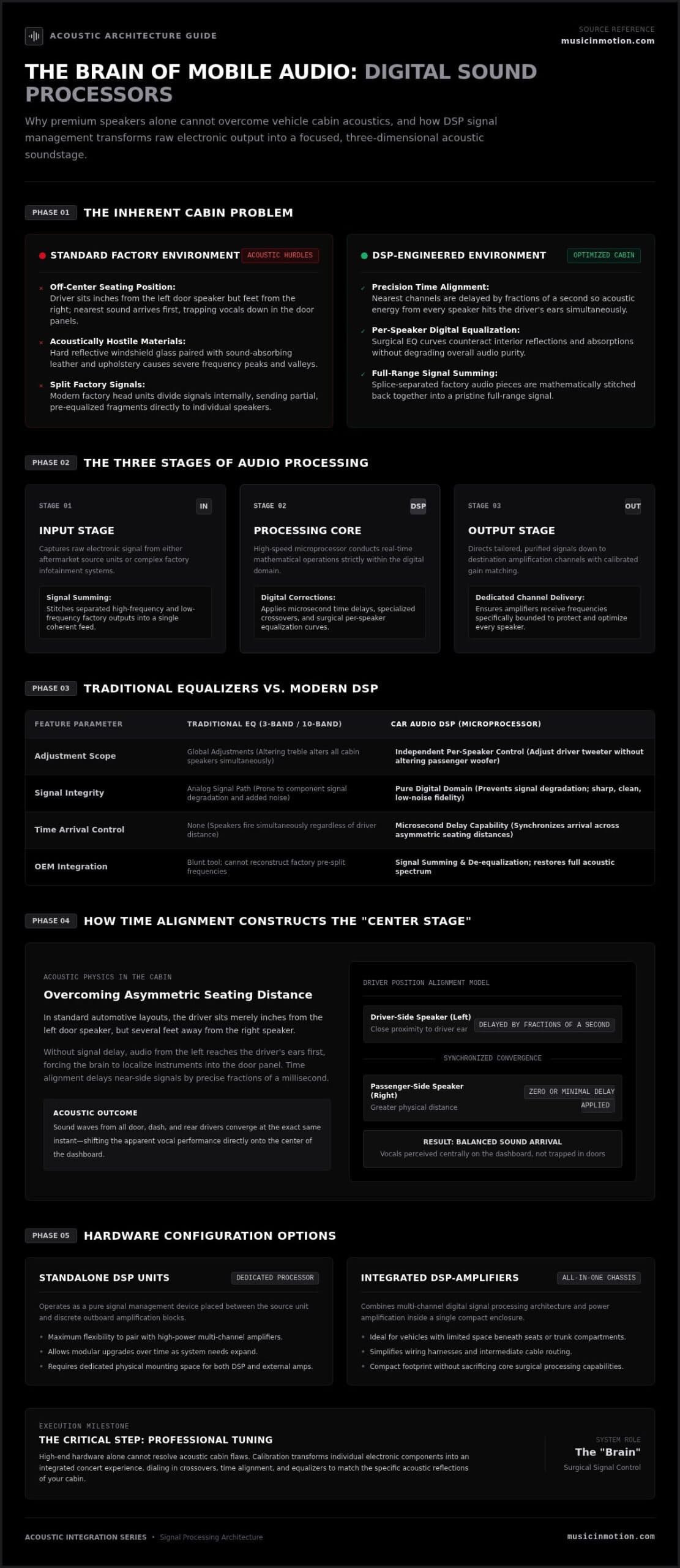
A standard 3-band or even a 10-band equalizer is usually insufficient for the complex environment of a car cabin. These traditional tools make global adjustments, meaning if you turn up the treble, it changes for every speaker in the car at once. In a vehicle, you sit closer to some speakers than others, and every piece of glass or plastic reflects sound differently. A DSP provides per-speaker control. We can adjust the frequency response for the driver’s side tweeter without affecting the passenger’s side woofer. Because the processing happens in the digital domain, it prevents the signal degradation often found in old-school analog components. This keeps your music clean, sharp, and free of added noise.
The Components of a Modern DSP
A modern processor handles the audio journey through three critical stages to ensure a high-performance result. We focus on these stages to maintain signal integrity from the dashboard to the trunk.
- Input stage: This section accepts signals from your source. Whether you have a high-end aftermarket radio or a complex factory infotainment system, the input stage gathers the raw audio data.
- Processing core: This is where the mathematical magic happens in real-time. The core applies crossovers, timing delays, and equalization curves based on the specific acoustics of your vehicle.
- Output stage: After the signal is perfected, the output stage sends the optimized audio to your amplifiers. This ensures each amp receives a tailored signal that is perfectly matched to the speakers it powers.
The Core Functions: How a DSP Shapes Your Acoustic Environment
A DSP isn’t just about volume; it’s about absolute control. We use these processors to fix the physical limitations inherent in any vehicle. If you are asking what is a car audio digital sound processor (DSP), the answer lies in its ability to manipulate every aspect of the acoustic environment. One of its most vital roles is signal summing. Modern factory systems often split the audio signal into separate pieces for tweeters and woofers. We use a DSP to stitch those pieces back together into a single, full-range high-fidelity signal before it reaches your amplifiers.
Once we have a clean signal, we use equalization to smooth out sonic peaks and dips. Car interiors are full of reflective glass and sound-absorbing leather that wreak havoc on audio waves. By applying digital audio post-processing in vehicles, we can counteract these surfaces. This ensures your speakers sound balanced regardless of the materials surrounding them. Learning what is a car audio digital sound processor (DSP) is the first step toward achieving professional-grade audio in your daily driver.
Time Alignment: Creating the ‘Center Stage’
In a home theater, you sit in the sweet spot. In a car, you’re always off-center. You sit inches from the left door but feet away from the right. This causes the sound from the left speaker to hit your ear first, making the music feel like it is trapped in your door. We use time alignment to delay the nearest speakers by tiny fractions of a second. This makes the sound from every speaker arrive at your ears at the exact same time. It creates a center stage where vocals appear to come from the middle of your dashboard instead of your floorboards. This correction adds incredible depth and width to your listening experience.
Precision Crossovers and Speaker Protection
Precision crossovers are the unsung heroes of speaker safety. Standard passive crossovers are often bulky and imprecise. With a DSP, we can set steep slopes, such as 24dB per octave or higher, to ensure each speaker only plays the frequencies it was built for. This protects your delicate tweeters from low-frequency notes that could cause damage. It also keeps your midbass from sounding muddy. This level of control allows us to blend your subwoofer seamlessly so the bass feels like it is coming from the front of the car rather than the trunk. If you are ready to hear the difference this control makes, our team can help you design a custom installation tailored to your vehicle.
Overcoming the ‘Car Problem’: Why DSP is Vital for Modern Vehicles
Vehicles are acoustically hostile environments. Glass reflects high frequencies, while thick fabrics and leather absorb mid-range tones. This imbalance creates a chaotic listening space where sound waves constantly bounce and clash. Without a DSP, even $5,000 speakers will still sound like they are in a car, not a studio. We call this the “Car Problem,” and it is the primary reason why high-end hardware often fails to impress without professional processing to manage the environment.
Modern factory head units add another layer of difficulty. Manufacturers use “baked-in” EQ curves to protect cheap factory speakers from distorting or blowing out. When you add high-quality aftermarket gear, that pre-distorted signal remains, which ruins the performance of your new equipment. A processor allows us to “de-equalize” the factory signal. We can flatten that pre-set curve to provide a clean, flat slate for your new system to build upon.
Correcting Factory Audio Limitations
In many 2026 vehicles, replacing the head unit is no longer a viable option. The dashboard screen now controls the climate, safety systems, and vehicle settings. A DSP allows us to keep your factory dash intact while completely rebuilding the audio quality from the inside out. It restores the signal while maintaining essential features like door chimes, parking sensors, and Bluetooth connectivity. If you are researching a Car Audio Upgrade for Stock Stereo, you’ll find that signal restoration is the foundation of any successful modern build. These processors even handle volume-dependent equalization, where the car automatically cuts bass as you turn the volume up.
The Physics of the Cabin
Car geometry creates standing waves and frequency cancellations. These occur when sound waves bounce off the windshield and hit each other, effectively “canceling” certain notes before they reach your ears. Advanced in-car digital sound processing addresses these issues by adjusting individual frequencies to compensate for the cabin’s unique shape. We use this technology to fix off-axis speaker placement in door panels and pillars, ensuring the sound reaches you directly. Understanding what is a car audio digital sound processor (DSP) means recognizing it as the only tool capable of fighting the laws of physics inside a vehicle. It turns a cramped, reflective cabin into an expansive and balanced listening room.
Choosing the Right Processor: Standalone vs. Integrated Solutions
Deciding which hardware fits your vehicle depends on your goals for space, power, and complexity. We generally categorize these devices into two camps: standalone units and integrated DSP-amplifiers. When you are determining what is a car audio digital sound processor (DSP) solution for your specific needs, you must first look at your existing equipment. If you already have high-quality aftermarket amplifiers, a standalone processor is the perfect addition. If you are starting from scratch in a compact vehicle, an all-in-one unit is often the smarter path.
Channel count is another critical factor. We analyze your vehicle to see how many speakers need independent control. A standard sedan might only need six channels, while a modern luxury SUV could require twelve or more to manage a full factory integration. The user interface also matters. The software used to tune these devices varies between brands. We prioritize platforms that offer stable, high-resolution control so we can deliver a reliable finished result every time.
When to Choose an Integrated DSP-Amp
Integrated DSP-amplifiers are ideal for “stealth” installations where space is at a premium. These units combine the processing brain and the power amplification into a single, compact chassis. This setup simplifies wiring significantly and reduces potential points of failure. We often recommend these for standard 5-channel or 6-channel upgrades where you want a massive boost in clarity without losing your trunk space. It is a clean, efficient way to get professional sound in a daily driver or a leased vehicle without a massive footprint.
The Power of Standalone Processors
Standalone processors offer the ultimate level of flexibility. These are the preferred choice when we are performing custom car audio fabrication for competition-grade systems. Because they don’t have built-in amplification, they can handle much higher channel counts. This is necessary for active 3-way front stages where each tweeter, midrange, and woofer has its own dedicated amplifier channel. Choosing a standalone unit also future-proofs your system. You can upgrade your amplifiers later without needing to replace your processing brain. If you want to explore which configuration is right for your vehicle, contact our expert team to start your custom audio journey.
The Art of the Tune: Why Professional Integration Delivers the Best Results
We believe that high-quality hardware is only half the battle. A DSP is a sophisticated tool, but it is not a “magic button” that fixes sound automatically. Its effectiveness depends entirely on the skill of the person behind the software. When you ask what is a car audio digital sound processor (DSP), remember that its true value is unlocked through calibration. We use professional-grade Real-Time Analyzers (RTA) and calibrated microphones to measure exactly how sound behaves inside your specific cabin. This data allows us to make adjustments that the human ear alone cannot pinpoint.
Our philosophy at Music In Motion focuses on the finished result. We ensure that the technology serves the music, not the other way around. Every vehicle we work on receives a custom tune that accounts for your specific listening preferences. Some drivers want the raw, expansive energy of a live concert, while others prefer the clinical, balanced precision of a studio recording. We bridge the gap between the hardware and your personal taste, ensuring every speaker works in perfect harmony with the others.
The Tuning Process: Beyond the Ear
We begin the tuning process by using acoustic measurement software to identify hidden frequency problems. These issues are often caused by the reflective glass and irregular cabin shapes we discussed earlier. Phase correction is another critical step in our workflow. We ensure all speakers move in unison for maximum impact. If your speakers are out of phase, they can cancel each other out, which leads to a lack of midbass and a thin, hollow sound. Finally, we perform “voicing” to match your favorite genres. We want your system to perform perfectly whether you are listening to a delicate jazz trio or a heavy rock anthem.
Reliability and Integration
Professional integration ensures your new audio system works seamlessly with your vehicle’s safety features. We verify that the DSP does not interfere with critical functions like parking sensors, door chimes, or lane-departure warnings. Proper gain matching is also a priority for our team. This technical step eliminates the annoying background hiss or “floor noise” that often plagues amateur installations. We prioritize a clean, silent background so your music can truly shine. If you are ready for a transformation, consult with our experts to see how we can optimize your vehicle’s acoustic potential.
Transform Your Daily Drive into a Personal Concert Hall
Achieving high-fidelity sound in a vehicle requires more than just high-end speakers. It requires the control and precision that only a digital signal processor can provide. We’ve seen how this technology acts as the brain of your system, correcting timing issues and bypassing restrictive factory settings. Now that you understand what is a car audio digital sound processor (DSP), you can see why it is the essential foundation of any serious audio build.
At Music In Motion, we’ve been custom fabrication experts since 1994. We prioritize a finished result that sounds exactly how you want it to feel. Whether you’re looking for precision tuning for land, marine, or powersports vehicles, our team focuses on a result-oriented philosophy over simple hardware sales. We help you unlock the true potential of your equipment through professional integration and expert calibration.
Upgrade Your Driving Experience with Professional Audio Tuning. We’re ready to help you rediscover your favorite music with clarity and impact you never thought possible.
Frequently Asked Questions
Do I really need a DSP if I already bought expensive speakers?
Yes, because even the world’s best speakers cannot fix the acoustic reflections of your car’s windshield or the distance between your seat and the door panels. Without a processor, those expensive components are limited by the car’s physics. A DSP allows us to optimize the output for your specific environment. It ensures you get the full value of your investment by making the speakers work together perfectly.
Can a DSP work with my factory radio and steering wheel controls?
Absolutely. Modern systems are designed to integrate seamlessly with your factory dash and steering wheel buttons. We use specialized interfaces to pull a clean signal from your stock head unit while keeping all your safety chimes and controls functional. This is a core part of what is a car audio digital sound processor (DSP) integration. You get high-end sound without losing any of the convenience features you use every day.
What is the difference between an EQ and a DSP?
Understanding what is a car audio digital sound processor (DSP) means looking beyond simple volume adjustments. While an equalizer only adjusts the volume of specific frequency bands, a DSP is far more powerful. It includes equalization but adds time alignment, digital crossovers, and signal summing. While an EQ might help with the tone, a DSP corrects the timing and placement of the sound to create a realistic, three-dimensional soundstage.
How long does it take to professionally tune a car audio DSP?
A thorough professional tune typically takes several hours of dedicated work. We use specialized measurement tools and software to analyze how sound moves through your cabin. This isn’t a “set it and forget it” process. We spend time adjusting crossovers, setting precise delays, and fine-tuning the equalization. This careful attention to detail is what separates a standard installation from a high-performance audio result.
Is a DSP-amplifier combo better than separate components?
It depends on your vehicle and your goals. A combo unit is excellent for saving space and simplifying the installation process in modern cars. Separate components offer more flexibility and power for larger, multi-amp systems. We evaluate your specific vehicle and listening needs to recommend the right path. Both options deliver incredible sound quality when tuned correctly by our team of specialists.
Can I tune a DSP myself with a smartphone app?
Some entry-level units offer app-based tuning, but these rarely match the precision of a professional setup. We use calibrated microphones and Real-Time Analyzers to see frequency problems that the human ear might miss. Attempting to tune by ear often leads to phase issues or speaker damage. For the best result, we recommend letting an expert handle the technical calibration with professional measurement equipment.
Will adding a DSP help with my car’s Bluetooth call quality?
A DSP primarily focuses on the audio output sent to your speakers for music playback. It won’t improve the microphone’s ability to pick up your voice during a call. However, it can make the person you are talking to sound much clearer through your car’s speakers. By removing factory distortion and balancing the frequency response, we ensure every part of your audio experience is crisp and intelligible.
Does a DSP drain my car battery faster than a standard amp?
No, a standalone DSP uses a very small amount of power. It is a microprocessor, similar to a small computer, rather than a high-draw power component like an amplifier. If you choose an integrated DSP-amplifier, its power draw will be similar to any other amplifier of the same wattage. We always ensure your vehicle’s electrical system is properly matched to your new audio components for total reliability.