
You’re cruising at 30 knots with the salt spray in your face, but your favorite track sounds thin and tinny because the low end has vanished into the open air. It’s a frustrating reality for many boaters when factory speakers simply can’t compete with the heavy roar of an engine. Finding the best marine subwoofer isn’t just about adding raw volume. It’s about choosing a specialized piece of engineering that can punch through environmental noise without cracking under the constant pressure of UV rays and saltwater.
We understand that you want your boat to sound as good as it looks, and we know how disappointing it is when gear fails after just one season. You deserve a system that remains reliable whether you’re at the dock or hitting top speeds. In this guide, you’ll discover our top-rated bass solutions for 2026 and learn how to navigate technical specs like IP65 ratings and specific power requirements. We’ll show you how to achieve a professional, seamless installation that delivers clear, impactful bass every time you head out on the water.
Key Takeaways
- Understand why open-water environments require specialized drivers that resist UV rays and salt while compensating for a lack of acoustic boundaries.
- Learn how to choose between infinite baffle and enclosed mounting styles based on your boat’s specific layout and storage configuration.
- Explore our top-rated picks to find the best marine subwoofer for your 2026 season, whether you prioritize raw performance or space-saving efficiency.
- Determine the specific amplification and wiring needs required to push through heavy engine noise without distorting your audio signal.
- Discover how we prioritize the finished result of your installation to ensure every component works together as a cohesive, high-fidelity system.
The Physics of Open-Water Bass: Why Standard Subwoofers Fail
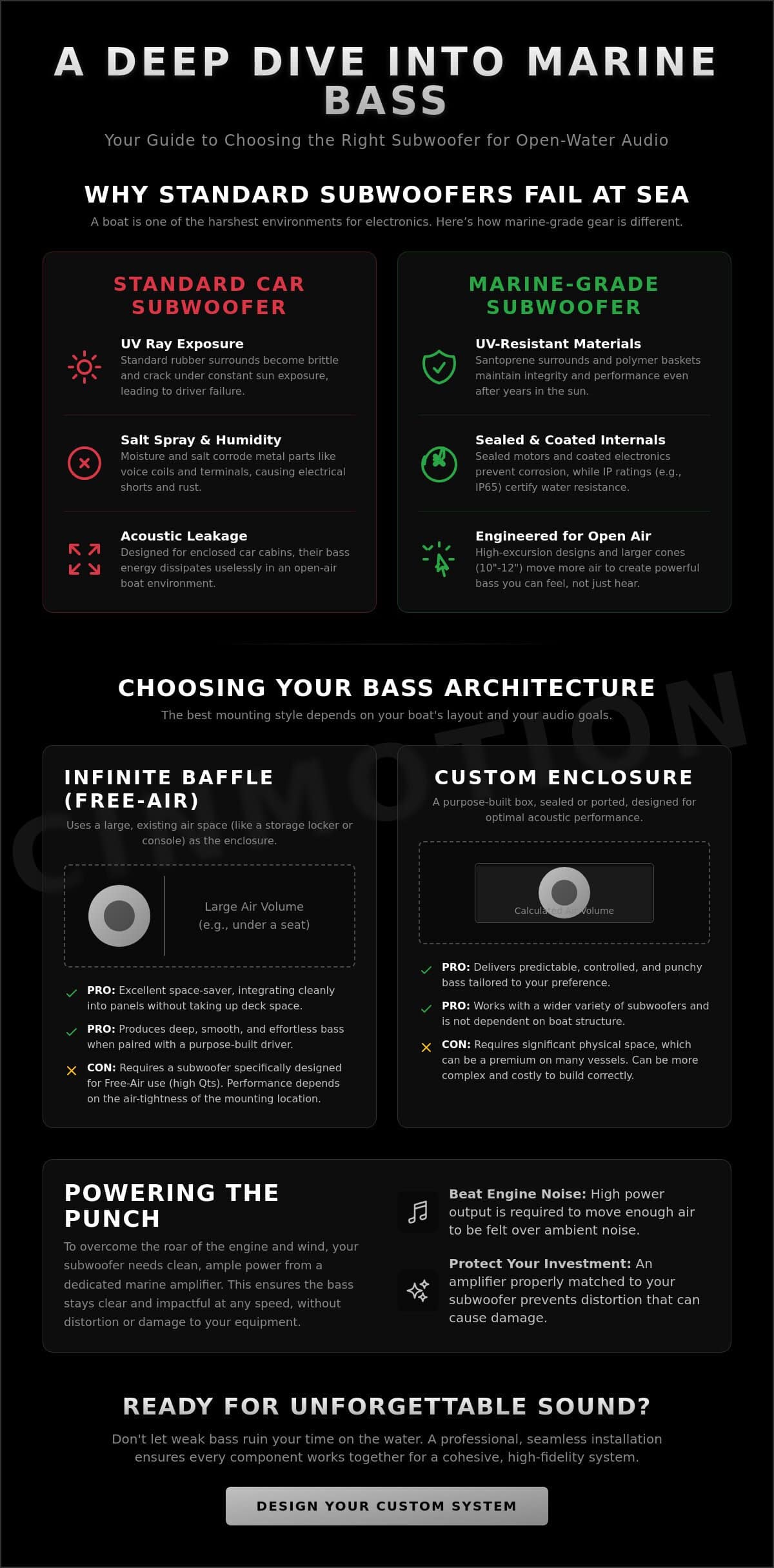
We’ve seen it happen too often. A boat owner installs a high-end car speaker, only to have it stop working after a few weeks on the lake. A standard subwoofer is designed for a dry, enclosed cabin where sound waves reflect off the roof and doors. This is known as the boundary effect, and it naturally boosts low-end frequencies. On the open water, that boundary doesn’t exist. Bass energy simply dissipates into the air, leaving your music sounding thin and weak. We call this acoustic leakage, and it’s the primary reason why car audio equipment fails to perform in a marine environment.
Salt spray, UV radiation, and constant vibration are the three primary enemies of your marine gear. Salt causes rapid corrosion in copper voice coils. UV rays turn standard rubber surrounds into brittle, cracked messes. High-frequency vibration from the hull can shake loose internal connections that weren’t designed for the sea. When we design premium marine audio systems, we account for these factors from the start. We know that the best marine subwoofer has to be tougher than anything you’d put in a truck. It requires specialized tuning to compensate for the lack of cabin gain and the high noise floor of the open deck.
Marine-Grade vs. Water-Resistant: The Crucial Difference
Don’t be fooled by vague marketing labels. “Water-resistant” usually means the speaker can handle a light mist, but it won’t survive a washdown or a heavy storm. We look for official Ingress Protection (IP) ratings to verify durability. An IP65 rating ensures the unit is protected against dust and low-pressure water jets. True marine subwoofers use Santoprene surrounds, plasticized spiders, and UV-stable polymer baskets. These materials won’t rot or warp in high humidity. We always warn against “marinized” car speakers. These are often just standard speakers with a white grille. They lack the internal drainage and salt-fog testing required for long-term survival on your vessel.
The Acoustic Challenge of the Open Deck
The biggest hurdle on a boat is the lack of containment. Because there are no walls to hold the sound, low frequencies disappear instantly. To get that impactful punch you can actually feel, you need to move a lot of air. This is why we typically recommend 10-inch or 12-inch drivers for marine use. A larger surface area allows the speaker to displace enough air to overcome the noise floor created by your engine and the wind. Finding the best marine subwoofer involves balancing this size with your available mounting space. It’s about creating enough pressure to cut through the roar of the water so your music stays clear at any speed.
Infinite Baffle vs. Enclosed: Choosing the Right Subwoofer Architecture
Deciding between an infinite baffle setup and a dedicated enclosure is the most critical step in your system design. The best marine subwoofer for your vessel isn’t always the most expensive one; it’s the one that matches your boat’s physical layout. While sound travels faster and farther in the ocean than in the air, your boat’s open deck presents a unique acoustic challenge. Without a cabin to trap the sound, we have to be strategic about how we mount the hardware to ensure the bass reaches your ears instead of disappearing over the stern.
We often see customers struggle with limited space, which usually dictates the mounting style. A sleek center console might require a different approach than a sprawling cruiser. Our goal is to find the balance between aesthetic integration and raw performance. We don’t believe in a one-size-fits-all solution. Instead, we look at the available cavities, the material of your hull, and how you typically use your boat to determine the ideal architecture.
Infinite Baffle (Free Air) Systems
Infinite baffle systems, commonly called “Free Air,” involve mounting the subwoofer directly into a fiberglass panel or seat base. The driver uses the large, irregular cavity behind the panel as its enclosure. There is a persistent myth that Free Air subs are lower quality than boxed versions. This is simply incorrect. When you use a high-Q driver specifically engineered for this application, the result is deep, effortless bass. These systems are incredible space-savers. A pontoon boat audio installation frequently relies on this method because the large bench seats provide the perfect volume of air for the speakers to breathe.
Enclosed Subwoofer Solutions
If you have the room, a dedicated enclosure can provide more “punch” and higher output levels. Sealed boxes are known for their tight, accurate response. Ported boxes offer more efficiency, which helps the bass cut through heavy engine roar at high speeds. For boats that lack flat mounting surfaces, pre-loaded tubes or external boxes are excellent alternatives. We frequently utilize our car audio fabrication techniques to build custom marine-grade boxes. These are designed to fit into specific lockers or under-dash areas, ensuring a professional look that blends with your boat’s interior. If you aren’t sure which style fits your hull, we can help you plan a custom layout that maximizes every inch of your deck.
Best Marine Subwoofers of 2026: Top Performers for Every Boat
Selecting the best marine subwoofer requires looking past the brand name to see how a unit handles the specific stresses of your vessel. We’ve tested dozens of configurations to see which drivers actually hold up when the salt and sun are at their worst. A subwoofer that sounds great in a showroom might fail on the water if it hasn’t undergone rigorous salt-fog and UV testing. We prioritize equipment that offers a balance of durability and acoustic precision. Whether you are outfitting a sleek center console or a massive pontoon, the right hardware makes all the difference in your listening experience. If you are looking for total system impact beyond just the low end, check out our guide on how to make my boat stereo louder.
The Ultimate Performer: JL Audio M6 Series
The JL Audio M6 series remains the industry standard for high-end fiberglass boats. Models like the M6-10W and M6-12W are specifically engineered for infinite baffle applications, meaning they don’t need a dedicated box to produce deep, accurate bass. Their Transflective™ RGB lighting integration is a standout feature. It provides smooth, even illumination that looks like a factory-installed luxury component rather than an aftermarket add-on. We find these are the best choice for owners who want audiophile-grade sound that integrates perfectly with their boat’s existing lines.
The Best for Pontoons and Towers: Wet Sounds REVO Series
For wakeboarding and large deck areas, you need raw output. Wet Sounds REVO subwoofers are built for this exact scenario. They utilize EFG™ (Epoxy Fiberglass) cones that are incredibly stiff and resistant to the elements. This durability allows them to push higher volumes without distortion, which is essential when you need the music to reach a rider 80 feet behind the boat. They offer a wide variety of grille options, making it easy to match custom boat interiors or aggressive tower setups.
The Best Value for Entry-Level Upgrades: Kicker KM Series
We often recommend the Kicker KM series as the ideal first upgrade for factory systems. These subwoofers are versatile and reliable. They frequently include both charcoal and white grilles in the box, giving you immediate flexibility during installation. The dual-voice coil options allow for creative wiring solutions, making it easier to pull maximum power from your amplifier. It is a solid, hard-hitting choice for the boater who wants a significant performance boost without a custom fabrication budget.
- JL Audio M6: Best for fiberglass boats and infinite baffle mounting.
- Wet Sounds REVO: Best for high-volume wake and tower applications.
- Kicker KM: Best for versatility and value-driven upgrades.
Powering the Punch: Amplification and Electrical Requirements
Even the best marine subwoofer won’t perform to its potential if it’s starved for power. Marine environments demand significantly more from an amplifier than a standard car cabin. On the water, you’re fighting the constant roar of the engine, the rush of the wind, and the wide-open sky that swallows low frequencies. Without enough wattage, your subwoofer will struggle and distort. This distortion generates excessive heat, which is the primary cause of voice coil failure. We always recommend choosing an amplifier with enough headroom to maintain a clean signal even when you’re cruising at high speeds.
We believe a successful installation starts with a robust electrical backbone. It’s not just about the hardware; it’s about the infrastructure that supports it. Before we even mount a driver, we ensure the boat’s charging system can handle the increased load. A weak electrical foundation leads to dimming lights, equipment resets, and poor sound quality. We prioritize reliability so you can focus on the internal experience of the music rather than worrying about your equipment.
Matching the Amplifier to the Subwoofer
When you’re selecting an amp, focus exclusively on the RMS (Root Mean Square) power rating. Ignore “Peak” or “Max” power numbers, as these are often marketing figures that don’t reflect real-world performance. A dedicated Mono-block Class D marine amplifier is the ideal choice for driving a subwoofer. These amplifiers are highly efficient, meaning they produce less heat and draw less current from your batteries. Safety is our top priority, so we only use marine-grade, tinned-copper wiring. Standard automotive wire will eventually succumb to “green rot” corrosion in a humid environment. Tinned copper resists this decay and ensures a consistent flow of power for years to come. We also utilize waterproof high-amperage circuit breakers to protect your vessel’s electrical system from shorts.
Dual Battery Systems and On-Board Charging
The fear of a dead battery is common among boaters who want a high-performance system. We solve this by separating the audio load from the engine’s needs. A dual-battery setup is the standard for any serious marine audio project. We designate one “Starting” battery for the engine and a separate “House” battery for the stereo, lighting, and accessories. To manage this, we install an Automatic Charging Relay (ACR). This smart device allows your alternator to charge both batteries while the engine is running but automatically isolates them when the engine is off. This ensures you always have plenty of cranking power to get home. For particularly high-wattage systems, we may suggest adding a secondary AGM battery or a high-capacity capacitor to stabilize the voltage during heavy bass hits. Before finalizing your power plan, we recommend reviewing our complete marine audio battery setup guide to understand how to properly isolate your cranking and house loads. If you want to ensure your boat is ready for a serious upgrade, we can audit your marine audio systems and build a power plan that never leaves you stranded.
- RMS Matching: Ensure your amp’s RMS output meets or slightly exceeds the subwoofer’s RMS rating.
- Tinned Copper: Use only marine-rated wire to prevent internal corrosion and resistance.
- Circuit Protection: Install ignition-protected breakers within 7 inches of the battery.
- Battery Isolation: Use an ACR to protect your starting battery from audio-related drain.
The Music In Motion Approach to Custom Marine Audio
Finding the best marine subwoofer is only half the battle. Even the most expensive driver can’t deliver its full potential if the installation is sloppy or the system design is flawed. We believe that the finished result is more than the sum of the parts. It is about how the hardware interacts with your boat’s specific acoustics and your personal listening habits. Our team focuses on delivering a complete solution that looks as good as it sounds. We treat every project as a partnership, ensuring that your investment provides long-term value and excitement. Whether we are working on a standard utility vessel or a complex custom cruiser, we apply the same level of technical precision and care.
Our expertise spans a wide spectrum of land and water-based transport. This versatility allows us to bring advanced techniques from different industries into the marine environment. We don’t just sell boxes and speakers; we provide a professional-grade transformation of your property. We pride ourselves on being specialists who remain focused on the practical needs of the user. This means we prioritize reliability and safety alongside high-end performance. We want you to feel confident every time you turn the key and crank the volume.
Custom Fabrication for Seamless Integration
A professional installation should look like it came from the factory. We specialize in custom fabrication that bridges the gap between aftermarket performance and OEM aesthetics. Our team creates custom mounting panels that perfectly match your boat’s gelcoat or upholstery textures. This isn’t just about looks; it’s about structural integrity. We ensure every mounting point has a 100% watertight seal to prevent hull rot or moisture intrusion. We also take pride in hiding all wiring and amplifiers behind existing panels. This creates a clean, uncluttered deck where the only evidence of an upgrade is the clear, impactful bass. Our goal is a “factory-plus” appearance that enhances the value of your vessel.
System Tuning for the Open Water
Tuning a boat is vastly different from tuning a car. We set crossovers and gains specifically for outdoor environments where wind and engine noise are constant factors. We balance the subwoofer with your existing marine audio systems to create a cohesive soundstage that stays clear at all speeds. Our process involves testing the system while the boat is stationary and while it is in motion to ensure the low end doesn’t disappear when you hit the throttle. We want the bass to provide a rich foundation for your entire music library without overpowering the vocals. If you are ready to transform your time on the water, we invite you to contact us for a custom marine audio consultation.
Elevate Your Experience on the Water
Achieving high-performance audio on a boat requires more than just high-end hardware. It demands a deep understanding of how sound behaves in open air and how to protect your equipment from the relentless salt and sun. We’ve explored how specialized engineering and the right mounting architecture create a foundation for deep, impactful bass. Whether you choose a high-output driver for tower speakers or a space-saving infinite baffle setup, the electrical backbone of your system remains the key to long-term reliability. Choosing the best marine subwoofer for your vessel is a significant decision, but the final result depends on how every component works together as a cohesive unit.
We’ve been refining the art of expert custom fabrication since 1994. As a national-level high-performance audio authority, we specialize in seamless marine-grade integration that respects the original lines of your boat. We don’t just sell parts; we deliver a finished experience that changes how you feel behind the wheel. Ready for deep, powerful bass on the water? Schedule your custom Marine Audio Consultation with Music In Motion today! We look forward to helping you build the perfect soundtrack for your next adventure.
Frequently Asked Questions
Can I use a car subwoofer in my boat if I keep it in a dry locker?
No, we don’t recommend using automotive equipment on a boat even if the area seems dry. High humidity and salt air penetrate every corner of a vessel, including sealed lockers. Car subwoofers lack the tinned-copper leads and UV-resistant materials required to survive these conditions. Within a single season, the internal components will likely corrode or the cone will warp from the constant moisture in the air.
Do I really need an amplifier for a marine subwoofer?
Yes, an amplifier is absolutely essential for any subwoofer installation. Your boat’s head unit doesn’t have the wattage to move a heavy subwoofer cone effectively. Without a dedicated amp, you’ll experience heavy distortion that can actually damage your speaker. A clean, powerful signal is the only way to hear your music clearly over the roar of the engine and the rush of the wind.
What is the best size for a marine subwoofer: 8, 10, or 12 inches?
A 10-inch or 12-inch driver is typically the best marine subwoofer size for most recreational boats. These larger sizes move enough air to create impactful bass in an open-deck environment where sound dissipates quickly. While 8-inch subs are great for compact cabins or small seating areas, they often struggle to cut through environmental noise at cruising speeds. We find that 10-inch models offer the best balance of performance and mounting flexibility.
Is it better to have one large subwoofer or two smaller ones on a boat?
Two smaller subwoofers often outperform a single large one because they distribute sound more evenly across the deck. Dual 10-inch subs provide more total cone surface area than a single 12-inch model, which results in more air displacement. This setup also makes it easier to find mounting locations in the fiberglass without requiring massive custom enclosures that take up valuable storage space.
How do I protect my marine subwoofer from salt and sun damage?
You protect your gear by selecting equipment with high Ingress Protection (IP) ratings and UV-stable polymers. Look for subwoofers with Santoprene surrounds and plasticized spiders that won’t rot in high humidity. We also suggest a light rinse with fresh water after salty outings. This prevents salt crystals from building up on the grilles or moving parts of the speaker over time.
Will adding a subwoofer drain my boat’s battery while the engine is off?
It will drain your battery if you don’t have a proper electrical foundation. Subwoofers require significant power, so we always suggest a dedicated house battery for your audio system. By using an Automatic Charging Relay, we ensure your starting battery stays fully charged. This allows you to enjoy deep bass at the sandbar without worrying about whether your engine will crank when it’s time to head home. For a complete breakdown of how to structure your power system, our marine audio battery setup reference guide covers everything from AGM vs. LFP battery selection to proper isolation strategies.
What does ‘Infinite Baffle’ mean in marine audio?
Infinite Baffle refers to a mounting style where the speaker doesn’t require a dedicated wooden box. The subwoofer uses the air trapped behind a seat base or inside a storage locker as its enclosure. This is a very common approach in marine audio because it saves space. It requires a specific type of driver designed to operate correctly without the back-pressure of a small, sealed box.
Can I install a marine subwoofer myself, or do I need a professional?
Professional installation is usually the best choice for marine projects involving custom fabrication or complex electrical work. While a simple speaker swap is manageable for some, cutting into fiberglass and sealing panels requires extreme precision. We ensure every connection is watertight and that the system is tuned for the unique acoustics of the water. This guarantees a finished result that lasts for many seasons.