
What if the high-tech gadget on your dashboard is actually leaving you completely exposed to a police laser gun? Many drivers assume a standard detector provides total coverage, but LiDAR technology has changed the rules of the road for 2026. We understand the anxiety that comes with seeing flashing lights in your rearview mirror, especially when you’ve already invested in what you thought was the best protection. Understanding laser jammers and their legality is the first step toward reclaiming your peace of mind on the open road.
You likely share the common fear of heavy fines and those dreaded insurance hikes that follow a single mistake. It’s frustrating to feel confused by technical jargon or worried about the legality of your vehicle modifications. We’re here to clear the air. This guide promises to help you master the technical and legal nuances of LiDAR defense so you can protect your driving record with confidence. We’ll break down how these systems function, detail the legal risks you need to know, and explain why a professional installation strategy is the key to a reliable, stealthy result.
Key Takeaways
- Learn why LiDAR’s narrow light beam requires a different defense strategy compared to traditional wide-beam radar.
- Gain a clear perspective by understanding laser jammers and their legality across federal and state lines in 2026.
- Discover why professional sensor placement and stealth fabrication are the most critical factors for a “Jam to Gun” result.
- Master the art of building a complete defense system by integrating high-performance radar detectors with active laser defense.
- Move beyond off-the-shelf products to a custom-tailored solution that protects your driving record and your vehicle’s aesthetic.
Understanding Laser Jammers: LiDAR vs. Radar Technology
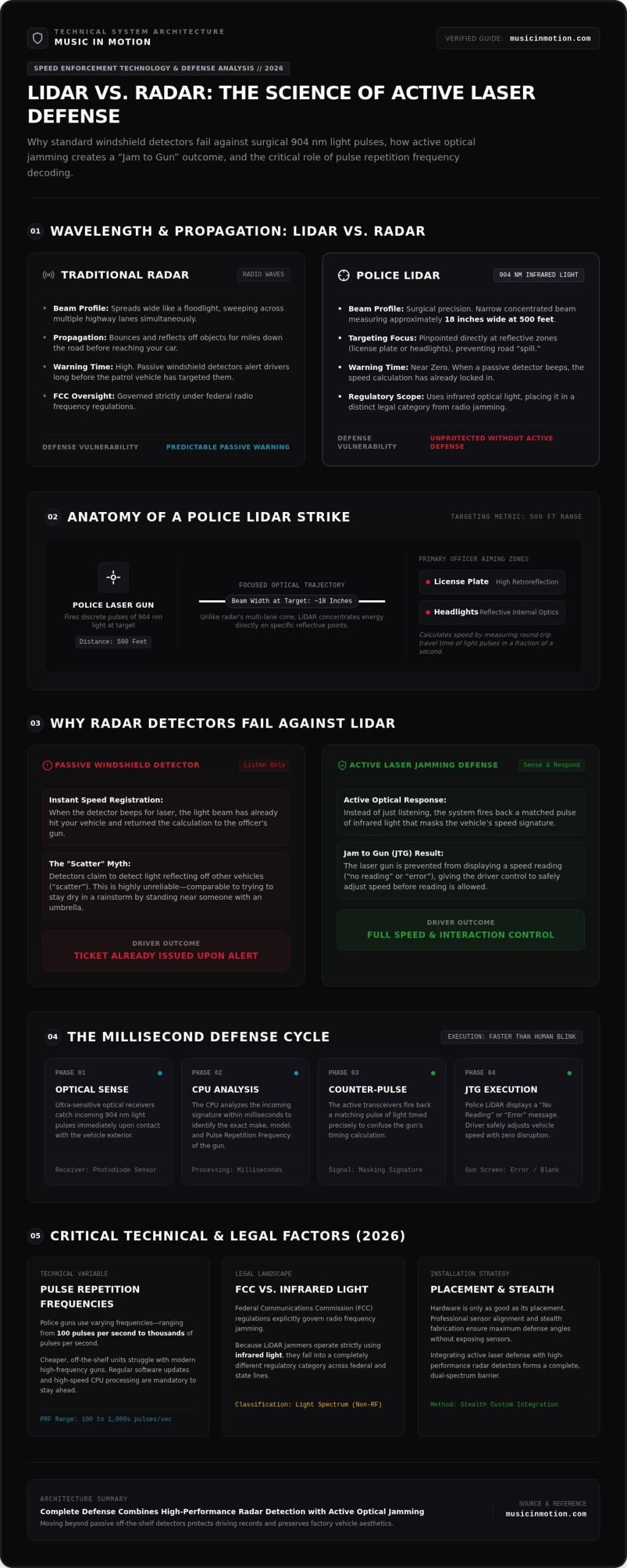
Speed enforcement has changed significantly over the last decade. While traditional radar is still in use, LiDAR (Light Detection and Ranging) has become the primary tool for law enforcement in 2026. Understanding laser jammers and their legality begins with recognizing that these two technologies are fundamentally different. Radar uses radio waves that spread out like a floodlight, covering multiple lanes and bouncing off objects for miles. In contrast, LiDAR uses a focused beam of infrared light. It’s precise, fast, and incredibly difficult to spot before it hits your vehicle. We’ve seen many drivers rely on outdated tech, only to be surprised by a ticket they never saw coming.
The Anatomy of a LiDAR Signal
A police laser gun works by firing short bursts of infrared light at a specific target on your car. It usually aims for reflective surfaces like your license plate or headlights. By measuring the time it takes for these pulses to travel to your car and back, the gun calculates your exact speed and distance. This process happens in a heartbeat. Because the beam is only about 18 inches wide at a distance of 500 feet, it doesn’t “spill” over the road like radar does. To get a better grasp of the physics involved, you can research how police LiDAR and laser jammers operate to see how 904 nm light pulses are tracked. Our team focuses on the technical precision required to counter these surgical strikes because we know that standard equipment often falls short.
Why Detectors Aren’t Enough
Many drivers rely on a windshield-mounted radar detector as their only line of defense. This is a risky strategy. Radar detectors are passive devices; they simply listen for signals. When a detector alerts you to a laser signal, it usually means the light beam has already hit your car and returned a speed reading to the officer. The “early warning” you expect with radar simply doesn’t exist here. While some detectors claim to pick up “scatter,” which is light reflecting off nearby vehicles, this is highly unreliable. Relying on scatter is like hoping to stay dry in a rainstorm by standing near someone with an umbrella. You need a dedicated, proactive solution to stay protected.
This is why we emphasize active defense over passive detection. A laser jammer doesn’t just listen; it responds. When it senses a LiDAR pulse, it fires back a signal that prevents the gun from displaying a speed. This gives you the control you need to adjust your driving without the panic of an immediate fine. Understanding laser jammers and their legality means realizing that a simple alert isn’t a solution, but a professional-grade active system is. We’re here to help you move from being a target to having a strategy that actually works.
How Laser Jammers Work: The Science of LiDAR Defense
Understanding laser jammers and their legality requires looking under the hood at the technology itself. The ultimate goal of any high-end system is what we call “Jam to Gun” (JTG). This means the police laser gun cannot display a speed reading until the vehicle is well within a range where the driver has already safely adjusted. We don’t just want an alert; we want control over the interaction. A successful JTG result relies on a sophisticated cycle of sensing, analyzing, and responding that happens faster than a human can blink.
When a police laser gun fires, it sends out a specific pulse pattern. Our systems use ultra-sensitive optical receivers to catch this light immediately. Once sensed, the system’s CPU analyzes the signal to identify the exact make and model of the laser gun. Unlike radio-based tools, these systems operate using infrared light. This is a critical distinction because FCC regulations on jamming devices apply specifically to radio frequencies, leaving light-based defense in a different regulatory category. After identification, the jammer fires back a matching pulse of light that effectively masks your vehicle’s speed signature, leaving the officer with a “no reading” or “error” code on their screen.
The Pulse Rate Battle
Modern speed enforcement guns use various Pulse Repetition Frequencies (PRF) to calculate speed. Some guns fire 100 pulses per second, while others fire thousands. A professional-grade defense system must have a powerful CPU to process these signals in milliseconds. We’ve seen that cheaper, off-the-shelf units often struggle with newer, high-frequency guns. In 2026, police technology is more diverse than ever, making high-speed processing and regular software updates essential for maintaining a reliable defense. We can help you choose the right radar and laser defense systems to ensure your hardware stays ahead of these evolving threats.
Jamming vs. Shifting
You might hear these devices called “laser shifters” instead of jammers. In the industry, “shifting” is often used to describe the process of moving the light’s return signal so the gun can’t lock on. It’s a softer term for the same active defense. The key is timing. If the response is off by even a fraction of a microsecond, the gun wins. We focus on stealth installations that allow the system to mask your vehicle effectively without drawing unnecessary attention. By merging technical precision with our “finished result” philosophy, we ensure your system works perfectly while remaining nearly invisible to the naked eye.
The Legal Landscape: Are Laser Jammers Legal in 2026?
The legal status of speed defense technology is often misunderstood by even the most seasoned drivers. While many people group radar and laser tools into the same category, the law treats them very differently. Understanding laser jammers and their legality requires a clear look at how federal and state agencies divide their oversight. At a federal level, there is a significant loophole that allows for the purchase and possession of these devices. However, state laws create a complex patchwork that every driver should understand before hitting the highway. We prioritize keeping our clients informed so they can enjoy their custom upgrades without unnecessary legal stress.
FCC vs. FDA: The Regulatory Divide
Federal law is very strict about radio frequency interference. The FCC prohibits any device that jams the radio spectrum, which makes radar jammers a federal felony. Laser jammers operate on a different principle. Because they use infrared light rather than radio waves, they fall completely outside FCC jurisdiction. Instead, the FDA regulates them as Class 1 laser products. This is the same classification used for computer mice or barcode scanners. Because light based vehicle accessories aren’t considered radio transmitters, you can legally buy and own these systems across the vast majority of the country.
2026 State Legality Guide
While they are federally legal, several states have passed specific laws to ban their use on public roads. In 2026, you will find strict prohibitions in states like California, Colorado, Illinois, Minnesota, Nebraska, Oklahoma, South Carolina, Tennessee, Utah, and Virginia. Texas is particularly clear on this point; under Texas Transportation Code Section 547.616, it is illegal to operate, install, or even possess a device designed to interfere with radar or laser signals. In these restricted areas, law enforcement officers are often trained to look for specific “error” codes on their guns that suggest a jammer is active.
Understanding laser jammers and their legality also means knowing the difference between possession and active use. In some jurisdictions, simply having the hardware installed can lead to a citation, while others only penalize you if the system is caught in action. This is why our “finished result” philosophy is so important. By using stealth fabrication techniques, we ensure that your sensors are tucked away and integrated into the vehicle’s design. This protects the aesthetic of your car and keeps your defense system discreet during a routine visual inspection. We believe in giving you the tools to stay protected while keeping your vehicle’s profile clean and professional.
Professional Selection and Stealth Installation
Buying the best technology on the market won’t help you if the installation is handled poorly. We see many drivers invest in premium hardware only to have it fail because of a sloppy DIY mounting job. Sensor placement is the single most important factor in system performance. Our “finished result” philosophy ensures your vehicle keeps its high-end look while gaining elite protection. We focus on custom fabrication that integrates sensors into the natural lines of your car, truck, or motorcycle. This approach provides a seamless appearance that looks like it came straight from the factory.
Common mistakes often involve visible wiring or placing sensors behind plastic trim that blocks infrared light. Understanding laser jammers and their legality means realizing that a visible, poorly mounted sensor isn’t just an eyesore; it’s a signal to law enforcement. We avoid these pitfalls by using specialized mounting strategies that keep the system discreet and fully functional. Our team prioritizes reliability. We treat every vehicle with the care it deserves, ensuring that your defense system is ready for the road without compromising your car’s aesthetic.
Sensor Alignment and Leveling
Precision is mandatory for any active defense. Sensors must be perfectly level and parallel to the ground to catch incoming light pulses effectively. Even a small 2-degree tilt can create a massive blind spot in your defense, allowing a police laser gun to get a reading before your system can respond. We use professional leveling tools and laser alignment systems to ensure total coverage. This technical rigor is why we handle the complex setup for you. We don’t just “clip it on”; we calibrate it for maximum impact.
The Art of Stealth Fabrication
We take pride in making your defense system look like a natural part of your vehicle. This often involves Custom Car Audio Fabrication techniques to create hidden mounting points. We use infrared-transparent acrylic to hide sensors behind grilles or bumpers without losing a bit of performance. Our team builds custom brackets that require no permanent damage to your vehicle, preserving its resale value and structural integrity. This level of customization is what sets a professional installation apart from a generic one.
We are ready to help you build a system that is as beautiful as it is effective. If you want a setup that blends perfectly with your car’s design while offering total peace of mind, contact us to explore our Radar and Laser Defense Systems today.
Building a Complete Defense: The Integrated Approach
We often tell our clients that a standalone jammer is only half the battle. While a jammer is your best defense against surgical LiDAR strikes, it can’t see the long-range radio waves used by traditional radar guns. To achieve true peace of mind, we recommend a multi-layered strategy. This involves integrating your active laser defense with a high-performance radar detector. Mastering the technical side of understanding laser jammers and their legality is essential, but the final piece of the puzzle is how you combine these tools into a single, cohesive system.
A complete setup allows you to monitor the road for miles in every direction. We specialize in creating custom-tailored solutions that fit your specific driving habits. For more depth on the hardware side, you can explore our Laser Defense System for Cars guide. We help you choose the right components so you aren’t just buying gadgets; you’re investing in a professional result that works when it matters most.
Radar and Laser Synergy
These two systems work together to create a safety bubble around your vehicle. Radar detectors excel at catching signals from around corners or over hills, giving you plenty of time to react. You can choose between a discreet dash-mounted unit or a fully integrated, custom-installed radar system that hides within your cabin. When we link these with your laser jammers, the system becomes a unified front against speed enforcement. You can see how these fit into a broader protection plan in our Vehicle Safety Systems Roundup. We ensure the interface is simple and easy to read so you stay focused on the road.
The Human Element: How to Use Your System
Technology is only as good as the person behind the wheel. We teach our clients the “Jam to Kill” protocol to ensure they use their systems responsibly. When your system alerts you to a laser strike, your first step is to check your speed and brake safely. Once you’ve reached the speed limit, you must use your kill switch to turn the jammer off. This allows the officer to eventually get a clean reading, which prevents unwanted attention. If you “Jam to Gun” all the way past the officer, it’s a red flag that you’re using an active defense. Understanding laser jammers and their legality means knowing that being discreet is your best legal protection. Training yourself to react calmly to high-intensity alerts ensures that you remain in control of the situation at all times.
Secure Your Drive with Expert LiDAR Defense
Speed enforcement technology moves fast, but your vehicle’s defense can move faster. By mastering the technical differences between radio waves and infrared light, you’re already ahead of the curve. Understanding laser jammers and their legality gives you the power to choose a system that protects your driving record without compromising your vehicle’s factory look. We’ve shown how critical professional sensor alignment and stealth fabrication are for achieving a reliable result that keeps you in control of every encounter on the road.
Our team brings over 30 years of custom vehicle electronics experience to every project. We specialize in high-end, stealth radar and laser integration that blends seamlessly with your car’s unique design. This national reputation for precision fabrication means your property is in safe hands from start to finish. We prioritize the finished result over a simple transaction, ensuring your system performs at its peak when you need it most. Explore Professional Laser Defense Solutions at Music In Motion and start driving with the confidence that comes from total, expert-level protection.
Frequently Asked Questions
Are laser jammers illegal in the United States at a federal level?
No, laser jammers are not illegal at the federal level in the United States. Federal law, specifically FCC regulations, prohibits devices that jam radio frequencies. Since laser jammers use infrared light rather than radio waves, they don’t fall under FCC jurisdiction. They are instead classified by the FDA as Class 1 laser products. This distinction is crucial for understanding laser jammers and their legality across the country.
What is the difference between a radar detector and a laser jammer?
A radar detector is a passive device that listens for radio waves emitted by police radar guns. It’s like a radio that alerts you when a signal is nearby. A laser jammer is an active defense system. When it detects a light pulse from a LiDAR gun, it fires back its own light signal to prevent the gun from calculating your speed. One just listens, while the other actively responds.
Can police tell if I am using a laser jammer?
Police can sometimes tell if you’re using a jammer if they see an “Error” or “Jam” code on their gun. However, our stealth fabrication techniques make the hardware nearly invisible to the naked eye. We also teach you the “Jam to Kill” protocol. By slowing down and turning the system off quickly, you allow the officer to get a normal reading, which helps you avoid drawing unwanted attention to your vehicle.
Do laser jammers work against all types of police laser guns?
High-end systems are designed to counter the vast majority of police laser guns used in 2026. However, law enforcement agencies constantly update their technology with new pulse rates and frequencies. This is why we emphasize the importance of regular software updates. A system that worked perfectly last year might need a firmware refresh to stay effective against the latest anti-jamming LiDAR guns hitting the streets today.
Is it difficult to install a laser jammer myself?
While DIY kits exist, we don’t recommend installing these systems yourself. LiDAR defense is a game of millimeters. If a sensor is tilted by just a couple of degrees or is slightly obstructed by a bumper lip, you’ll have a blind spot that leaves you exposed. We use professional alignment tools and custom mounting brackets to ensure your sensors are perfectly level and parallel to the road for 360-degree protection.
How much does it cost to have a professional install a laser defense system?
The cost of a professional installation varies based on the complexity of your vehicle and the number of sensors required for total coverage. Every car has unique mounting challenges, from intricate grilles to aerodynamic bumpers. We focus on providing a finished result that prioritizes performance and aesthetics. While we don’t provide flat rates, we can help you determine the best configuration for your specific needs and vehicle type.
Do I need a laser jammer if I already have a high-end radar detector?
Yes, you still need a jammer because radar detectors are often ineffective against laser. Radar spreads out in a wide beam, but LiDAR is a pinpoint light pulse that hits your car almost instantly. By the time your radar detector alerts you to a laser strike, the officer usually already has your speed reading. Understanding laser jammers and their legality means realizing that a complete defense requires both passive detection and active countermeasures.
What happens if I am caught with a laser jammer in a state where they are banned?
If you’re caught using a jammer in a state where they are prohibited, penalties typically include a fine and the possible confiscation of the device. Some states, like Texas, have very specific statutes that ban the possession and use of these devices. This is why we focus on stealth installations and user training. We want you to enjoy the benefits of your system while minimizing your visual profile on the road.