The wrong frequency sent to a high-end tweeter doesn’t just sound bad; it’s often a fatal mistake for your equipment. We’ve seen many enthusiasts hesitate to upgrade because they’re worried about the technical complexity of active vs passive crossovers car audio setups. It’s a valid concern. You want a soundstage that feels wide and clear, but the fear of blowing a driver or overcomplicating your amplifier rack often stalls a project before it starts. We understand that you want professional-grade results without needing an engineering degree to enjoy your drive.
This 2026 guide clears the fog around system architecture so you can choose the right path for your vehicle. We’ll break down the critical differences between the plug-and-play simplicity of passive networks and the surgical precision of active tuning. You’ll gain a clear understanding of the equipment required for each setup and how these choices impact your final soundstage. We’re moving beyond mere hardware to focus on the finished result: a system that’s reliable, powerful, and perfectly tailored to your ears. From daily drivers to custom marine builds, we’ll help you find the balance that works for your lifestyle.
Key Takeaways
- Understand how crossovers act as traffic controllers to protect your speakers from damaging frequencies and ensure crystal-clear audio.
- Identify the benefits of passive crossovers for straightforward, reliable upgrades that don’t require additional power sources.
- Compare active vs passive crossovers car audio to determine if your build requires the surgical precision and tuning flexibility of an active system.
- Learn why professional calibration with specialized tools like Real-Time Analyzers is essential for unlocking the full potential of an active setup.
- Gain the confidence to choose a system architecture that balances your budget with your desire for a high-fidelity listening experience.
What is a Car Audio Crossover and Why Do You Need One?
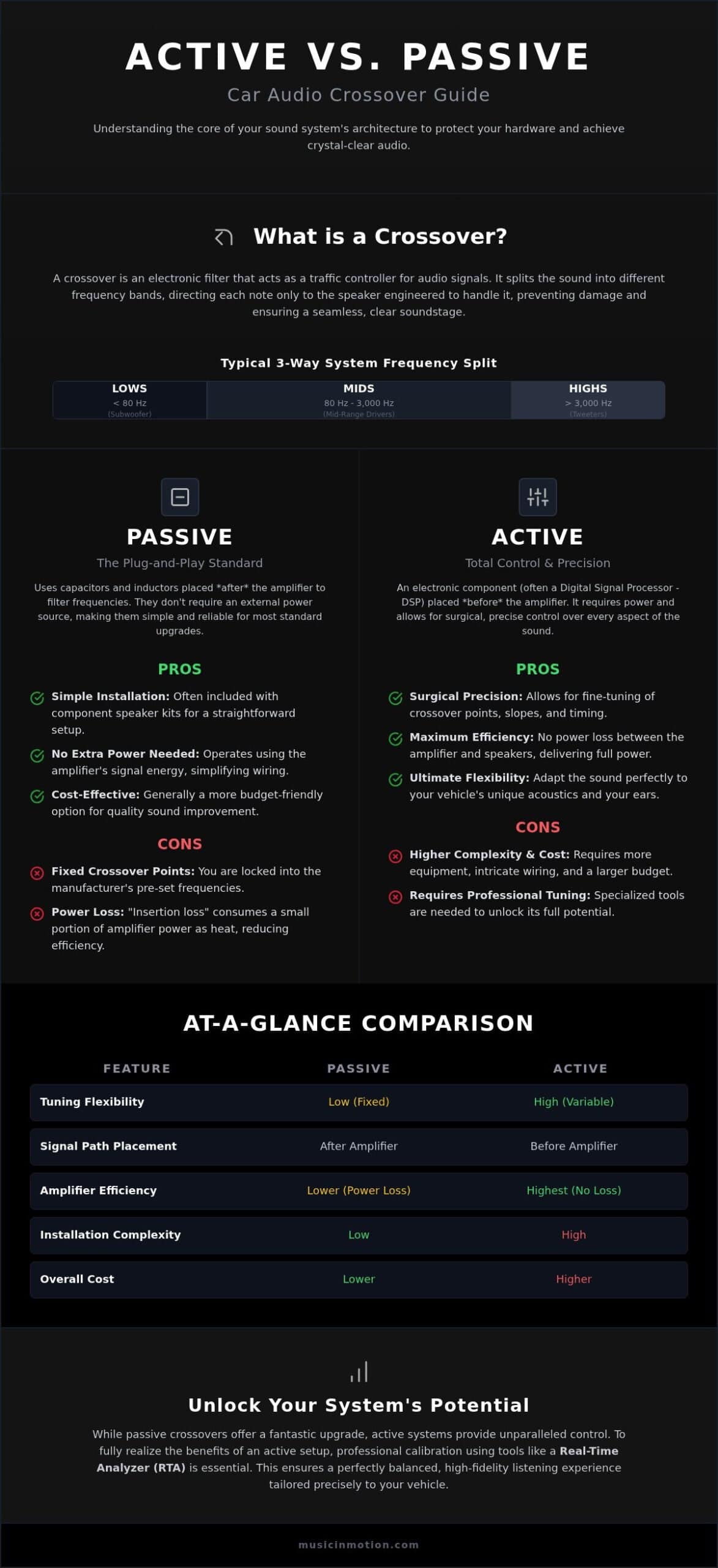
A crossover is the silent conductor of your vehicle’s orchestra. At its core, it’s an electronic filter designed to split the full-range audio signal into specific frequency bands. We use these filters to ensure that each speaker in your car only receives the notes it was engineered to play. This isn’t just about sound quality; it’s about survival for your hardware. Without a crossover, your delicate tweeters would attempt to reproduce deep, vibrating bass notes. This leads to immediate physical damage and a blown voice coil. We prioritize these components to protect your investment and keep your music clear at high volumes.
Beyond protection, crossovers are the key to a seamless frequency response. When multiple speakers play the same overlapping frequencies, they can cancel each other out or create harsh peaks. A well-designed crossover creates a smooth hand-off from the subwoofer to the door speakers, and finally to the tweeters. This prevents clipping and distortion, allowing your amplifiers to work more efficiently. When deciding between active vs passive crossovers car audio, the goal remains the same: total clarity and safety for every driver in your system.
The Traffic Controller Analogy
We often describe audio frequencies as a high-speed, multi-lane highway. Imagine the low-frequency bass notes as heavy, slow-moving freight trucks and the high-frequency treble as nimble, fast sports cars. The crossover acts as the essential system of off-ramps and interchanges. It directs the freight trucks toward the heavy-duty subwoofer industrial zones and keeps the sports cars on the expressway toward the tweeters. When this traffic control fails, the result is a muddy, congested mess. If a freight truck tries to take a tight sports car exit, it crashes. In your audio system, that crash sounds like a distorted tweeter or a ruined mid-range driver.
Frequency Ranges: Highs, Mids, and Lows
Achieving a perfect soundstage requires precise crossover points. For a standard three-way system, we typically set subwoofers to handle everything below 80Hz. Mid-range drivers take the meat of the music between 80Hz and 3,000Hz, while tweeters handle the crisp details above that mark. The slope of the crossover, measured in decibels per octave, determines how aggressively the signal is cut off. A 24dB slope is a steep cliff, providing maximum protection and separation. Many factory systems use very basic, shallow filters that often result in a flat, lifeless sound. If you’re planning a car audio upgrade for stock stereo, replacing these weak factory points is the first step toward high-fidelity audio.
Passive Crossovers: The Plug-and-Play Standard
Passive crossovers represent the most common entry point for high-quality sound. We often find these small, rectangular boxes included in aftermarket component speaker kits. They sit directly in the signal path between your amplifier and your speakers. We call them “passive” because they don’t require their own power source to function. They simply use the electrical energy from your music signal to do their job. This makes them a cost-effective and reliable choice for many standard car audio upgrades.
While they are convenient, they do come with technical trade-offs. One major factor is “insertion loss.” Because these components are placed after the amplifier, they consume a small portion of the power, converting it into heat instead of sound. When comparing active vs passive crossovers car audio, this loss of efficiency is one reason why high-output systems often move away from passive designs. You also face fixed crossover points; you’re locked into the settings the manufacturer chose in the factory. This limits your ability to adjust the sound if your car’s interior creates unusual echoes or dead spots.
How Passive Networks Work
Passive networks rely on capacitors and inductors to filter the signal. Capacitors act as high-pass filters, blocking low bass notes from reaching your tweeters. Inductors, or coils, act as low-pass filters to keep high frequencies out of your woofers. These components are precisely matched to specific drivers, such as those found in premium marine audio systems or high-end car component sets. This matching ensures the speakers perform safely, though it prevents you from “tweaking” the transition point between the woofer and the tweeter to better suit your personal taste.
When to Choose a Passive Setup
Choosing a passive setup is often the best move for daily drivers or entry-level builds where space is at a premium. You only need two amplifier channels to power a full front stage of four speakers. This keeps your installation clean and your equipment list short. However, you won’t have access to advanced features like time alignment or individual driver level control. If you want a straightforward path to better sound without the complexity of a digital processor, we can help you select a high-performance component set that delivers immediate results. It’s a reliable, effective solution that works for most listeners who want to improve their commute without rebuilding the entire car.
Active Crossovers: Total Control and Precision
Active crossovers shift the filtration process to the beginning of the signal chain. Unlike the passive units we discussed previously, active filters process the audio signal before it reaches your amplifiers. This architecture requires a dedicated amplifier channel for every single driver in your vehicle. For a standard two-way front stage, this means using four channels of amplification instead of two. We call this bi-amping. While it increases the amount of hardware in your rack, the level of precision it unlocks is unparalleled. We use this approach when the goal is a truly custom, high-fidelity listening experience.
In 2026, the brain of nearly every high-end active system is the Digital Signal Processor (DSP). These units allow us to perform surgical adjustments that were impossible with traditional hardware. We can set exact crossover points down to the single hertz and choose slopes that perfectly protect your drivers. This level of control is why active setups are the foundation for complex car audio fabrication projects. We aren’t just installing speakers; we’re building a custom-tuned environment that matches the unique acoustics of your cabin.
The Power of the DSP
A DSP handles more than just frequency splits; it manages the entire soundstage. One of the most critical features is time alignment. Because you sit closer to the left speaker than the right in a car, the sound reaches your ears at different times, which ruins the stereo image. We use the DSP to delay the signal from the nearest speakers by mere milliseconds. This ensures the sound from every driver hits your ears at the exact same moment. The result is a perfect center image on your dashboard, making it feel like the band is performing right on your hood. This is a primary reason why the active vs passive crossovers car audio choice is so vital for enthusiasts.
Efficiency and Headroom
Efficiency is another major advantage of the active path. By removing the passive components between the amp and the speaker, we eliminate insertion loss entirely. Every watt your amplifier produces goes directly to the speaker’s voice coil. This results in a system that sounds significantly louder and cleaner, even when using the same amount of raw power. Because the crossover is digital and external, you aren’t limited to using speakers from a single manufacturer’s “kit.” We can mix and match the best tweeters from one brand with high-output woofers from another to create a sound profile that is uniquely yours.
Many modern high-performance amplifiers now feature integrated DSPs. This all-in-one approach reduces the complexity of your equipment rack while maintaining the surgical control of a standalone processor. It’s a streamlined, professional solution that brings world-class tuning to almost any vehicle without sacrificing cargo space.
Active vs. Passive: Which Architecture is Right for You?
Choosing between active vs passive crossovers car audio often comes down to the balance between your budget and your expectations for the final soundstage. Passive systems are cost-effective because they require fewer amplifier channels and less wiring labor. We typically recommend them for listeners who want a substantial boost in clarity without rebuilding the entire car. On the other hand, active systems represent the absolute ceiling of audio performance. While they require a larger investment in hardware and professional tuning time, they provide the surgical control necessary for a world-class listening experience.
Installation complexity is another major factor. A passive setup is relatively simple; we run one pair of wires from the amplifier to the crossover, then split to the speakers. An active setup requires individual wire runs for every single driver in the system. This increases the labor and materials needed, but it’s the only way to achieve perfect time alignment. We also consider your vehicle’s environment. A noisy convertible or a rugged powersports vehicle often requires the raw output and aggressive EQ of an active system to cut through wind and engine noise. A quiet luxury sedan might reach your goals with a high-end passive component set.
The Decision Matrix: Goal-Based Selection
- Scenario A: You want a significant step up from factory sound with minimal modifications. A high-quality passive component set is your best path. It’s reliable, sounds great, and keeps the equipment list short.
- Scenario B: You’re building a custom system and want a “concert on the dashboard” experience. You need an active system. The ability to tune every speaker individually is the only way to achieve a perfect center image.
- Scenario C: You’re integrating with modern vehicle safety systems and factory screens. We often use active DSPs here to strip away factory EQ and keep your safety chimes and sensors functioning perfectly.
Reliability and System Longevity
We’ve found that active systems offer a unique level of reliability through software. A properly tuned DSP includes “fail-safe” settings that prevent anyone from accidentally turning the volume up high enough to fry a tweeter. Passive crossovers, while durable, rely on physical components like capacitors and coils. Over years of extreme cabin heat and vibration, these components can eventually drift in value or fail. An active system remains stable and adjustable for the life of the vehicle. However, this stability depends entirely on the initial calibration. We use professional-grade tools to ensure your active crossover points are set safely before you ever hit the road. If you’re ready to upgrade, our team can help you design a custom audio architecture that fits your specific vehicle and listening style.
Professional Integration: The Music In Motion Approach
A perfect system on paper doesn’t always translate to a perfect experience on the road. We’ve seen many enthusiasts spend significant amounts on high-end components only to be disappointed by the final sound. This is where professional integration makes the difference. When you’re weighing the choice of active vs passive crossovers car audio, remember that the hardware is just the beginning. An active system is a powerful tool, but it’s also a complex one. Without professional measurement, you’re essentially guessing at the settings that define your soundstage.
We use specialized tools like Real-Time Analyzers (RTA) to map the acoustic response of your cabin. Every vehicle has unique acoustic fingerprints; reflections and dead spots are caused by glass, plastic, and upholstery. We identify these issues and use the DSP to correct them. We also employ oscilloscopes to set amplifier gains with surgical precision. This ensures your system stays clear and distortion-free, even when you’re pushing the volume. Our goal is to protect your equipment while unlocking its absolute maximum potential.
Custom Fabrication for Active Systems
Active tuning is most effective when the speakers are physically positioned for success. We often build custom A-pillars or kick panels to optimize driver aiming. These custom locations reduce the need for heavy digital processing, resulting in a more natural sound. We also take pride in our stealth integration. We can house multiple amplifiers and complex signal processors in hidden enclosures, maintaining your vehicle’s utility and factory look. We use premium grounding techniques and high-quality wiring to prevent alternator whine and signal interference. This attention to detail ensures your background is dead silent so your music can shine.
The Value of Professional Tuning
We believe that high-performance audio should be reliable and approachable. You shouldn’t have to worry about the technical details of slopes and frequencies. Our team handles the complexity so you can focus on the feeling of the drive. We don’t just sell equipment; we deliver a finished result that improves your daily life. Whether you’re upgrading a daily driver or a custom marine build, we focus on the emotional impact of the music. We’re ready to help you find the perfect balance for your next project. Our philosophy prioritizes the delivery of a finished result over the mere transaction of goods, ensuring your system sounds as good as it looks.
Contact Music In Motion for a Professional Audio Consultation
Elevate Your Driving Experience with Precision Audio
Choosing between active vs passive crossovers car audio architectures marks the difference between a simple upgrade and a world-class soundstage. While passive systems offer a reliable, plug-and-play solution for many vehicles, the surgical precision of an active DSP-driven setup unlocks the true potential of your equipment. We’ve seen how professional measurement and custom fabrication turn a collection of hardware into a seamless, immersive listening environment. Whether you want the simplicity of a matched component set or the “concert on the dashboard” feel of active tuning, the right choice depends on your specific goals.
We’ve been refining our expert system design since 1994, establishing ourselves as nationwide leaders in custom vehicle fabrication. As specialists in DSP tuning and active system integration, we handle the technical complexity so you can simply enjoy the music. We’re ready to help you navigate these choices to find the perfect balance for your car, boat, or motorcycle. Schedule Your Custom Audio Consultation with Music In Motion today. We look forward to helping you transform your daily commute into a high-fidelity experience.
Frequently Asked Questions
Can I use an active crossover with my existing factory radio?
Yes, you can certainly integrate an active setup with a factory head unit. Modern active crossovers and Digital Signal Processors (DSPs) often feature high-level inputs designed to accept signals directly from your original radio. We use these processors to strip away the pre-set factory equalization, providing a clean, flat signal for your new amplifiers. This allows you to maintain your dashboard’s look and safety features while enjoying professional-grade tuning precision.
Do I need a separate amplifier channel for every speaker in an active system?
A dedicated amplifier channel for each individual driver is the standard requirement for an active architecture. In a traditional passive setup, one channel powers both a woofer and a tweeter through a shared filter box. When comparing active vs passive crossovers car audio, the active route requires more amplification because the signal is split before reaching the amp. This gives you independent control over every speaker’s volume, timing, and safety limits.
Is a DSP the same thing as an active crossover?
A Digital Signal Processor (DSP) includes an active crossover, but it offers significantly more control. While a basic active crossover only splits frequencies, a DSP provides surgical equalization, time alignment, and phase control for every speaker in the vehicle. Most modern high-end active systems use a DSP as the primary brain. It’s the most advanced way to handle the signal processing required for a custom-tuned, high-performance vehicle environment.
Can I mix active and passive crossovers in the same car audio system?
We often mix these architectures in “hybrid” systems to balance performance and cost. For example, you might use an active crossover to split the signal between your subwoofer and your front door speakers, while using a passive crossover to manage the split between the front woofer and tweeter. This approach provides the surgical control of active bass management while maintaining the simplicity and lower equipment cost of passive components for the higher frequencies.
What is the best crossover frequency for my car’s tweeters?
Most car audio tweeters perform best with a crossover point set between 3,000Hz and 5,000Hz. Setting the point too low can cause physical damage because the tweeter cannot handle the high-energy vibrations of lower frequencies. We always check the manufacturer’s specifications for the “resonant frequency” and set the filter at least one full octave above that point. This ensures long-term reliability and crisp, clear high-end detail in your soundstage.
Will an active crossover make my speakers louder?
An active crossover can make your system sound louder by improving overall efficiency. By removing the passive components between the amplifier and the speaker, you eliminate “insertion loss,” meaning all the power goes directly to the voice coil. Additionally, active systems allow us to maximize the headroom of each amplifier channel. This results in a cleaner, more impactful sound at high volumes compared to a standard passive configuration using the same raw wattage.
Why do active crossovers require a 12V power connection?
Active crossovers use electronic circuitry and transistors to filter the audio signal, which requires a constant power source to function. Passive crossovers are “unpowered” because they rely on the electrical energy already present in the amplified audio signal. Because active units process the signal at a low level before it reaches the amplifier, they need a dedicated 12V connection to maintain signal integrity and provide the necessary processing power for real-time tuning.
Is an active system worth it for a marine audio setup?
Active systems are incredibly valuable in marine environments where you must overcome massive amounts of wind and engine noise. The ability to tune each speaker individually allows us to push the limits of your equipment without risking damage in open-air conditions. When comparing active vs passive crossovers car audio or marine audio, the active path provides the raw output and durability needed for a high-performance sound that stays clear across the water.