You could spend over a thousand dollars on a top-tier driver and still end up with bass that sounds like a rattling tin can. It’s a frustrating reality many enthusiasts face: spending big on hardware only to be let down by thin, muddy sound or annoying port noises. When we look at the debate of a custom vs prefab subwoofer box, the enclosure isn’t just a wooden container. It’s a critical engineering component that dictates exactly how air moves inside your vehicle.
We understand the appeal of a quick fix, and prefab boxes offer a level of convenience that’s hard to ignore. However, we also know the disappointment of losing your entire trunk to a generic cube that wasn’t designed for your specific car. This article helps you weigh those trade-offs. You’ll discover why the box matters as much as the driver and learn how to choose between off-the-shelf ease and the surgical precision of custom fabrication. We’ll break down the differences in material quality, air volume math, and long-term reliability so you can finally achieve the professional, deep-hitting results your music deserves.
Key Takeaways
- Learn why the right enclosure is a precise engineering solution that unlocks the full potential of your high-end driver.
- Compare the practical trade-offs of a custom vs prefab subwoofer box to see which option balances your budget with your performance goals.
- Discover how premium materials and internal bracing prevent the air leaks and rattling that often plague standard off-the-shelf boxes.
- Find out how to reclaim your trunk space while using your vehicle’s specific interior shape to naturally boost bass response.
- See why we prioritize a finished result that integrates seamlessly with your vehicle’s electronics for a professional, reliable installation.
Prefab vs. Custom Subwoofer Boxes: Defining the Options
Deciding on a custom vs prefab subwoofer box is often the first major fork in the road for a car audio build. For many beginners, a prefabricated enclosure is the default choice because it’s sitting on the shelf ready for immediate use. You buy it, bolt in the driver, and you’re on the road. But there is a fundamental trade-off at play. You are choosing immediate convenience over long-term acoustic performance. We see the enclosure as the most influential component in your system; it acts as the lungs of your subwoofer.
The Reality of Mass-Produced Prefab Enclosures
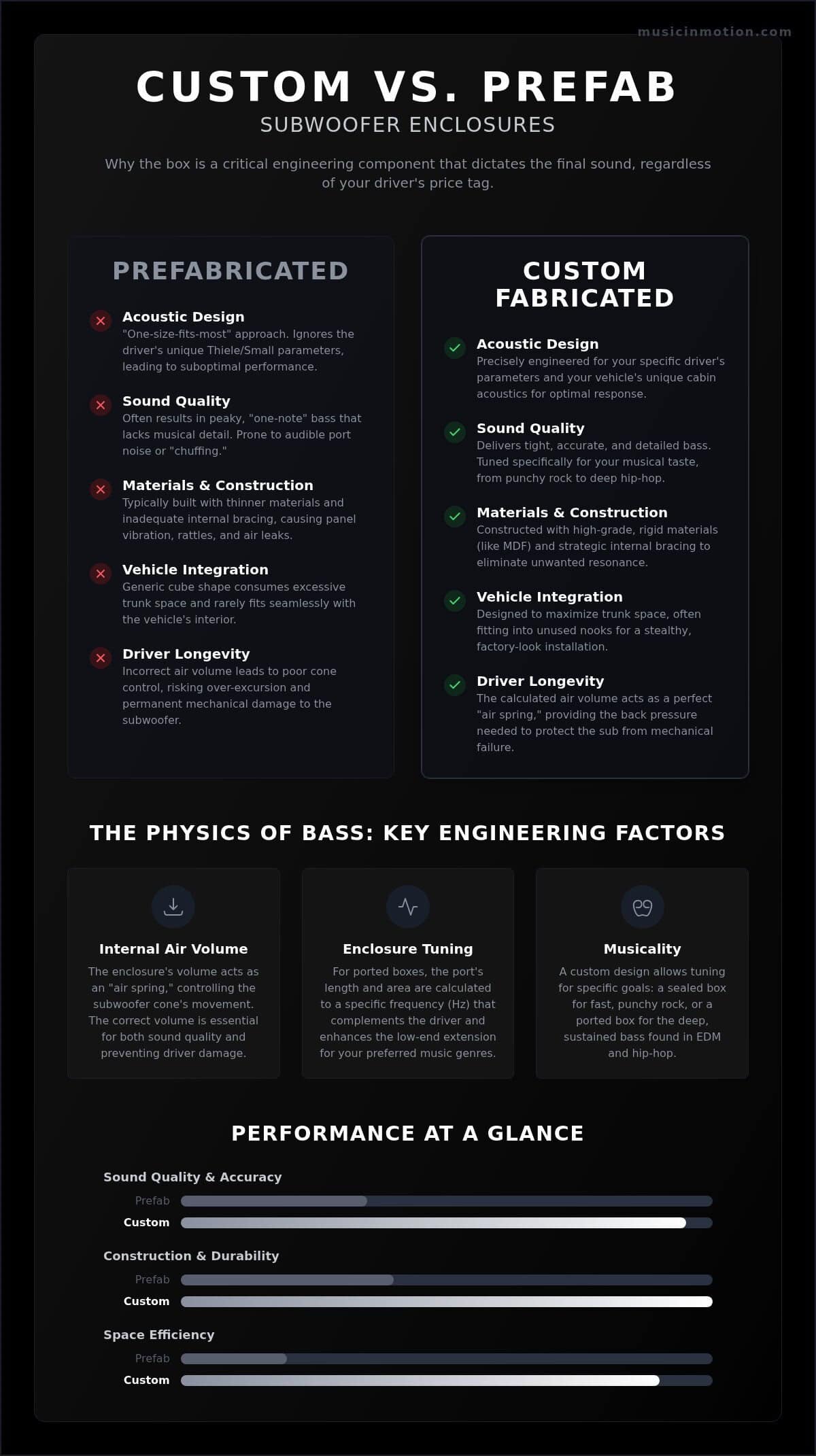
Manufacturers design prefab boxes to accommodate a wide range of different subwoofers. They aim for an “average” internal volume that works well enough for many different brands. However, regarding The Physics of Bass, “well enough” usually means compromise. When a box is too large or too small for a specific driver, you get peaky, boomy bass that lacks musical detail. You might have an expensive, high-end subwoofer, but a cheap box can easily ruin the performance of a premium driver. These generic enclosures often use thinner materials and lack the internal bracing needed to handle high-pressure levels without vibrating or “chuffing.”
The Custom Fabrication Philosophy
When you look at the custom vs prefab subwoofer box debate from a performance standpoint, the custom side is about removing limitations. Our approach starts with a blueprint, not a saw. We don’t view the enclosure as a separate accessory; we treat it as a fundamental part of your vehicle’s architecture. A custom subwoofer box is an enclosure engineered specifically for a driver’s Thiele/Small parameters and a vehicle’s unique cabin acoustics. This process allows us to design for your specific goals, whether you want a stealthy installation that saves trunk space or a high-output system designed for maximum impact. We focus on the finished result, ensuring the technical math of the box matches the air space available in your vehicle. By solving these puzzles before the first piece of wood is cut, we guarantee that your equipment is optimized for both sound quality and longevity. This collaborative design phase is what separates a standard audio upgrade from a truly professional system integration.
The Physics of Bass: Why Internal Volume and Tuning Matter
Every subwoofer has a unique personality defined by its Thiele/Small (T/S) parameters. Think of these as the DNA of your driver. These specifications tell us exactly how much air the speaker needs to move to produce accurate sound. When comparing a custom vs prefab subwoofer box, the prefab option usually ignores these specific numbers in favor of a “one-size-fits-most” approach. This often results in a high “Q” factor, which creates boomy, one-note bass that lacks musical detail and precision.
Port design is another area where generic boxes often fail. If a port is too small or tuned to the wrong frequency, you’ll experience “chuffing.” This is the audible sound of air rushing through the opening, which ruins the listening experience. We calculate the exact port displacement and area needed to ensure smooth, silent airflow. Understanding the different types of subwoofer enclosures is essential to this process. Whether you need the tight accuracy of a sealed box or the high efficiency of a ported design, the math must be perfect for the driver to function as intended.
Tuning for Your Musical Taste
Your favorite playlist should dictate the design of your enclosure. Rock and metal fans generally prefer the fast, punchy transient response that a custom sealed enclosure provides. Conversely, hip-hop or EDM listeners usually want the massive low-end extension found in a precisely tuned ported box. We find the “sweet spot” by adjusting the internal air volume and port length to match your specific genres. Customization is the only way to ensure your system doesn’t just play loud, but plays accurately. If you’re looking for a setup that reflects your personal style, our team at Music In Motion can help you dial in that perfect balance.
Mechanical Power Handling and Longevity
Many enthusiasts worry about thermal failure, but mechanical failure is just as dangerous. The air trapped inside a box acts like a spring. It provides the necessary back pressure to control the physical movement of the subwoofer cone. If an enclosure is too large, that air spring becomes too weak. This allows the subwoofer to move past its physical limits, a condition known as over-excursion. This often leads to torn surrounds, bottomed-out voice coils, or permanent driver damage. A custom enclosure acts as a form of equipment insurance. We engineer the internal pressure to keep the driver within its safe operating range, ensuring your investment sounds great for years without the risk of mechanical breakdown.
Construction Standards: Materials, Bracing, and Rigidity
When we weigh the value of a custom vs prefab subwoofer box, construction quality is where the gap becomes a chasm. Most people focus on the subwoofer’s power rating, but enclosure rigidity is the most overlooked factor in real-world performance. If the walls of your box flex even a millimeter, you lose acoustic energy. Every vibration of the box wall is energy stolen from the bass output. This flex creates a muddy, imprecise sound because the energy intended for your ears is wasted vibrating the wood itself. We solve this through superior materials and strategic internal bracing that eliminates wall flex entirely.
Material Science in Custom Enclosures
Material choice impacts more than just sound; it affects your vehicle’s daily drivability. While most prefab boxes use standard 3/4-inch MDF (Medium-Density Fiberboard), many budget options rely on low-density particle board that crumbles under high pressure. We prefer high-grade, 13-ply Baltic Birch plywood for high-output systems. It offers a significantly better strength-to-weight ratio than standard MDF. This choice results in a more rigid enclosure that weighs less, helping preserve your vehicle’s fuel efficiency without sacrificing a single decibel of punch.
Assembly Techniques for Maximum Output
A box is only as strong as its weakest joint. We treat assembly as a craft. “Close enough” doesn’t cut it when you’re dealing with the massive pressure levels of a modern subwoofer. We ensure every seam is perfectly airtight to prevent pressure leaks that cause whistling or chuffing. For heavy, high-excursion drivers, we employ double baffles. This adds a second layer of material to the mounting surface. It allows us to flush-mount the driver for a professional look while providing the structural support needed for extreme cone movement.
We also utilize advanced fabrication techniques to optimize airflow and strength:
- Kerf bending: This involves precise cuts to create smooth, rounded corners for better internal air movement.
- 45-degree corner inserts: These reinforce joints and reduce internal standing waves that can color the sound.
- Internal resin coating: We use this to seal the wood grain and increase surface density for maximum reflection.
These details ensure the custom vs prefab subwoofer box choice isn’t just about price. It’s about building a foundation that lets your audio system perform at its absolute peak. By focusing on the math and the build quality, we deliver a finished result that lasts for the life of your vehicle.
Optimizing Vehicle Space: Integration and Cabin Gain
One of the most common complaints we hear about car audio is the loss of trunk space. A prefab box is often a space killer. It is a generic cube that ignores the contours of your vehicle. When you compare a custom vs prefab subwoofer box, you’re choosing between a bulky obstacle and an integrated solution. We design enclosures that fit into unused cavities. These include side panels, under-seat areas, or spare tire wells. This allows you to keep your cargo space while gaining world-class bass.
Your vehicle’s interior acts as a secondary enclosure. This is known as cabin gain. The shape and volume of your car naturally amplify certain frequencies. A generic box ignores this variable. We calculate how your specific cabin will interact with the subwoofer. This ensures the bass sounds balanced and powerful at the driver’s seat. It won’t just be loud in the trunk. It will be accurate to the recording and feel like it’s part of the music rather than an afterthought.
Many modern vehicles have complex infotainment systems. If you are planning a Car Audio Upgrade for Stock Stereo, custom fabrication is essential. It allows us to hide the enclosure and integration hardware. This maintains the factory look while completely transforming the sound. We focus on the finished result, ensuring the new bass matches the existing system’s output and your personal listening preferences.
Aesthetic and Stealth Integration
We believe a great installation should look like it came from the factory. Our fabrication team matches vinyl, carpet, and leather to your vehicle’s original upholstery. We ensure you still have access to spare tires and cargo tie-downs. This stealth approach is perfect for those who want high-performance audio without the cluttered look of a generic box. We can even integrate subtle LED lighting that matches your vehicle’s interior theme for a professional touch.
Acoustic Placement and Phase Alignment
The direction your subwoofer faces changes how it sounds. Facing it toward the rear often provides better loading against the tailgate. This increases output through physical reinforcement. Facing it upward might be better for an SUV to avoid floor rattles. We solve phase cancellation issues by choosing the perfect placement. We use signal processing to align the bass with your front speakers. This level of precision is a major factor in the custom vs prefab subwoofer box decision. The finished result is a system that sounds like it was built for your car. Because it was.
Ready to reclaim your trunk and upgrade your sound? Contact Music In Motion to discuss a vehicle-specific enclosure design that fits your lifestyle.
The Professional Advantage: Why Custom Fabrication Wins in 2026
Choosing between a custom vs prefab subwoofer box is ultimately a choice between a commodity and a craft. We believe that a high-performance audio system is only as good as its weakest link. In many cases, that link is a generic enclosure that wasn’t designed for the specific electrical and mechanical environment of your car. Professional fabrication is an investment in a finished result. It ensures that every component works in harmony with your vehicle’s existing systems rather than fighting against them.
Modern vehicles in 2026 are packed with sophisticated technology, from blind-spot sensors to complex data buses. An amateur installation can lead to electrical noise or even system failures. We prioritize safety and reliability, ensuring that high-current power draws are properly fused and integrated. This level of detail is a core part of Custom Car Audio Fabrication, where we blend art and science to create something that looks and performs better than factory equipment.
Tuning the System to the Enclosure
The build is only half the battle. Once the enclosure is installed, we use professional diagnostic tools like oscilloscopes and RTA meters to calibrate your system. We set gains with precision to ensure your amplifier never sends a clipped signal to your subwoofer. This protects your voice coils and ensures the cleanest possible output. We also integrate Digital Signal Processing (DSP) to align the phase and frequency response of the sub with your cabin’s acoustics. There is a massive difference between “loud” bass and “accurate” bass. Our tuning process ensures you experience the latter, with every kick drum and bass line sounding exactly as the artist intended.
Summary: Is Custom Right for You?
Deciding on a custom vs prefab subwoofer box depends on your long-term goals. If you are looking for a temporary boost in a secondary vehicle, a prefab box might suffice. However, if you take pride in your vehicle and want a system that lasts for years, custom fabrication is the clear winner. It adds a level of prestige and resale value that a generic box simply cannot match. You gain a professional-looking installation that preserves your trunk’s utility while delivering elite sound quality. We invite you to consult with our specialists to see how we can turn your vision into a reality. We focus on the math and the craftsmanship so you can focus on the drive.
Upgrade Your Driving Experience with Precision Engineering
The choice between a custom vs prefab subwoofer box isn’t just about aesthetics; it’s about how the music feels when you’re behind the wheel. We’ve explored how proper internal volume protects your equipment and how rigid materials prevent energy loss. By choosing a solution tailored to your vehicle’s unique cabin gain, you can reclaim your cargo space while gaining elite sound quality. We focus on the math and the craftsmanship so your audio system performs at its absolute peak.
We bring over 30 years of custom fabrication expertise to every build. As an authorized dealer for premium audio brands, we specialize in seamless vehicle integration that respects your car’s original design. We’re here to solve the complex engineering puzzles so you can enjoy a reliable, high-performance system for years to come. Your vehicle deserves a solution that matches your lifestyle and your musical taste. Let’s build something that makes every drive memorable.
Frequently Asked Questions
Is a custom subwoofer box really worth the extra cost?
Yes, a custom enclosure is worth the investment if you prioritize sound quality and vehicle utility. While prefab boxes are cheaper upfront, they often compromise the driver’s performance and waste cargo space. We design custom solutions to match your subwoofer’s exact specifications, ensuring you get the full output you paid for. It’s a choice between a temporary part and a finished result that enhances your daily drive.
What is the best material for a custom subwoofer enclosure?
We recommend 13-ply Baltic Birch plywood for high-performance builds. It offers a superior strength-to-weight ratio compared to standard MDF, which means a more rigid box that won’t vibrate or flex. While MDF is a common industry standard for budget builds, Baltic Birch handles extreme pressure better and helps maintain your vehicle’s fuel efficiency by keeping the total weight lower. We prioritize these premium materials to ensure long-term reliability.
Can I use a prefab box and just modify it myself?
You can add bracing or sealant to a prefab box, but you can’t easily change its internal volume or port tuning. Modifying a generic enclosure often leads to structural weaknesses or air leaks that ruin sound quality. If the original math of the box doesn’t match your subwoofer’s DNA, even the best modifications won’t fix the underlying acoustic issues. We suggest starting with a clean-sheet design to avoid these compromises.
How much trunk space will I lose with a custom subwoofer box?
You’ll likely save more space with a custom design than with a generic prefab option. We specialize in stealth integration, building enclosures into side panels, spare tire wells, or under-seat cavities. Prefab boxes are usually bulky cubes that sit in the middle of your trunk. In the custom vs prefab subwoofer box debate, customization is the only way to get deep bass without sacrificing your vehicle’s practical utility.
Does a custom box make a cheap subwoofer sound better?
A well-engineered box can significantly improve the performance of an entry-level driver. Even a budget subwoofer will sound tighter and more controlled when placed in an enclosure with the correct air volume and bracing. However, a custom box won’t change the physical limits of a cheap speaker. We view the enclosure as a foundation; it ensures your equipment, regardless of price, is operating at its absolute peak potential.
What is the difference between sealed and ported custom boxes?
Sealed boxes are smaller and prioritize tight, accurate bass with excellent transient response, making them ideal for rock or jazz. Ported boxes use a vent to increase efficiency and low-end extension, which is perfect for hip-hop or EDM. We help you choose based on your musical taste and available space. Both designs require precise math to ensure the air spring inside the box correctly controls the subwoofer’s movement.
How do I know what tuning frequency my custom box should have?
Tuning frequency depends on your subwoofer’s parameters and the type of music you enjoy. Most daily-driver ported systems are tuned between 32Hz and 35Hz for a balance of punch and low-end reach. If you tune too high, the bass sounds peaky and annoying. If you tune too low, you lose output. We solve this math for you, ensuring the port is optimized for the specific custom vs prefab subwoofer box application you need.
Will a custom box protect my subwoofer from blowing?
Yes, a custom enclosure provides the correct internal air pressure to control the subwoofer’s cone. This back pressure prevents over-excursion, which is a leading cause of mechanical failure. Prefab boxes are often too large for high-power drivers, leaving them unsupported and prone to damage even at rated power. We engineer our enclosures as a form of equipment insurance, protecting your investment while delivering the professional sound quality you expect.