Why does your favorite singer sound like they’re trapped in your driver-side door pocket instead of performing right on your dashboard? It’s a common frustration for many enthusiasts. You invest in premium speakers and a powerful amplifier, yet the music still feels lopsided, flat, and stuck at your feet. We understand that feeling of disappointment when high-end gear doesn’t immediately deliver the “live” experience you were promised.
The reality is that your car’s interior is an acoustic nightmare where you’re always sitting in the “wrong” seat. This guide on car audio time alignment explained will show you how to bridge that gap. We’ll help you master the science of digital delay to eliminate acoustic imbalance and create a perfectly centered, high-end soundstage. You’ll learn how to achieve a “phantom center” where vocals float right on the hood and your subwoofer blends seamlessly with your front speakers. We’re going to walk through the essential role of a DSP and give you the confidence to use tuning software to transform your daily commute into a front-row concert experience.
Key Takeaways
- Understand how digital delay tricks your brain into ignoring the physical proximity of the driver-side speaker to restore acoustic balance.
- In this guide, you’ll find car audio time alignment explained as the essential solution to the off-center listening position inherent in every vehicle.
- Learn why a Digital Sound Processor (DSP) is the mandatory tool for achieving professional-grade results through active speaker control.
- Discover our step-by-step methodology for measuring speaker distances and establishing the furthest driver as your primary timing reference.
- Gain the skills to phase-align your subwoofer with your mid-bass drivers for a punchy, unified performance that feels like one cohesive system.
The Physics of Sound: What is Car Audio Time Alignment?
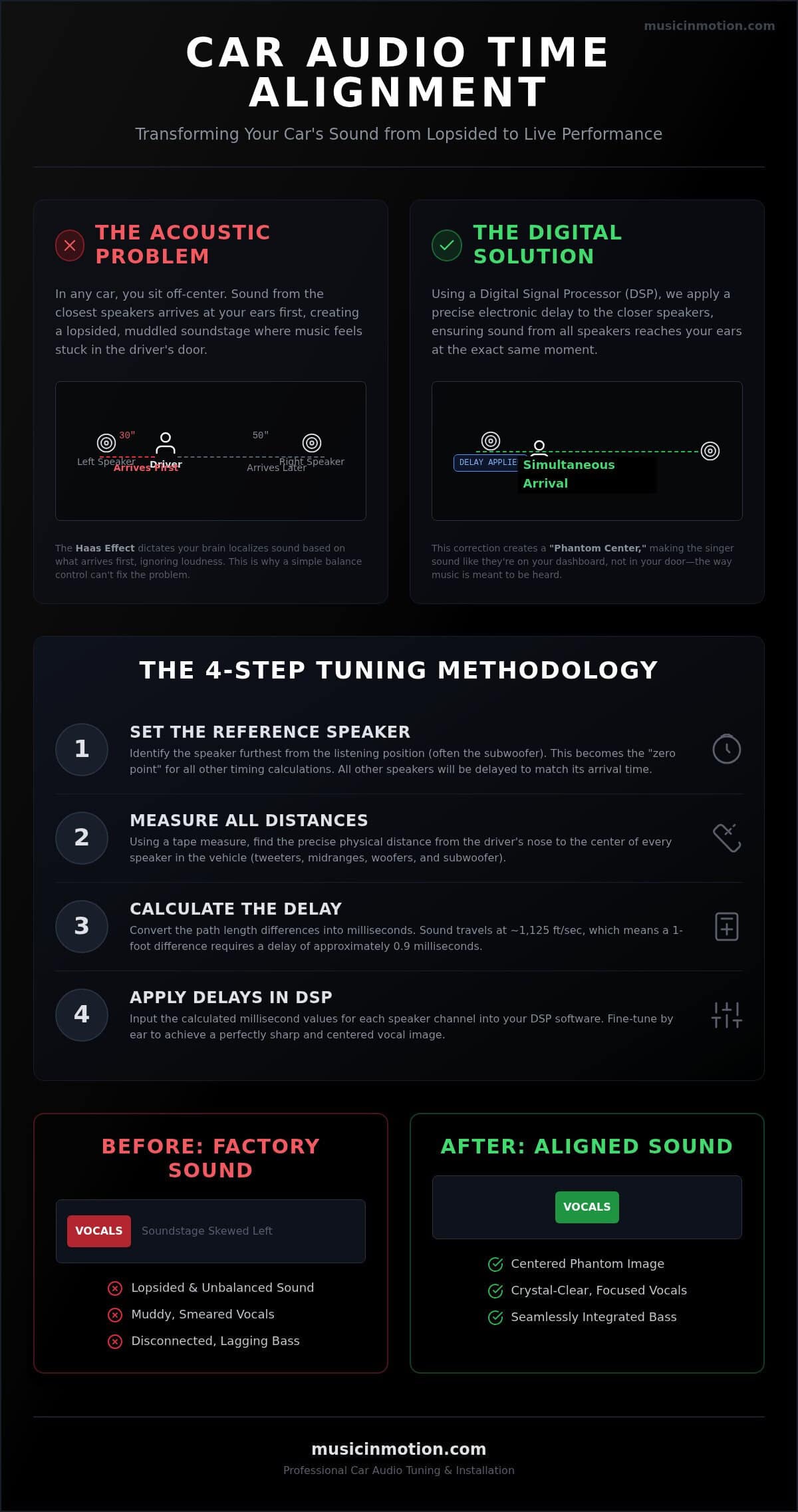
Sound waves are fast, but they aren’t instantaneous. In a typical vehicle, you’re never sitting in the middle of your speakers. You might be thirty inches from the driver-side tweeter and fifty inches from the passenger-side one. Because sound travels at roughly 1,125 feet per second, those twenty inches create a massive timing gap. Having car audio time alignment explained simply starts with this: it’s the process of using a digital processor to delay the closest speakers. We do this so every sound wave, from the deepest 20Hz bass to the highest 20kHz shimmer, reaches your ears at the exact same moment.
To get this right, we look at the math. Sound moves at approximately 1.13 feet per millisecond. If your left speaker is one foot closer than your right, it needs a delay of about 0.9 milliseconds to stay in sync. This level of precision is fundamental to Loudspeaker time-alignment in any multi-driver system. Without it, your music sounds messy and disorganized. By delaying the near-side speakers, we effectively “push” them back digitally until they’re equidistant from your head. This creates a balanced, cohesive experience that feels natural instead of lopsided.
The Haas Effect and Your Brain
Your brain is incredibly sensitive to timing. The Haas Effect, often called the precedence effect, dictates that our brains prioritize the sound that arrives first to determine where a noise is coming from. Even if the passenger-side speaker is louder, your brain will “lock” onto the driver-side door because the sound hits your ear first. This is why standard volume balance controls always fail to fix a bad soundstage. They change the intensity, but they don’t change the reality of the timing. When we fix the timing, the “phantom center” appears. Suddenly, the singer isn’t in your door; they’re standing right on your dashboard.
Milliseconds vs. Inches
Tuning is a game of measurements. We start by identifying a “Reference Speaker,” which is usually the furthest driver in the system, like the subwoofer or the far-right kick panel. We then measure the distance from your head to every other speaker. We convert these physical inches into digital milliseconds of delay. Even a tiny 0.5ms adjustment can be the difference between a vocal that sounds “blurry” and one that sounds razor-sharp. Our team focuses on these micro-adjustments because they’re what turn a pile of expensive hardware into a high-end audio system, achieving a level of precision similar to the controlled environments at Starsound Studios. It’s the final, essential step in any professional build.
Why Your Car is Acoustically Broken (and How Delay Fixes It)
Your vehicle is likely the only place where you’re forced to sit in the worst possible spot for critical listening. In a home theater or a professional studio, you sit centered between the left and right speakers. In your car, you’re crammed against the left door, inches from one speaker and feet away from the other. This creates what we call the “Center Seat” problem. Because you’re physically closer to the driver-side speakers, those sound waves hit your eardrum significantly earlier than the ones from the passenger side. This timing delta is why factory systems often sound “muddy” or “smeared.” The waves arrive out of sync, causing phase cancellations that rob the music of its life and clarity. At Music In Motion, we don’t just install parts; we correct the vehicle’s acoustic environment.
To fix this, we use Digital Signal Processing (DSP) to realign the arrival times. By delaying the speakers closest to you, we trick your brain into thinking you’re sitting exactly in the middle of the soundstage. This is car audio time alignment explained at its most practical level: it’s the digital correction of a physical flaw. Without this step, even the most expensive speakers will struggle to sound better than a basic factory setup because they’re still fighting the car’s interior layout.
The Path Length Challenge
Precision starts with a tape measure. We calculate the distance from your nose to every individual tweeter, midrange, and woofer in the cabin. The floor, dashboard, and glass act as acoustic obstacles that can bounce or block frequencies, but the most significant timing lag usually comes from the trunk. Because subwoofers are often located the furthest away, their low-frequency notes arrive long after the high-frequency notes from your dash tweeters. This lack of cohesion makes the bass feel disconnected from the rest of the music. We solve this by using the subwoofer as our timing foundation and delaying everything else to match its pace.
Localization and the ‘Phantom Center’
The ultimate goal of a professional tune is the “phantom center.” This is a phenomenon where the singer’s voice sounds like it’s coming from a single point on the dashboard, right above your steering wheel, rather than from the doors. Proper time alignment “detaches” the sound from the physical speaker locations. It creates a sense of stereo depth, where instruments have specific places in a 3D space. You don’t just hear the music; you feel the stage. If you’re ready to stop listening to your doors and start listening to the performance, it might be time to explore Car Audio Upgrades that prioritize this level of digital precision.
The DSP Solution: How Digital Delay Works in 2026
A Digital Sound Processor (DSP) is the brain of any modern high-fidelity system. It acts as the central command post, allowing us to manipulate every aspect of the audio signal before it ever reaches your speakers. To get car audio time alignment explained properly, we have to talk about active control. In a traditional passive system, one amplifier channel might power both a tweeter and a woofer. This makes it impossible to delay them separately. An active system gives each speaker its own dedicated channel, which is the only way to ensure every driver is perfectly in sync with your ears.
This level of control is necessary to overcome the psychoacoustic phenomenon where your brain prioritizes the first sound it hears. By 2026 standards, professional-grade DSPs offer incredible resolution. We’re no longer limited to coarse adjustments. Modern processors allow us to tune in increments of 0.01ms, which is roughly equivalent to moving a speaker just 1/8th of an inch. This precision is what allows us to lock in a razor-sharp soundstage that feels three-dimensional and immersive.
Head Units vs. External DSPs
We often see enthusiasts rely on the basic time correction built into their aftermarket head units. While these are a start, they’re usually too generic for a truly high-end result. Standalone DSPs provide the processing power needed for complex custom car audio fabrication projects where speaker placement is unique. They also allow us to integrate seamlessly with factory infotainment screens. If you want to keep your dashboard looking original while achieving world-class sound, consider a Car Audio Upgrade for Stock Stereo that utilizes an external processor.
The Resolution of Tuning
Maintaining audio quality during digital delay requires high bit-depth and significant processing power. If a processor lacks the “muscle” to handle these calculations, you might experience a loss of detail or added noise. High-resolution DSPs ensure that the signal remains pure even as we apply complex timing offsets. Digital Latency is the total time it takes for a processor to convert and output the signal; it’s a fixed value we account for during the initial system design to keep the audio perfectly synced with any video playback on your dash. We prioritize processors that keep this latency low while providing the granular control needed for a perfect tune.
Measuring for Success: A Step-by-Step Tuning Methodology
Achieving a world-class soundstage requires more than just high-end equipment. It requires a disciplined approach to measurement. Having car audio time alignment explained only gets you halfway there; the real magic happens during the execution. We always start with a clear roadmap to ensure every driver in the system is contributing to a unified image. If you’re tackling this yourself, grab a friend and a high-quality tape measure. Precision is the foundation of a great tune.
The Tape Measure Method
- Step 1: Sit in the driver’s seat in your natural listening position. Have your helper hold the end of the tape measure at your nose while you pull it to the center of each speaker’s dust cap. Measure every tweeter, midrange, and woofer individually.
- Step 2: Identify your Reference Point. This is the furthest speaker in the vehicle, which is almost always the subwoofer or the passenger-side kick panel speaker. This driver stays at zero delay.
- Step 3: Calculate the difference. Subtract the distance of each closer speaker from the distance of the reference speaker. Enter these values into your DSP software to align the system.
We emphasize using a helper because accuracy at head level is critical. If your measurements are off by even an inch, the center image will shift. This physical measurement phase is the essential first step before you ever touch a tuning microphone.
Acoustic Measurement (RTA and Impulse Response)
Physical distances provide a great starting point, but they don’t tell the whole story. Reflections from the windshield, side glass, and dashboard can change when a sound actually reaches your ears. This is why physical distance doesn’t always equal acoustic arrival time. We use a Real-Time Analyzer (RTA) and a specialized measurement microphone to look at the impulse response of each channel. This allows us to see exactly when the sound arrives at the listening position, regardless of what the tape measure says.
Once the data is in, we fine-tune by ear. We recommend using a high-quality mono vocal track for this stage. If the time alignment is correct, the singer should sound like a tight, focused point in the center of your dashboard. If the image is blurry or shifted, we make micro-adjustments in 0.02ms increments until the center is rock-solid. If you’re looking for a partner to help dial in your system, our team is ready to help with your next Custom Installation.
The Final Result: Integrating Time Alignment into a High-Performance Build
Time alignment is the final, crucial step in our tuning process. It happens only after we’ve completed professional car audio tuning, which includes setting levels, equalizing the cabin, and defining crossover points. Think of it as the glue that holds the entire acoustic image together. When we have car audio time alignment explained to our clients, we describe it as the moment the physical speakers “disappear.” You stop hearing sound coming from the door panels or the dash corners. Instead, the cabin boundaries seem to expand, and you’re left with a cohesive performance right on your dashboard. This transformation is where your investment in high-end hardware finally pays off. Our team prioritizes the sensory experience of the driver above all else; we want you to feel the music, not just hear the equipment. Outside of the automotive world, this same dedication to immersive quality is found in professional event production from Debut Media, ensuring corporate gatherings achieve a similar level of audio-visual impact.
One of the most satisfying results of proper timing is making the bass sound like it’s coming from the front dash rather than the trunk. In most vehicles, the subwoofer is the furthest speaker from your ears. This physical distance causes the bass notes to arrive late, making the low end feel disconnected or “slow.” The secret to fixing this is actually delaying the front speakers to wait for the subwoofer’s signal. By aligning the arrival times, we create a seamless blend where the bass feels like it’s hitting the dashboard at the exact same moment as your mid-bass drivers. We test this impact with kick-drum heavy tracks. If the timing is right, the kick feels like one solid, unified punch directly in front of you.
Phase vs. Time Alignment
It’s vital to understand that shifting time also shifts phase. If two speakers play the same frequency but their timing is slightly off, they can cancel each other out, leading to “thin” sound or missing notes. This is a common pitfall that simple DIY tunes often miss. We use a phase-flip test at the crossover points to verify acoustic summation. By temporarily reversing the polarity of a speaker and listening for a significant drop in volume, we can confirm that the drivers are pushing air in unison once they’re back in phase. This ensures your system delivers maximum impact and crystal-clear detail. If you’re ready to hear your music as the artist intended, experience the difference of a professionally tuned system with our expert team.
Transform Your Vehicle into a Front-Row Experience
We’ve covered the physics and the methodology, but the true value of having car audio time alignment explained is the emotional impact it has on your daily drive. By using digital delay to correct for unequal speaker distances, you move from a lopsided, “muddy” sound to a razor-sharp stage where every instrument has its place. It’s the difference between hearing speakers in a door and experiencing a live performance on your dashboard. This digital correction is the only way to overcome the acoustic flaws inherent in every vehicle cabin.
At Music In Motion, we’ve spent over 30 years mastering high-performance audio. We’re an enthusiast-owned and operated team that’s been focused on custom fabrication for land and sea since 1994. We know that great hardware is only the beginning; the final tune is what makes the investment worthwhile. Whether you’re building a complex custom project or just want your commute to sound better, we have the specialized knowledge to deliver a finished result you can feel.
Ready to stop listening to your door panels and start feeling the stage? Elevate Your Driving Experience with a Custom Music In Motion Build. We’re excited to help you find the perfect balance for your vehicle.
Frequently Asked Questions
What is the difference between time alignment and balance?
Balance only changes the relative volume between your left and right speakers. It shifts the intensity but doesn’t fix the timing of the sound waves. Time alignment delays the signal so that sound from all speakers reaches your ears at the exact same moment. While balance can make the left side quieter, it won’t fix the “smeared” sound caused by one speaker hitting your ear before the other.
Do I need a DSP to use time alignment in my car?
A Digital Sound Processor (DSP) is the mandatory tool for achieving professional results. While some high-end aftermarket head units offer basic timing features, a dedicated DSP provides the granular control needed for complex cabin environments. It allows our team to delay individual channels in increments as small as 0.01ms. This level of precision is essential for creating a “phantom center” where the singer sounds like they are standing right on your dashboard.
How do I calculate the delay in milliseconds from inches?
Sound travels at roughly 1,125 feet per second, which is about 1.13 feet per millisecond. To calculate delay, measure the distance from your nose to each speaker. Identify the furthest speaker as your reference point (zero delay). Subtract the distance of a closer speaker from that reference distance. Divide that number by 13.5 if you are measuring in inches. This gives you the precise milliseconds of delay needed for that specific speaker channel.
Will time alignment make my car audio louder?
Time alignment doesn’t increase raw volume, but it often makes the system feel more powerful. By ensuring sound waves from multiple speakers arrive at your ears simultaneously, you eliminate phase cancellations. This results in much clearer mid-bass and a focused vocal performance. The music sounds more “solid” and less disorganized. Having car audio time alignment explained helps you understand that clarity and impact are often more important than pure loudness.
Should I time align my subwoofer to my front speakers?
Aligning your subwoofer is the secret to making bass feel like it’s coming from the dashboard instead of the trunk. Since the sub is usually the furthest driver, we set it as the reference point and delay the front speakers to match. This ensures the low-frequency “thump” hits your ears at the same moment as the higher-frequency “snap.” It creates a unified, punchy experience that feels completely cohesive and integrated with the rest of the system.
Can I use time alignment with factory speakers?
You can definitely use a DSP to time align factory speakers. Even standard equipment benefits from having car audio time alignment explained and applied to the system. While premium speakers improve detail, fixing the timing addresses the physical layout of the car interior. By adding a processor to a factory setup, we can significantly improve the soundstage. It makes a standard utility system feel like a high-end custom installation without changing the original look.
What is the Haas Effect in car audio?
The Haas Effect is a psychoacoustic phenomenon where your brain localizes sound based on which wave arrives first. In a vehicle, the driver-side speaker is always closer, so your brain “locks” onto it regardless of volume. Time alignment overcomes this by delaying the closer speaker by a few milliseconds. This tricks your brain into thinking you’re sitting perfectly centered, which is the foundation for a high-end, three-dimensional soundstage in any car or boat.
Why does my soundstage feel like it’s pulling to the left?
Your soundstage pulls to the left because you’re sitting much closer to the driver-side door. Because of the Haas Effect, the sound from the left speaker reaches your ear first, causing your brain to perceive the music as coming from that side. Implementing time alignment fixes this by delaying those left-side signals. This shifts the perceived sound back to the center of the dashboard, creating a natural and immersive front-row listening environment for the driver.