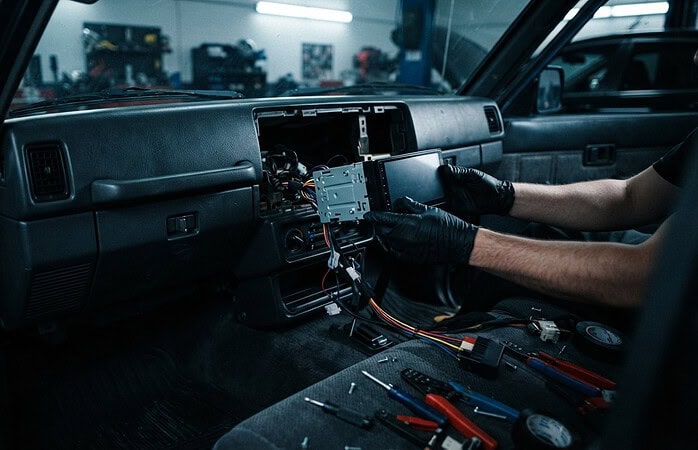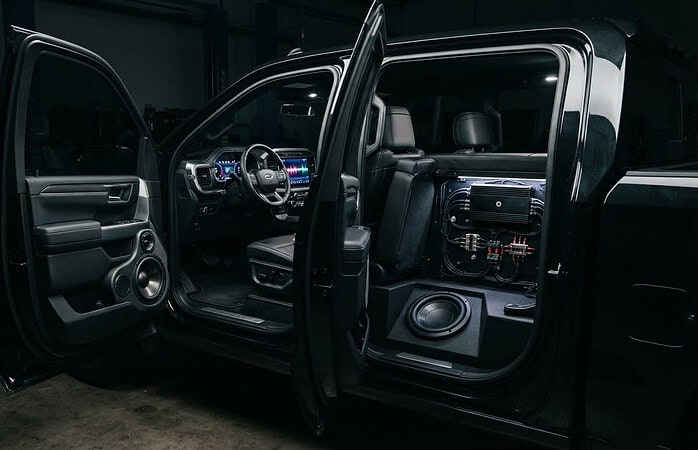
You might think that coating every square inch of your vehicle in heavy damping material is the only way to achieve a quiet ride, but the truth is that your very first choice determines your entire experience behind the wheel. We understand the frustration of a premium audio system being drowned out by relentless tire hum or a thin door panel that rattles every time the bass hits. It pulls you out of the music and makes even a high-end vehicle feel unrefined. Whether you want to eliminate highway drone or finally hear the full potential of your speakers, deciding if sound deadening doors vs floor worth it is the most important step in your build.
At Music In Motion, we focus on the final result rather than just selling you a box of materials. We’ve spent decades perfecting the balance between cabin comfort and acoustic performance. This guide will help you decide where to invest your effort first by comparing the specific benefits of each application. We will show you how treating your doors can transform your mid-bass response while floor treatments tackle the grit and grime of road noise. By the end, you’ll have a clear priority list to turn your daily driver into a silent, high-fidelity sanctuary.
Key Takeaways
- Identify why doors are the primary target for audio enthusiasts who want to eliminate rattles and maximize speaker performance.
- Explore how floor treatments tackle low-frequency road noise and exhaust drone to provide a quieter, more comfortable cabin.
- Evaluate the labor and ROI of each project to determine if sound deadening doors vs floor worth it for your budget and vehicle type.
- Learn why a professional, multi-layer approach using vibration dampers and noise barriers is essential for a high-end, finished result.
- Understand the difference between structure-borne vibrations and airborne noise so you can apply the right solution to your specific problem.
Understanding Automotive Sound Deadening: Doors vs. Floor
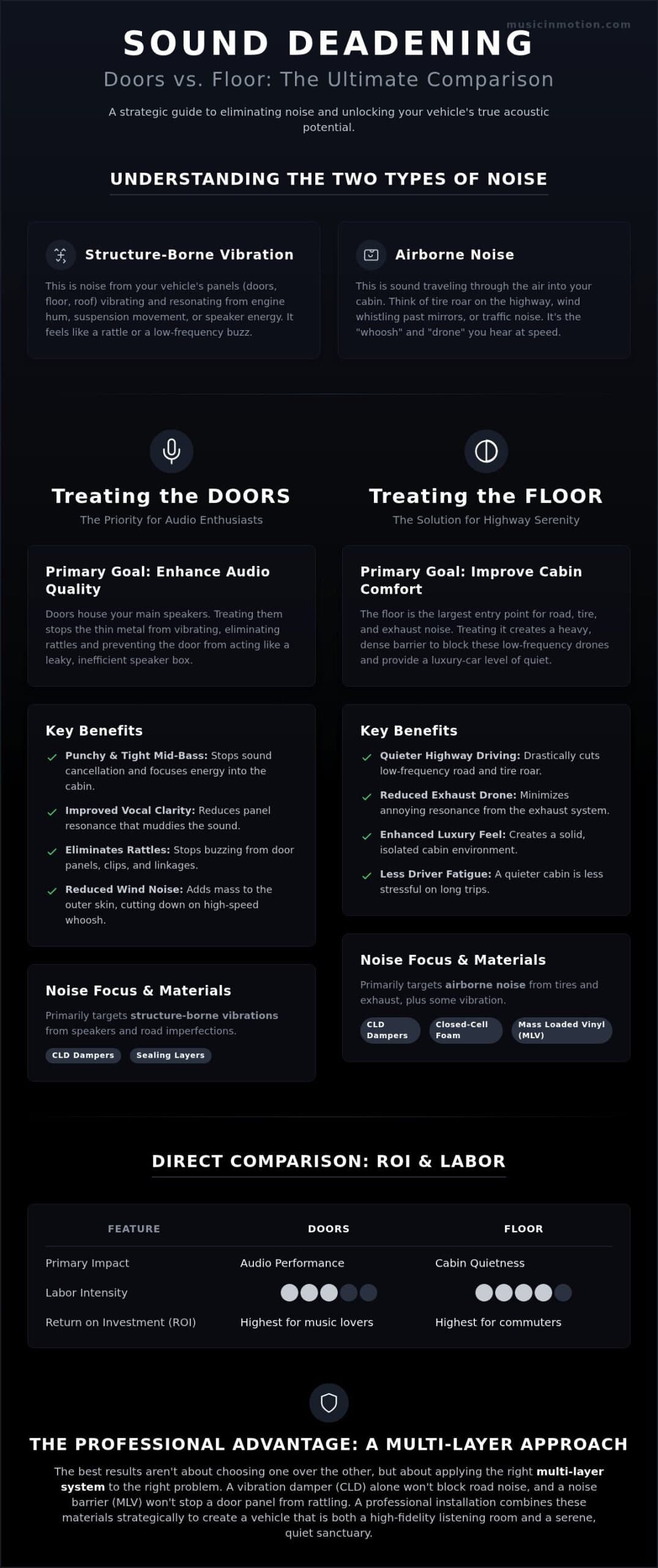
Automotive sound deadening isn’t about slapping a single layer of material onto a metal panel and calling it a day. We view it as a strategic, multi-layer system designed to tackle two distinct enemies: structure-borne vibration and airborne noise. Structure-borne noise happens when your engine or suspension makes the metal panels of your car ring like a bell. Airborne noise is the wind whistling past your mirrors or the roar of tires on asphalt. If you are deciding if sound deadening doors vs floor worth it, you have to understand that these two areas face completely different acoustic challenges. The vertical door panels are thin and prone to resonance, while the horizontal floor pan acts as a massive entry point for road grime and mechanical hum. Taking a generic approach often leads to a wasted budget because you might use the wrong tool for the job.
The Science of Vibration Damping
Most factory door panels are surprisingly thin. When your speakers play, they turn those panels into secondary sound sources that rattle and distort your music. We use Constrained Layer Dampers (CLD) to solve this. These materials, often made with a butyl rubber core and an aluminum face, add mass and change the resonant frequency of the sheet metal. Instead of a hollow “ting” when you knock on the door, you get a solid, dead “thud.” This transformation is essential for a high-performance audio experience. Acoustic decoupling is the process of using specialized materials to prevent vibrations from transferring between two different surfaces, ensuring your cabin remains a quiet sanctuary.
Mass Loading vs. Sound Absorption
Stopping a panel from vibrating is only half the battle. To truly block outside noise, we rely on mass loading and sound absorption. Mass Loaded Vinyl (MLV) acts as a heavy, flexible shield that physically blocks sound waves from entering the cabin. While the doors benefit from vibration damping, the floor requires a more robust combination of materials because it sits directly above the loudest parts of the vehicle. We often utilize a “sandwich” of butyl rubber for damping, closed-cell foam for decoupling, and a heavy acoustic barrier for blocking. This specific combination ensures that low-frequency road drone is stopped before it ever reaches your ears. Whether you’re looking for punchy bass or a silent commute, determining where sound deadening doors vs floor worth it depends on your specific goals.
Treating Your Doors: The Priority for Audio Enthusiasts
If you are an audio enthusiast, the doors are your primary battleground. Most factory speakers are mounted directly to the thin sheet metal of the inner door skin. This creates an environment where the door acts like a leaky speaker box. Instead of projecting sound into the cabin, much of the energy is wasted vibrating the metal and escaping through various gaps. This is why we consider door treatment the essential first step for any car audio upgrade for stock stereo systems. By reinforcing the structure, you stop the panels from competing with your speakers. The result is immediately noticeable. Mid-bass becomes punchy and tight while vocals gain a level of clarity that was previously lost in the rattle.
Beyond the music, treating your doors offers a significant lifestyle upgrade. You will notice a substantial reduction in wind noise at highway speeds and a quieter experience in busy parking lots. When deciding if sound deadening doors vs floor worth it, the doors often win for those who prioritize the internal listening experience over pure road noise isolation. It is the most effective way to make a standard vehicle feel like a premium luxury car from the inside out.
Creating a Sealed Acoustic Enclosure
A speaker works by moving air. When it moves forward, it creates a sound wave; when it moves backward, it creates another wave of equal intensity. In an untreated door, these waves often meet through large service holes in the metal, causing them to cancel each other out. We use specialized materials to seal these access points, effectively turning the door into a solid enclosure. This level of car audio fabrication ensures that all the speaker’s energy is directed toward your ears. If you want a finished result that rivals high-end home audio, sealing the inner skin is a vital step in the process.
Eliminating Interior Rattles
Even with great speakers, a single buzzing plastic clip can ruin a song. Doors are filled with moving parts like lock rods, window regulators, and wiring harnesses. We use foam gaskets and decouplers to isolate these components from the plastic door card. This prevents the “buzz” that occurs during heavy bass tracks. You can test your own vehicle by using a frequency sweep app. Play a slow tone from 20Hz to 200Hz and listen for specific panels that vibrate. If you’re tired of chasing rattles, our team can help you integrate a professional solution that stays silent for years.
Floor Sound Deadening: The Solution for Highway Serenity
While doors are the priority for audio clarity, the floor is the primary entry point for the relentless drone of the road. If you spend hours on the highway, you know that low-frequency tire roar and exhaust hum can be physically draining. The floor pan of your vehicle acts like a giant drum head. Every vibration from the suspension or the road surface causes that massive sheet of metal to resonate, amplifying noise throughout the entire cabin. For long-distance commuters or drivers with high-performance exhausts, this is where deciding if sound deadening doors vs floor worth it becomes a question of endurance. Treating the floor transforms the vehicle from a noisy utility machine into a refined, quiet sanctuary.
We also see significant benefits for specialized vehicles. Older cars and RVs often suffer from heat soak through the floorboards. Adding a high-quality deadening layer acts as a thermal barrier, keeping the cabin cooler in the summer and warmer in the winter. It’s a practical upgrade that improves the overall environment, making every trip more comfortable regardless of the weather outside. This dual-purpose benefit of acoustic and thermal control makes the floor a high-value target for total vehicle restoration projects, and for those who want to extend that protection to the exterior, In The Garage provides premium shields to safeguard your car in any environment.
Blocking Road and Tire Resonance
To stop airborne tire roar, we rely on heavy Mass Loaded Vinyl (MLV) barriers. Unlike the vibration damping used in doors, blocking road noise requires a dense, heavy material that sound waves cannot easily penetrate. We focus our efforts on high-impact areas like the wheel wells and the firewall, where tire and engine noise are most aggressive. This creates that elusive “luxury car” feel that many modern vehicles lack from the factory. When the floor pan is silent, the entire driving experience feels more composed and expensive, allowing you to hold a conversation without raising your voice.
Managing Exhaust and Drivetrain Drone
High-performance vehicles often suffer from mechanical noise radiating through the transmission tunnel. We manage this by applying thermal-acoustic hybrids that handle both heat and vibration. Reducing this constant background noise does more than just make the car quieter; it significantly reduces driver fatigue. This level of comfort complements modern vehicle safety systems by keeping the driver alert and focused on the road. Whether you are chasing a faster lap time or a peaceful commute, the investment in floor treatment pays dividends in every mile you drive.
Direct Comparison: Doors vs. Floor Worth and ROI
Choosing where to start your project depends entirely on your ultimate goal for the vehicle. We often find that customers feel overwhelmed by the technical specifications of different materials, but the decision usually boils down to a balance of effort versus reward. When you are evaluating if sound deadening doors vs floor worth it, you have to look at the immediate impact on your daily drive. Doors offer the most dramatic change in how you interact with your vehicle’s technology, while the floor provides a foundational shift in how the car feels on the open road. Both are valuable, but they serve different masters.
We also need to address the common concern regarding added weight. A full, professional treatment for both doors and the floor typically adds between 50 and 100 pounds to a standard sedan or SUV. While this might sound significant, it is roughly equivalent to carrying a single extra passenger or a few bags of groceries. For the vast majority of drivers, the slight increase in weight is a negligible trade-off for the massive gain in cabin refinement and audio performance.
Labor and Installation Complexity
The gap in labor intensity between these two projects is vast. Treating a set of doors generally takes our team between 2 and 4 hours. It is a straightforward process, though it does carry the risk of “broken-clip syndrome” if you aren’t familiar with how modern door panels are fastened. In contrast, a full floor treatment is an extreme undertaking that requires 10 to 15 hours or more. We have to remove the seats, the center console, and the entire carpet set to reach the metal floor pan. Because modern vehicles house complex wiring looms and safety sensors under the carpet, professional installation is the safest way to ensure everything is reassembled correctly without triggering airbag lights or electrical faults.
The ROI Verdict: Which is “More” Worth It?
To help you decide, we use a simple framework based on your primary driving habits. If you are an audio lover, the doors are 100% essential. You cannot achieve high-fidelity sound in a vibrating metal environment. For these users, the floor is a “nice to have” upgrade that can wait. For long-distance commuters, however, the floor provides the most significant reduction in driver fatigue by silencing the constant roar of the highway. If you are looking for the absolute best value for your dollar, the doors offer the biggest perceived change for the lowest initial investment. They make the stereo sound better and make the doors close with a satisfying, high-end thud. If you’re ready to transform your ride, we can help you plan a custom installation that fits your specific needs.
The Professional Advantage: Why Expert Integration Matters
Our philosophy at Music In Motion is simple: we deliver a finished result, not just a box of parts. When you weigh if sound deadening doors vs floor worth it, the quality of the installation is just as critical as the choice of location. A professional integration uses a strategic, multi-layer approach that a simple DIY kit often misses. We combine Constrained Layer Dampers (CLD) to stop vibrations, closed-cell foam to decouple panels, and Mass Loaded Vinyl (MLV) to block external noise. This three-stage system ensures that every frequency is managed correctly, providing a level of silence that single-layer applications simply cannot match.
We also prioritize the long-term health of your vehicle. Modern cars are complex rolling computers filled with wiring looms, side-impact sensors, and delicate airbag triggers. Our team has decades of experience navigating these systems to ensure that factory serviceability and safety sensor calibration remain perfect. This expertise extends beyond the road; professional sound deadening is the essential foundation for premium marine audio systems and specialty RV builds where vibration control is even more challenging. We focus on the outcome of the project to ensure your vehicle feels solid and refined for the life of the car.
Beyond the Mat: Custom Fabrication
Expert installation goes beyond sticking mats to metal. We often use custom-fabricated speaker baffles that work in tandem with our damping materials to create a perfectly tuned acoustic environment. To ensure a permanent bond, we utilize specialized tools like heavy-duty rollers and heat guns. This level of precision ensures the material never peels or sags over time, even in the high-heat environment of a car door. We integrate these techniques into every high-end build to make sure your speakers perform exactly as the engineers intended.
Protecting Your Investment
One of the biggest risks of improper installation is the creation of moisture traps. If the material isn’t rolled down perfectly, air pockets can form, leading to condensation and eventual rust inside your door skins or floor pan. We use professional-grade butyl rubber because it remains stable in extreme temperatures and doesn’t carry the foul odor of cheap, asphalt-based mats. This choice ensures your cabin stays healthy and your vehicle’s structural integrity remains intact for years. If you’re ready to see the difference a professional touch makes, Contact Music In Motion for a custom sound deadening consultation today.
Transform Your Cabin into a High-Fidelity Sanctuary
Deciding where to begin your journey depends on your specific lifestyle needs. If you want punchy bass and crystal-clear vocals, start with the doors to create a sealed acoustic enclosure. If your goal is to silence the highway drone and reduce driver fatigue during long commutes, the floor is your best investment. We understand that every vehicle presents unique challenges. At Music In Motion, we focus on the final experience behind the wheel rather than just the hardware. We’ve spent decades perfecting custom fabrication and high-performance electronics integration to ensure your vehicle feels as good as it sounds.
Deciding if sound deadening doors vs floor worth it is the first step toward a more refined driving experience. We don’t just install materials; we deliver a finished result that prioritizes long-term reliability and factory-grade safety. Our specialists ensure that every panel is sealed and every sensor remains perfectly calibrated. You don’t have to settle for a noisy, vibrating cabin that detracts from your daily commute. Elevate your driving experience with professional sound deadening at Music In Motion. We are ready to help you build the quiet, high-performance sanctuary you deserve.
Frequently Asked Questions
Is sound deadening worth it if I still have factory speakers?
Yes, sound deadening is absolutely worth it even with a factory setup. By reducing the noise floor, you allow the stock speakers to perform without competing against road hum. This creates a much cleaner sound at lower volumes. We find that many customers are surprised by the improved bass response once the door panels stop vibrating. It is the most effective way to extract every bit of performance from your existing hardware without replacing the stereo.
How much weight does sound deadening add to my car?
A full treatment typically adds between 50 and 100 pounds to your vehicle. While this sounds like a lot, it is roughly equivalent to carrying a single extra passenger or a few bags of groceries. For most modern vehicles, this slight increase has a negligible impact on fuel economy or handling. When considering if sound deadening doors vs floor worth it, the massive gain in cabin comfort far outweighs the minor weight penalty.
Can I just do the front doors, or do I need to do all four?
You can certainly start with just the front doors if you are the primary driver. Since the front speakers provide the majority of your soundstage, treating those areas offers the most immediate improvement to your audio quality. However, treating all four doors creates a more uniform acoustic environment and better isolates the cabin from external wind noise. We usually recommend a full set for those seeking a true luxury car feel for all passengers.
Does sound deadening help with my car’s air conditioning or heating?
Yes, sound deadening materials often provide significant thermal insulation. Materials like closed-cell foam and butyl rubber act as barriers against heat transfer through the metal panels. This helps your air conditioning stay cooler in the summer and keeps the cabin warmer during the winter. It is a practical secondary benefit that improves your overall comfort, especially in vehicles with large floor pans or thin roof skins that tend to absorb significant solar heat.
What is the difference between sound deadening and sound proofing?
Sound deadening focuses on stopping vibrations in the metal panels, while soundproofing aims to block airborne noise from entering the cabin. Deadening uses damping mats to eliminate the ringing of sheet metal. Soundproofing requires heavy barriers like Mass Loaded Vinyl to physically stop sound waves. We use a combination of both techniques to ensure your vehicle is both vibration-free and properly isolated from the loud environment of the highway during your daily commute.
How much road noise reduction can I realistically expect from just the doors?
Door treatments primarily reduce wind noise and ambient sounds from nearby traffic rather than low-frequency road roar. While they significantly improve audio clarity, they won’t stop the deep hum of tires on asphalt. For that specific problem, floor and wheel well treatments are necessary. If you are debating if sound deadening doors vs floor worth it for highway noise, remember that doors are for the music and floors are for the silence.
Will sound deadening my floor void my vehicle’s warranty?
Installing sound deadening material will not void your vehicle’s factory warranty. Under the Magnuson-Moss Warranty Act, a manufacturer cannot void your entire warranty simply because you added aftermarket components. The only exception is if the installation itself causes a specific failure, such as blocking a drain hole or damaging a wiring harness. Our professional team ensures that every installation maintains factory serviceability and safety standards to protect your long-term investment and peace of mind.
Which material is better: asphalt-based or butyl-based deadeners?
Butyl-based materials are far superior to older asphalt-based products. Asphalt deadeners are often cheaper, but they carry a strong chemical odor and can melt or peel away in high temperatures. High-quality butyl rubber remains stable across a wide temperature range and provides much better vibration damping without the smell. We only use professional-grade butyl to ensure a permanent bond and a healthy cabin environment for our customers for the life of the vehicle.