Imagine it’s a Tuesday morning in mid-January, the thermometer reads ten below, and you’re already running late. You click your remote from the kitchen window, but there’s no flash of lights or rumble of the engine because your system couldn’t penetrate the frost-covered glass. We’ve all been there, shivering in a cabin that feels like an icebox while waiting for the defroster to finally kick in. We believe that a remote starter shouldn’t be a gamble every time the temperature drops.
Finding the best remote start system for cold weather means looking past the box and focusing on three pillars: signal range, battery management, and climate integration. We’ve spent years perfecting these installations to ensure your car isn’t just running, but is actually warm when you step inside. This 2026 reliability guide will show you how to choose a system that offers guaranteed two-way feedback and activates your heated seats automatically. We’ll explore the hardware that survives sub-zero winters and the professional integration techniques that protect your vehicle’s electronics from the strain of extreme cold.
Key Takeaways
- Learn why extreme cold causes standard systems to fail and how to choose hardware that withstands 2026 winter conditions.
- Discover why 2-way confirmation is the most critical feature for the best remote start system for cold weather.
- Compare the instant response of RF remotes with the range of smartphone apps to find the right balance for your daily routine.
- Explore advanced integration options that automatically activate your heated seats, steering wheel, and defrosters.
- Understand why professional installation and soldered connections are necessary to prevent electrical failure in sub-zero temperatures.
Why Standard Remote Starts Fail in Extreme Cold
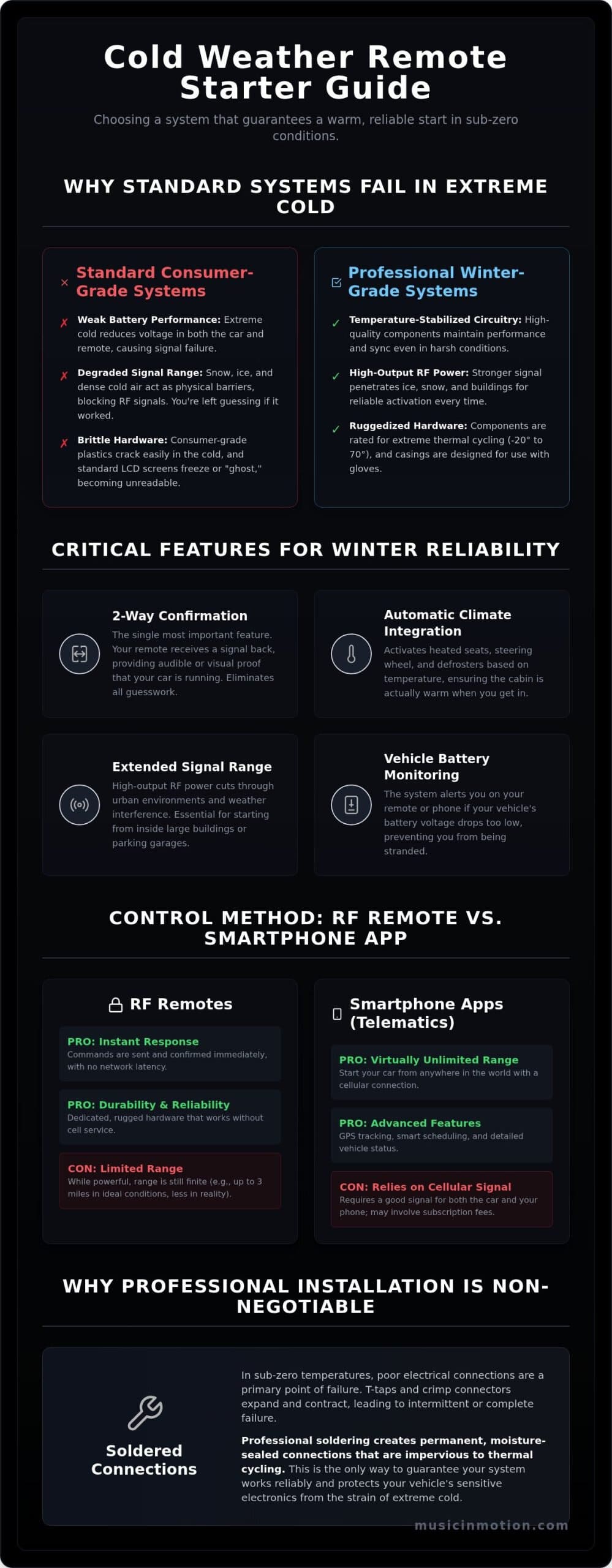
A standard Remote starter often works perfectly during a mild autumn afternoon, but it’s a different story when the thermometer hits twenty below. We’ve seen countless drivers frustrated because their entry-level system simply gave up during the first real blizzard of the year. The failure usually isn’t a fluke; it’s a matter of physics. Extreme cold aggressively alters battery chemistry, reducing the voltage available to both your vehicle’s ignition system and the handheld remote. When the battery in your pocket is cold, it lacks the punch to send a strong signal through the heavy, dense air of a winter morning.
Finding the best remote start system for cold weather requires moving beyond consumer-grade hardware found at big-box retailers. Professional-grade components use higher quality capacitors and resistors that don’t drift out of spec when the temperature fluctuates. This is why we focus on specialized integration rather than just selling a box. A true Winter-Grade Remote Start is a system designed with high-output RF and temperature-stabilized circuitry. This ensures that the internal clock of the remote and the vehicle’s receiver stay perfectly synced, even in the harshest conditions.
The Impact of Sub-Zero Temperatures on Range
Snow and ice are more than just a nuisance to clear off your windshield; they’re physical barriers to radio frequency (RF) signals. A thick layer of frozen sleet on your glass can act like a grounded shield, significantly degrading the reception of your car’s antenna. In urban environments, cold, dense air coupled with snow accumulation creates a “noisy” environment for signals to navigate. If you’re using a basic 1-way system, you’re essentially shouting into a void and hoping your car heard you. Without confirmation, you’re left guessing until you walk outside and realize the engine never turned over. High-frequency signal penetration is vital when you’re trying to start a vehicle from deep inside an office building or apartment complex.
Hardware Durability: Beyond Waterproofing
We prioritize hardware that can survive the physical reality of a northern winter. Many cheap remotes use standard LCD screens that suffer from “ghosting” or complete freezing in sub-zero temps, making them impossible to read. Our preferred systems feature internal components rated for extreme thermal cycling. This refers to the rapid expansion and contraction of materials as the car cabin goes from -20 to 70 degrees in minutes. High-end systems also feature ruggedized casings. These are specifically designed for easy handling while you’re wearing heavy gloves, preventing the accidental drops that shatter brittle, consumer-grade plastics during a 2026 cold snap.
Must-Have Features for the Best Remote Start System
Reliability in 2026 isn’t just about the engine turning over. It’s about confidence. When you’re searching for the best remote start system for cold weather, you need features that overcome the physical limitations of winter. We always recommend 2-way confirmation as the baseline for any serious installation. Unlike basic systems, a 2-way remote sends a signal back to your hand, confirming the car is actually running. This eliminates the “did it work?” anxiety that often leads to walking out to a frozen vehicle. We also prioritize security integration, ensuring your doors remain locked and the engine shuts down if anyone attempts to drive away without the key.
Range is another critical factor where many consumers get misled. Manufacturers often tout a “3-mile range,” but in a dense urban environment with snow-packed buildings, that translates to roughly three blocks of reliable penetration. High-output RF power is essential to cut through atmospheric density and frozen glass. Additionally, modern 2026 systems now offer integrated battery monitoring. This feature sends a push notification to your remote or phone if your vehicle’s voltage drops too low. This gives you a chance to address a failing battery before it leaves you stranded in a blizzard.
2-Way LCD vs. LED Feedback
Choosing between LCD and LED feedback depends on your specific needs. An LCD screen offers the advantage of showing you the actual cabin temperature, so you know exactly when it’s warm enough to head outside. LED remotes, on the other hand, provide a simplified and highly durable alternative. They use bright light patterns and audible chirps to confirm engine runtime and door lock status. Both options ensure you aren’t left guessing in the cold, but LCD remotes provide that extra layer of sensory detail that many of our clients appreciate.
Advanced Telematics and Smartphone Control
For those who want zero distance limitations, smartphone integration via platforms like DroneMobile is the gold standard. By using cellular networks, you can start your car from anywhere in the world. This allows for intelligent scheduling, where your car warms up automatically based on your morning alarm or work calendar. These systems often include GPS tracking and geofencing, adding a significant layer of security during the winter months. If you’re concerned about your vehicle’s factory coverage, remember that the Magnuson-Moss Warranty Act protects your right to install aftermarket systems without voiding your warranty. If you’re ready to upgrade your winter commute, our team at Music In Motion can help you select the perfect feature set for your vehicle.
RF Remotes vs. Smartphone Apps: Which is Better for Winter?
We often get asked whether a traditional remote or a smartphone app is the better investment for a 2026 winter. The answer depends on your daily routine and where you park. While apps offer high-tech convenience, a dedicated RF (Radio Frequency) remote remains the backbone of the best remote start system for cold weather. It provides a direct, near-instant connection to your vehicle. When you press the button on an RF remote, the command reaches the car in milliseconds. In contrast, smartphone apps rely on cellular handshakes that can take 10 to 30 seconds to process, which feels like an eternity when you’re standing in a freezing wind.
We also consider the long-term value of your investment. An RF remote is usually a one-time hardware purchase. Smartphone telematics usually require a monthly or annual subscription to keep the cellular link active. For many of our clients, the “Hybrid Approach” is the ultimate solution. This involves using a high-end physical remote for daily use at home or work, while keeping the app as a backup for those times you’re miles away or deep inside a large shopping mall. This setup ensures you have a finished result regardless of the environment.
The Case for Long-Range RF Remotes
RF remotes excel in environments where cell signals struggle. If you park in a concrete parking garage or live in a rural area with spotty coverage, a long-range remote is non-negotiable. Modern 2026 remotes feature improved rechargeable batteries that can last for months on a single charge, even in the cold. They are also much easier to operate when you’re wearing heavy winter gloves. Fumbling with a touchscreen in sub-zero weather is a hassle you don’t need when a tactile button gets the job done instantly through a coat pocket.
The Advantages of Telematics (App Control)
Despite the speed of RF, telematics offer “unlimited” range that a physical remote simply can’t touch. If you’re landing at the airport and want your car warm by the time the shuttle drops you off, the app is your best friend. These platforms also provide detailed vehicle health reports sent directly to your phone. You can check your battery voltage or fuel levels before you even leave the house. For families, multi-user access is a game changer. You can grant access to a spouse or teenager without needing to buy and program extra hardware remotes for every driver.
Optimizing Your System for Sub-Zero Performance
Having the best remote start system for cold weather means your vehicle is more than just running; it’s actually ready for your commute. In 2026, we don’t settle for a simple ignition trigger. We focus on deep integration that communicates with your car’s brain to manage both comfort and mechanical safety. 2026 systems can now use “Wait-to-Start” data directly from the vehicle’s CAN-bus. This allows the hardware to monitor internal sensors and ensure every component is primed before the starter motor ever engages. We also configure these systems to activate rear defrosters and heated mirrors automatically. By using external temperature sensors, the system knows exactly when to clear your field of vision before you even step outside.
Diesel-Specific Winter Startup Logic
Diesel engines require a specialized startup logic when the mercury dips. We’ve seen many basic installations rely on fixed delays, which are often too short for a frigid morning or unnecessarily long for a pre-warmed engine. Professional integration uses glow plug sensing technology to wait for the precise moment the cylinders are ready for combustion. This protects your high-torque starter from unnecessary strain and ensures a clean start on the first try. For our heavy-duty truck clients, we often enable turbo timer features. This allows the engine to idle and cool down properly after a long haul, which is essential for protecting the turbocharger’s bearings from heat soak and premature failure.
Auxiliary Control: The “Comfort” Factor
The real value of the best remote start system for cold weather is the comfort it provides during a sub-zero morning. We program your system to trigger heated seats and steering wheels automatically once the interior temperature falls below a specific threshold. This isn’t just a luxury; it’s about creating a seamless transition from your home to the driver’s seat. By integrating with factory OEM data systems, we ensure these features work in harmony with your vehicle’s original electronics. You can even customize the runtime via your remote or smartphone to ensure the cabin is perfectly warm without wasting excess fuel. If you’re ready for a system that handles the details for you, reach out to Music In Motion to start your custom integration project.
Why Professional Installation is Non-Negotiable
Even the best remote start system for cold weather is only as reliable as the person who wired it. Modern 2026 vehicles are rolling computers, and their electrical systems are more sensitive than ever. We’ve seen countless DIY attempts and big-box store “hacks” fail the moment the temperature drops below zero. The culprit is often a simple crimp connector or a “vampire” tap that loses its grip when the cold makes plastic and metal shrink. We prioritize clean, soldered connections for every single joint. Solder doesn’t become brittle or snap in a deep freeze, ensuring your car starts every morning without fail.
Security is the other half of the installation equation. Modern vehicle immobilizers require sophisticated bypass modules to allow a remote start without a physical key in the ignition. These modules must perform a complex digital handshake with your car’s brain. If this isn’t handled by an expert, you risk triggering anti-theft lockouts that can leave you stranded. We also take the time to calibrate your shock sensors. Many standard systems will trigger false alarms when heavy snow slides off the roof or a snowplow rumbles by. We fine-tune these settings so your alarm only sounds when there’s a genuine threat, keeping your neighbors happy during a midnight blizzard.
Integrating with Modern Vehicle Electronics
Push-to-start systems and advanced keyless entry have changed the game for aftermarket upgrades. Many consumers believe a “T-Harness” makes the process plug-and-play, but for 2026 models, these harnesses often miss the secondary data paths required for climate control. A professional remote start installation ensures that every auxiliary function, from your heated steering wheel to your defrost cycle, is fully integrated into the vehicle’s CAN-bus. This level of precision protects your electrical system’s longevity and maintains your factory warranty through certified, industry-standard practices.
The Music In Motion Difference
We don’t view a remote start as a simple transaction of goods. Our team is focused on the finished result, ensuring that the hardware we install feels like a natural extension of your vehicle. This often involves custom fabrication to hide modules and wiring, providing a stealth, factory-look installation that won’t interfere with your legroom or interior aesthetics. We take pride in our specialized knowledge and our ability to handle complex projects that others turn away. For those looking to enhance their vehicle even further, we recommend exploring our vehicle safety systems roundup to see how we provide total protection for your investment.
Take Command of Your Winter Morning
A freezing winter morning in 2026 doesn’t have to start with a shivering dash to your driveway. Choosing the best remote start system for cold weather is about more than just range; it’s about the confidence that your car will respond every time. We’ve explored how 2-way feedback, specialized diesel logic, and intelligent auxiliary integration transform a basic utility into a true comfort system. By prioritizing professional-grade hardware and soldered connections, you ensure your vehicle remains reliable when the thermometer hits its lowest point.
Our team of Certified Master Technicians is ready to deliver a finished result that exceeds expectations. We offer a lifetime labor warranty on all installations and provide specialized solutions for European, Diesel, and Keyless vehicles. Don’t leave your comfort to chance this year. Upgrade your winter driving experience with a professional remote start from Music In Motion and enjoy the feeling of stepping into a warm, defrosted cabin every single day. We look forward to helping you customize the perfect solution for your vehicle.
Frequently Asked Questions
Will a remote start system void my new car warranty in 2026?
No, a professionally installed remote start system will not void your new car warranty. Under the federal Magnuson-Moss Warranty Act, a manufacturer cannot deny a warranty claim simply because an aftermarket part was installed. They must prove the aftermarket system specifically caused the failure in question. We follow certified installation practices to ensure your factory coverage remains fully intact while providing the winter comfort you deserve.
Can I install a remote start on a manual transmission vehicle for winter?
Yes, we can safely install remote starts on manual transmission vehicles using specialized hardware. These systems require a specific safety sequence to ensure the car is in neutral and the emergency brake is engaged before allowing the engine to start. This prevents the vehicle from moving forward while unattended. It’s a precise integration that requires expert handling to maintain high safety standards throughout the winter months.
How long should I let my car run after remote starting in extreme cold?
We generally recommend letting your car run for 10 to 15 minutes during extreme cold. This provides enough time for the engine to reach a safe operating temperature and for the climate control to begin defrosting windows and warming seats. Most of our systems feature adjustable run timers, allowing you to customize this duration based on how quickly your specific vehicle heats up in sub-zero conditions.
Does remote start work on diesel trucks with glow plugs?
Absolutely, and we specialize in these high-demand applications for heavy-duty trucks. The best remote start system for cold weather must include a “Wait-to-Start” feature or direct glow plug sensing via the CAN-bus. This ensures the system waits for the glow plugs to warm the cylinders before attempting to crank the engine. This logic is essential for protecting your diesel’s high-torque starter and ensuring a reliable start every time.
What happens if I try to remote start my car while it is low on fuel?
Many advanced 2026 systems are programmed to monitor your fuel levels and will either refuse to start or shut down early if the tank is too low. This prevents the engine from stalling out and potentially sucking air into the fuel lines, which is especially important for diesel owners. We configure these safety thresholds during installation to protect your engine and ensure you have enough fuel to reach a station.
Can a remote start system help defrost my windows automatically?
Yes, through advanced data integration, we can program your system to activate the rear defroster and heated mirrors automatically. When the external temperature sensor detects freezing conditions, the system triggers these auxiliary heaters the moment the engine starts. This ensures your field of vision is clear by the time you reach the driveway, making your morning routine much safer and more efficient for daily driving.
How do I know if my remote start signal actually reached the car?
You’ll know for certain if you choose a 2-way remote start system. These remotes receive a confirmation signal back from the vehicle and provide visual or audible feedback once the engine is running. If you’re using a smartphone-based system, you’ll receive a push notification confirming the startup. This eliminates the guesswork and ensures you aren’t walking out to a cold car that never actually turned over.
Are smartphone-based remote starts more reliable than traditional remotes?
Reliability depends on your specific environment and parking situation. Smartphone apps offer unlimited range via cellular networks but can experience lag or signal drops in dead zones. Traditional RF remotes provide near-instant response and work in remote areas without cell service. For the best remote start system for cold weather, we recommend a hybrid approach that gives you both a physical remote for speed and an app for long-distance control.