Cranking your volume to the max isn’t just ineffective; it’s a fast track to permanent hearing damage and distorted, unlistenable audio. You’ve likely felt that frustration when the music you love turns into a muffled mess the moment you hit highway speeds. Wind noise becomes a physical wall, and your helmet padding seems to swallow every high note before it reaches your ears. We understand the struggle of learning how to hear motorcycle speakers with a helmet without sacrificing your safety or your gear.
At Music In Motion, we believe you shouldn’t have to choose between a safe ride and a high-fidelity soundtrack. This 2026 guide reveals the professional secrets to overcoming acoustic interference and achieving punchy, clear sound at any speed. We’ll walk you through the balance of bike speakers and headsets, the benefits of custom-fabricated pods, and how the latest 2026 advancements and best practices for in-helmet audio can enhance your setup. You’re about to discover how a strategic approach to frequency clarity and acoustic positioning can transform your entire riding experience. Whether you’re cruising local backroads or pushing through the wind at 70 mph, we have the specialized knowledge to enhance every note of your journey.
Key Takeaways
- Learn why simply increasing volume fails to beat the “wind wall” and how frequency masking hides your music behind road noise.
- Understand the importance of high-sensitivity fairing speakers and precise angling to project sound directly through high-speed turbulence.
- Discover the “spacer secret” for your helmet’s ear pockets, a critical step in mastering how to hear motorcycle speakers with a helmet with maximum clarity.
- Find out why high-fidelity earplugs actually improve your audio experience by filtering out wind roar while letting music frequencies pass through.
- Explore how professional Digital Signal Processing (DSP) tuning and custom fabrication create a balanced audio environment tailored to your specific bike.
The Physics of the ‘Wind Wall’: Why Volume Isn’t Enough
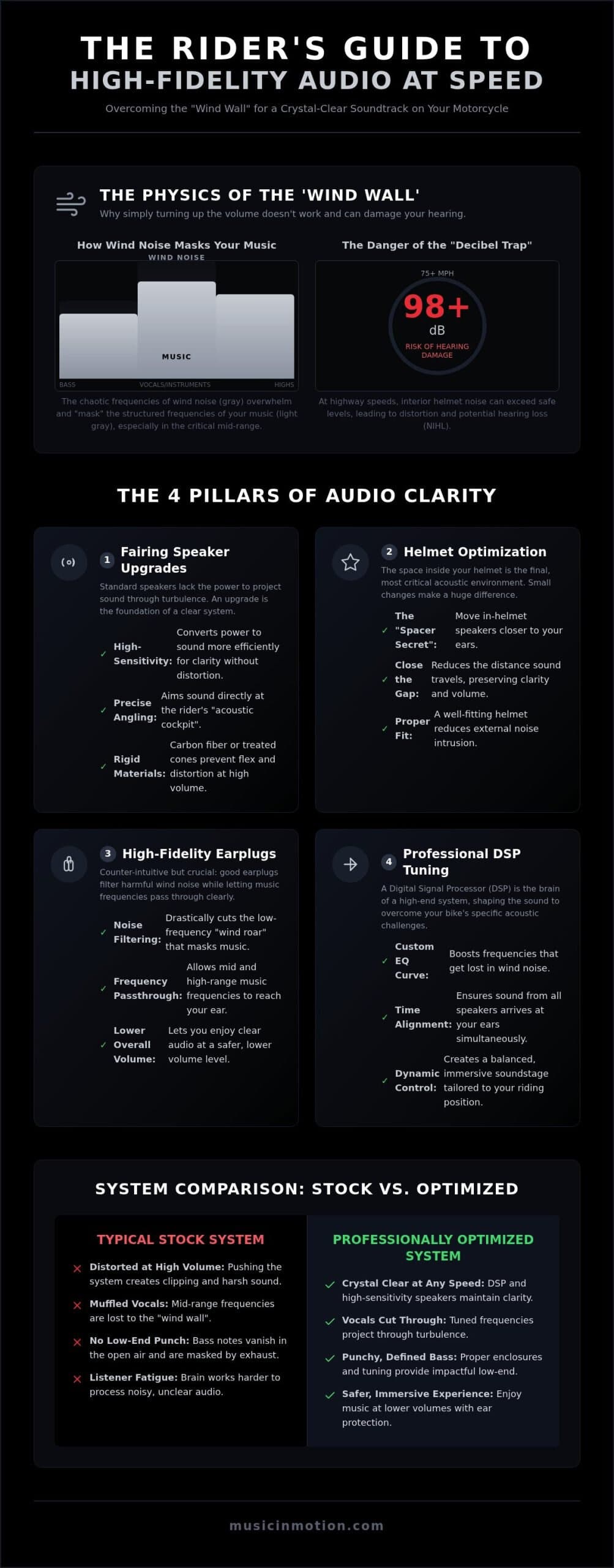
Many riders believe the only solution for how to hear motorcycle speakers with a helmet is to install a massive amplifier and crank the dial. We see this mistake often. While raw power matters, physics dictates that wind noise acts as a “masking” force rather than just a volume competitor. Frequency masking occurs when two sounds occupy the same spectral range; the louder, more chaotic sound effectively hides the more organized one. On a motorcycle, the “wind wall” is a high-energy chaotic signal that specifically targets the frequencies where your music lives.
We approach these challenges with the same logic we use for car audio upgrades for stock stereo systems. We prioritize signal clarity and frequency separation over sheer decibel levels. In a car, we fight tire hum; on a bike, we fight a 70 mph gale. To win, we must protect the “Acoustic Cockpit.” This is the small, fragile pocket of relatively calm air between your fairing and your chest. If the audio signal isn’t optimized to survive this zone, no amount of volume will make it clear once it hits the turbulence around your helmet.
How Wind Noise Cancels Your Music
Wind noise isn’t a flat sound. It’s a spectrum of low and mid-range frequencies that directly overlap with vocals and lead instruments. As you accelerate, the turbulence around your helmet increases. Full-face helmets provide a more aerodynamic profile, but modular helmets often create additional “dirty air” around the hinges and seals. At 60 mph, mid-range frequencies are typically the first to disappear. Your exhaust note adds to the problem by masking lower-frequency bass notes, leaving you with a thin, tinny sound that lacks any punch.
The Limit of Human Hearing and Audio Distortion
Falling into the “Decibel Trap” is dangerous for your gear and your ears. Pushing a standard system past its limit creates clipping and distortion. Your brain has a much harder time processing 100dB of distorted noise than it does 90dB of crystal-clear audio. Research indicates that at speeds exceeding 75 mph, noise levels inside a helmet can surpass 98dB. Prolonged exposure to these levels without proper management can lead to Noise-Induced Hearing Loss (NIHL).
There is a distinct point of diminishing returns for fairing-mounted speakers where adding more volume only increases the “noise floor” without improving clarity. An acoustic shadow is the physical area where sound waves are blocked or deflected by the helmet’s outer shell, significantly reducing the audio pressure that actually reaches the rider’s ear canal. To overcome this, we don’t just need it louder; we need it smarter.
Fairing Speaker Upgrades: Projecting Sound Through the Turbulence
If you’re struggling with how to hear motorcycle speakers with a helmet, the hardware in your fairing is the first place to look. Most factory systems lack the “throw” required to push sound past your handlebars at highway speeds. We solve this by prioritizing high-sensitivity speakers. Sensitivity measures how effectively a speaker converts power into sound; in an open-air environment, every decibel counts. High-output speakers allow your audio to remain clear and punchy without forcing your amplifier into distortion.
Achieving this level of performance often requires specialized car audio fabrication techniques adapted for the road. While cars have sealed cabins to trap bass, motorcycles are “infinite baffle” environments. Without a proper enclosure, your mid-bass frequencies simply vanish into the wind. We focus on creating a rigid, sealed environment within your fairing to ensure the speaker’s energy is projected forward toward you, rather than vibrating the plastic housing.
Choosing High-Output Fairing Speakers
Material choice is a critical factor for longevity and projection. We prefer carbon fiber or treated paper cones because they’re stiff enough to resist “cone flex” at high volumes but light enough to react quickly to complex musical notes. While waterproofing is essential, it shouldn’t come at the cost of acoustic transparency. We select drivers that utilize weather-resistant treatments on the surrounds and spiders, ensuring they survive a sudden downpour while maintaining the high-frequency detail needed to cut through wind noise. Coaxial speakers are often the standard for fairings because they provide a “point source” of sound, keeping the tweeter and woofer aligned for better timing.
Custom Fabrication for Better Imaging
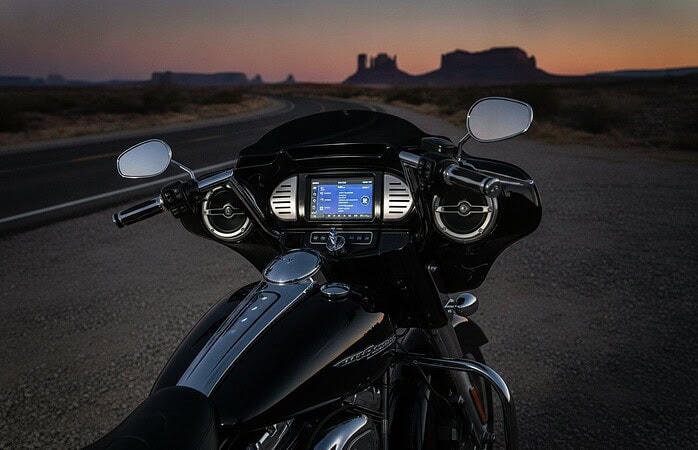
Standard bolt-on kits often suffer from poor imaging because the speakers are aimed at the rider’s chest or knees. This is a major hurdle when figuring out how to hear motorcycle speakers with a helmet, as the audio has to fight its way up to your ears. We use custom-molded pods to change the axis of the speaker, angling it directly toward the rider’s head. This significantly reduces the impact of the “acoustic shadow” created by your helmet’s chin bar.
To further enhance the sound stage, we often recommend adding lower fairing speakers. This creates a wall of sound that surrounds the rider, providing a much fuller experience. This setup works best when paired with a high-fidelity earplug strategy. According to the NIDCD guidelines on hearing protection, protecting your ears from the constant roar of the wind actually makes it easier for your brain to focus on the music frequencies. If you’re ready to stop guessing and start listening, we can help you design a custom motorcycle audio system that delivers studio-quality sound at 70 mph.
Optimizing Your Helmet for Audio Clarity
Even the most powerful fairing speakers can’t overcome a poorly configured helmet. We often see riders spend thousands on bike audio only to lose the benefit because their helmet setup is working against them. We approach the helmet as a specialized acoustic chamber, much like we do when designing a premium marine audio system. In both environments, you’re dealing with high ambient noise and harsh conditions. Success requires millimeter-perfect positioning and a deep understanding of how to hear motorcycle speakers with a helmet without simply turning up the volume.
The goal is to minimize the air gap between the speaker and your ear canal. Every millimeter of space allows wind noise to rush in and drown out the music. By optimizing the internal environment of your helmet, you create a “quiet zone” where frequencies can reach your ears with minimal interference. This isn’t just about comfort; it’s about acoustic efficiency. We want your audio to feel intimate and clear, not distant and muffled.
Step-by-Step Speaker Positioning
Most helmets come with pre-cut speaker pockets, but these are rarely in the right spot for every rider. We recommend a simple three-step process to find your “sweet spot.” First, perform a “finger test” by putting your helmet on and reaching inside to mark exactly where your ear canal sits against the liner. Second, adjust the speaker height and forward-tilt to match your specific anatomy. Third, use the “Spacer Secret.” Most high-end communication systems include foam spacers. Use them to move the speaker outward until it lightly touches your ear. This physical proximity is the most effective way to improve how to hear motorcycle speakers with a helmet at highway speeds.
Reducing ‘Noise Floor’ Inside the Helmet
Your helmet’s “noise floor” is the base level of wind roar you hear while riding. If this floor is too high, your music has to be incredibly loud to be audible. We focus on sealing the bottom of the helmet to prevent air from rushing up past your chin. Using a chin curtain and a thick neck roll can significantly drop the internal decibel level. A 3dB reduction in wind noise is equivalent to doubling your amplifier power. By choosing a “quiet” helmet model and sealing these gaps, you effectively give your audio system a massive power boost without touching a single wire.
The Counter-Intuitive Secret: High-Fidelity Earplugs
It sounds backwards to put something in your ears when you’re struggling with how to hear motorcycle speakers with a helmet. Most riders think earplugs will just make the muffled audio problem worse. However, the secret lies in the Signal-to-Noise Ratio (SNR). Standard foam earplugs are the enemy of good music because they muffle all frequencies equally, including the ones you want to hear. High-fidelity acoustic filters are different. They act as a sophisticated gatekeeper, slashing the chaotic roar of the wind while allowing your music’s crisp highs and punchy mids to pass through.
This strategy is now more accessible than ever. As of January 2026, Pennsylvania law (Act 43 of 2025) permits riders to use listening devices in both ears. This means you can legally use high-fidelity plugs to protect your hearing while finally enjoying your audio system at highway speeds. We treat this as part of a total “smart bike” experience, applying the same precision we use for professional remote start installation to ensure your ride is as comfortable as it is secure. By lowering the “noise floor” in your ears, you actually make the speakers sound louder and clearer.
Foam vs. Filtered Earplugs
Filtered plugs, such as the Alpine MotoGP MotoSafe or Earpeace Moto Pro, essentially provide a custom “EQ” for your environment. They target the 100dB+ wind roar that causes permanent tinnitus and hearing damage, but they leave a “window” open for the vocal range of your speakers. By filtering out the white noise of the wind, the speaker’s vocal range starts to pop. Your brain no longer has to work overtime to separate the lyrics from the turbulence. This makes the speaker’s output feel more prominent and detailed, even if the actual volume is lower than before.
DSP Tuning: The Final Polish
Hardware is only half the battle. To truly master how to hear motorcycle speakers with a helmet, we utilize Digital Signal Processing (DSP). A professional DSP tune allows us to “EQ” out the specific frequencies where wind noise is most aggressive. We can configure speed-dependent volume and EQ settings that automatically adjust as you accelerate. As the wind gets louder, the DSP compensates by boosting specific frequencies to maintain clarity. This level of automation turns a standard bike into a high-performance audio machine. If you want to experience this difference for yourself, schedule an audio consultation with our experts today.
Professional Motorcycle Audio Integration with Music In Motion
Achieving the perfect balance between your fairing and your head is a challenge we tackle with specialized expertise. We don’t believe in generic, one-size-fits-all kits. Instead, we design a “Total Audio Environment” that accounts for your specific bike’s geometry and your preferred riding gear. This holistic approach is the only way to truly master how to hear motorcycle speakers with a helmet while maintaining the aesthetic of your ride. We focus on the finished result, ensuring that every component works in harmony to deliver clarity at speed.
Our team applies a level of stealth integration and laser defense system for cars style precision to every motorcycle build. This means no messy wires, exposed components, or compromised fairings. We also address the backbone of your system by upgrading high-output charging components and professional wiring. High-performance audio demands significant current. Without a stable power supply, even the best speakers will clip and fail when you need them most. We ensure your bike has the electrical “muscle” to support your soundtrack.
The Music In Motion Custom Process
- Consultation: We start by listening to you. We need to know if you ride with a modular or full-face helmet, as the wind profile changes the acoustic requirements. We match the system to your specific riding style and typical cruising speeds.
- Fabrication: We create a soundstage on two wheels. Using custom-fabricated pods and mounting solutions, we ensure your speakers are positioned for maximum projection and minimal interference.
- Tuning: This is where the magic happens. We use Real Time Analysis (RTA) tools to identify frequency gaps. This allows us to defeat wind noise before you even hit the road by building a custom DSP profile tailored to your motorcycle’s unique acoustic signature.
Get the Ultimate Ride Experience
We bridge the gap between your fairing audio and your helmet environment to create a seamless, immersive listening experience. You deserve to hear every note of your favorite playlist without the ear fatigue of distorted, high-volume noise. Our goal is to improve your daily life behind the bars by making your soundtrack as reliable as your engine. We take pride in our growth as a specialist shop, but our focus remains on the practical needs of our riders. If you’re ready to transform your motorcycle into a high-fidelity concert hall, we’re ready to build it. Experience the best in motorcycle audio at Music In Motion and see what professional integration can do for your next journey.
Elevate Your Ride with Precision Audio
Achieving crystal clear sound at highway speeds requires more than just a powerful amplifier. We’ve explored how strategic frequency management and millimeter-perfect speaker placement can defeat the chaotic wind noise that plagues so many riders. By combining custom-fabricated fairing pods with high-fidelity acoustic filters, you can finally master how to hear motorcycle speakers with a helmet while protecting your long-term hearing. It’s about working with physics, not against it, to create a quiet zone where your music can thrive.
At Music In Motion, we’ve built our reputation as a national leader in vehicle electronics integration. Our team specializes in high-output powersports audio and custom fabrication, ensuring your system is as rugged as the bike it’s mounted on. We don’t just sell hardware; we provide a complete solution tailored to your specific helmet and riding style. Ready for crystal clear audio on the open road? Contact Music In Motion for a custom motorcycle audio consultation today.
The open road is waiting, and it’s time your favorite soundtrack finally kept up with the pace of your journey. We’re here to help you hear every note.
Frequently Asked Questions
Can you actually hear fairing speakers at 70 mph?
Yes, you can hear fairing speakers clearly at 70 mph if the system is designed to overcome the wind wall. We achieve this by using high-sensitivity speakers and professional DSP tuning to boost the specific frequencies that wind noise usually masks. Without these upgrades, factory systems typically wash out long before you hit highway speeds. Professional installation ensures the sound is projected directly at the rider rather than into the environment.
Do I need a special helmet to hear my motorcycle speakers better?
You don’t need a specific brand, but a helmet with deep ear pockets and good aerodynamics makes a significant difference. Full-face helmets are generally quieter, which lowers the noise floor inside the shell. This makes learning how to hear motorcycle speakers with a helmet much easier. We focus on optimizing the helmet you already own by ensuring the internal speakers are positioned millimeter-perfect against your ear canals.
Why does my music sound muffled when I wear my helmet?
Music sounds muffled because the helmet shell and internal padding act as a physical barrier that creates an acoustic shadow. If your speakers are even a few millimeters too far from your ears, the high-frequency details are lost to the foam padding. We solve this by using foam spacers to move the speakers closer to your ears. This physical adjustment restores the clarity and punch that helmet liners usually absorb.
Will earplugs make it harder to hear my motorcycle’s audio system?
High-fidelity earplugs actually make it easier to hear your music by filtering out the chaotic roar of the wind. Foam earplugs muffle everything, but filtered plugs target low-frequency road noise while letting musical frequencies pass through. This improves the signal-to-noise ratio in your ears. It is a professional secret that allows you to enjoy clear audio without needing to crank the volume to dangerous, distorted levels.
What is the best amplifier for a motorcycle audio system?
The best amplifier for a bike is a high-output, Class D unit specifically designed for powersports environments. These amplifiers are compact enough to fit inside a fairing and efficient enough to avoid draining your battery. We prioritize models with built-in DSP capabilities. This allows us to fine-tune the output to match your specific bike and helmet setup, ensuring the audio signal remains clean at any speed.
How do I stop my motorcycle speakers from distorting at high volumes?
Distortion is usually caused by an underpowered amplifier clipping the signal or by speakers reaching their mechanical limit. We prevent this by matching high-sensitivity speakers with an amplifier that provides plenty of headroom. Setting the gain correctly during installation is vital. We use specialized tools to ensure your system reaches maximum volume without ever crossing into the distortion that ruins your speakers and causes ear fatigue.
Is it better to have speakers in the fairing or in the helmet?
A hybrid approach often provides the best results for most riders. Fairing speakers provide a physical punch and a wide soundstage, while helmet speakers offer intimacy and clarity at high speeds. We often integrate both systems to create a total audio environment. This combination ensures you have a rich musical experience while cruising and crystal-clear audio when the wind noise picks up on the highway.
Can I add more speakers to my motorcycle to make it easier to hear?
Adding more speakers, such as in the lower fairings or saddlebag lids, creates a fuller sound stage that surrounds the rider. This wall of sound makes it much easier to how to hear motorcycle speakers with a helmet because the audio is coming from multiple directions. We use custom-molded pods to ensure these additional speakers are aimed correctly. This expansion provides the depth needed to stay ahead of the wind.